
The Space Needle was never meant to last.
Built in 110 days for the 1962 World’s Fair — a fair whose theme was Century 21, meaning the future — the structure was designed with an expiration date implied in its ambition. Fairs build things to be torn down. Seattle kept theirs, and spent the next five decades figuring out what to do with it.
The answer, for most of that time, was: feed people at the top while the floor rotates slowly beneath them.
There’s something worth examining in that instinct. The rotating restaurant — Sky City — opened with the building and ran for over fifty years. It wasn’t incidental to the experience. It was the experience. The idea that you could eat a meal while the city moved around you, that the horizon itself could be the entertainment — this was very much in keeping with what 1962 believed about the future. Effortless. Technological. Legible.
I grew up going to Sky City. My parents took my sister and me for seafood and the slow revolution of the view — Mount Rainier to the north, Puget Sound to the west, the city below reorganizing itself with each turn. It wasn’t a theme park. It was a dining room, and the window happened to be the entire world.
When the $100 million renovation completed in 2018, the restaurant was gone. In its place: the Loupe Lounge, a 21-and-over revolving ultra-lounge with a glass floor, $89 minimum per person, cocktails and small plates, two-hour maximums. The rotating level now connects by spiral stair to the observation deck above, where full-height tilted glass panels replaced the old safety mesh. Visitors sit on what the designers call Skyrisers — angled glass benches that cantilever out over open air.

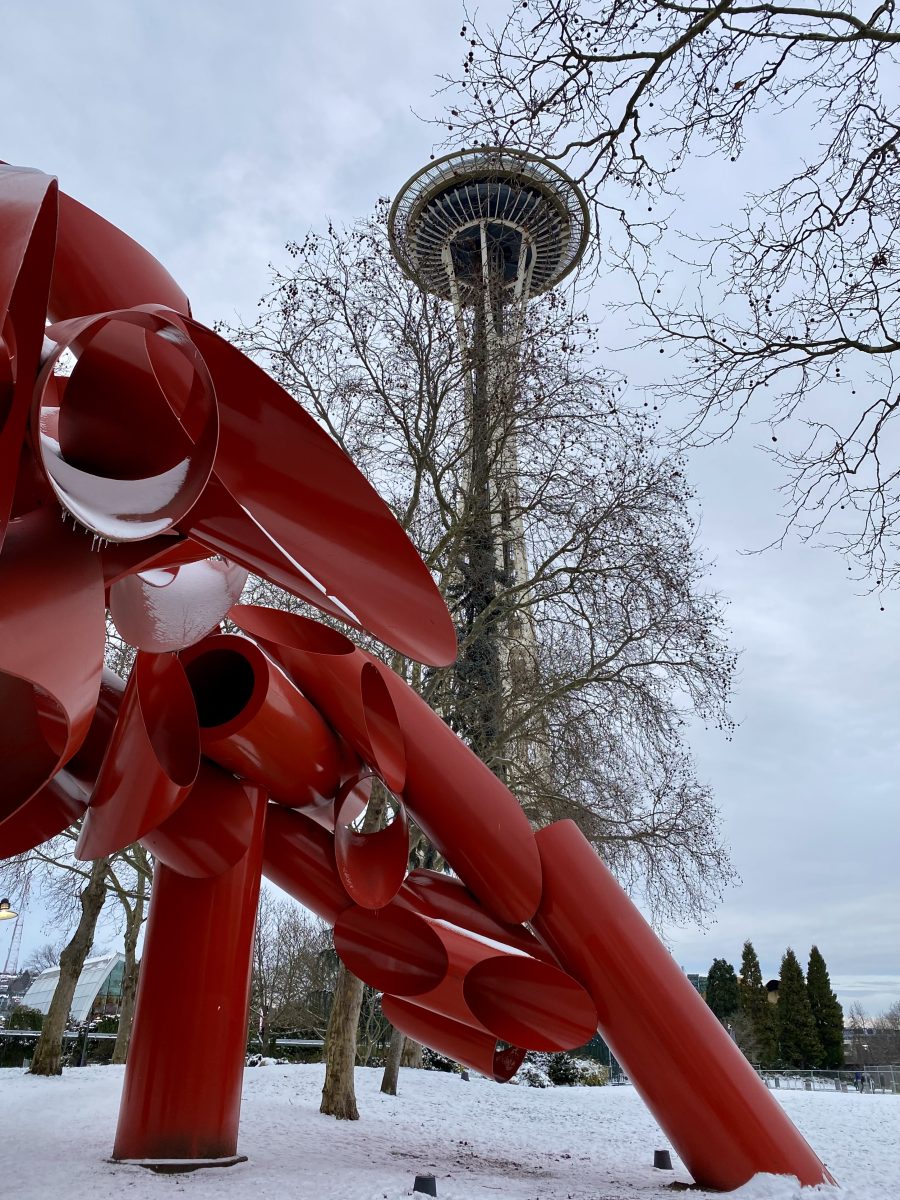

Standing below it in January 2022, with the city still icy from the previous day’s storm, I looked up at the renovated structure and understood what the designers were attempting. The original Needle was a silhouette — dramatic from a distance, but visually heavy at close range. The renovation opened it. 176 tons of glass, a dematerialized top. From the sculpture garden below, the hovering disc now reads as something genuinely weightless. The architects (Olson Kundig, with the restoration firm MG2) succeeded in making a 60-year-old structure feel as though it had caught up with what it always promised to be.
What was gained is real: spatial openness, visual clarity, a structural legibility the original building had only gestured toward. The renovation understood the Needle as a form that needed to be seen and see through simultaneously — and it solved that problem.
What was lost is equally real, though harder to quantify. Sky City wasn’t beautiful architecture. It was a table with an extraordinary view and an extraordinary mechanism. What it offered was duration — a reason to stay at the top long enough for the city to show you its full rotation, to let the relationship between place and time become the subject of the meal. The Loupe Lounge offers a version of this, but for a narrow audience and at a price point that converts the experience from civic to exclusive.
The Space Needle was built with public money and federal support as an expression of what American optimism believed it could build. For five decades it fed families. The renovation is technically superior. But something of its original democratic character — the idea that anyone could take an elevator to the sky and eat salmon while the world turned — didn’t survive the update.
The choices a renovation makes about what to keep and what to replace say something about what a city thinks it has become.
The best views of Seattle, as it turns out, still include the Needle. We found them from the Olympic Sculpture Park, where Henry Moore and Richard Serra hold their ground against the water and the Space Needle rises behind them — present without demanding anything. From there, standing in the cold with the sound behind us and the structure framed against the hill, it seemed right that we hadn’t gone up. The building makes more sense from the outside. Most things built to represent the future do.


The Space Needle sits at the intersection of Early Modern optimism and civic ambition — designed in the same decade as the Eiffel Tower’s postwar recontextualization, and facing the same long question: what does an era’s monument become when the era ends? Explore the Early Modern page of the Architecture Style Guide →