
Twenty-one missions, roughly a day’s walk apart, built to the same formula along six hundred miles of California coastline — and at Capistrano, the formula’s clearest expression sits right next to its most visible ruin.
The Formula
Junípero Serra, a Franciscan friar, founded the mission chain beginning in 1769 under the joint authority of the Spanish Crown and the Franciscan order — colonization and conversion pursued as a single project, part of King Carlos III’s push to secure Alta California against Russian and British territorial interest, with the Franciscans taking over mission-building duties after Spain expelled the Jesuits the previous decade.
Serra ultimately established nine of the eventual twenty-one missions himself before his death in 1784; the rest followed under his successors through 1823. The missions were spaced roughly a day’s ride apart along El Camino Real, the King’s Highway, forming a chain intended to secure Spanish claims to Alta California as much as to spread Catholicism.
Each mission followed a remarkably consistent architectural formula: a quadrangle plan built around a central courtyard, the church anchoring one corner, living quarters and workshops and storage rooms lining the remaining sides, the whole compound designed to function as a self-sustaining settlement rather than simply a place of worship.
The formula’s material logic was practical before it was aesthetic. Thick adobe walls — sun-dried mud brick, sometimes several feet deep — kept interiors cool through California’s dry heat and doubled as fortification.
Red clay tile roofs replaced the original thatch after early mission fires, a fireproofing solution that became, almost by accident, the defining visual signature of an entire regional architectural style still being built today, a century and a half later, in tract homes that have never seen a Spanish friar. Covered corridors — arcaded walkways with round arches — ran along the courtyard’s interior edges, providing shade and connecting the compound’s functions without requiring anyone to cross open ground in the sun.


What Capistrano Holds
Capistrano was founded on November 1, 1776, the seventh mission in the chain. Its Great Stone Church, begun in 1797 and consecrated in 1806, was by far the most ambitious structure Serra’s successors built — a cut-stone basilica with seven domes and a bell tower rising above the quadrangle, designed to be the grandest church in Alta California. It stood for six years.
The earthquake of December 8, 1812 collapsed the church’s roof and towers during morning mass, killing forty Acjachemen worshippers inside. What remains is ruin: stone walls open to the sky, the bell tower reduced to a fragment, the seven domes gone entirely.
The ruin is not treated as a footnote at Capistrano — it’s the site’s central visual fact, roped off but fully visible, stone still bearing the fracture lines of the collapse. Standing inside it, the ambition of the original design is legible in exactly the same moment as its failure.


A hundred feet away, Serra Chapel has done what the Great Stone Church could not: survive. Built earlier, in 1782, and constructed in far humbler adobe rather than stone, it’s the oldest building in California still in continuous use, and the only standing church in which Junípero Serra is known to have said Mass.
Whitewashed walls, a gilded Baroque altarpiece brought from Barcelona in the 1920s, low beamed ceilings — the whole space is a study in how much can survive when a building doesn’t try to be a landmark.
Between the two churches, the mission’s gardens hold their own quiet argument: fountains, bougainvillea, the swallows that gave Capistrano its enduring cultural fame, migrating back to the ruins each spring in a pattern that predates any of us and will presumably outlast the current buildings too.


What the Formula Cost
The mission system’s architecture cannot be separated from what built it. The quadrangle’s workshops and storage rooms were worked by Acjachemen people — the indigenous population of this stretch of coast — brought into the mission system through a combination of religious conversion, economic dependency, and, especially after initial contact, the coercive pressure of a population already devastated by introduced disease.
Once baptized, converts were generally not permitted to leave; the mission’s labor economy, which produced the cattle hides, tallow, and grain that sustained the whole chain, depended on a workforce that had little practical freedom to withhold it.
This is not incidental to the buildings. The scale of Capistrano’s quadrangle, the volume of its workshops, the ambition of the Great Stone Church itself — all of it was built by Acjachemen hands, under a system that combined genuine religious conviction with a labor structure indistinguishable, in practice, from forced servitude.
Reading the mission honestly means holding the architectural achievement and its cost in the same frame, the way Capistrano’s own ruined church and surviving chapel sit a hundred feet apart, refusing to let you look at one without the other.


The Same Formula, Along the Coast
The quadrangle logic repeats with remarkable consistency at every mission I’ve visited since. At Mission San Luis Obispo de Tolosa, the fifth in the chain, the same courtyard-and-corredor plan holds, scaled down and worn smoother by two and a half centuries of continuous use as an active parish.


At Mission Santa Barbara — the “Queen of the Missions,” and the only one to maintain an unbroken line of Franciscan friars since its 1786 founding — the formula gets its most monumental treatment: twin bell towers, a Roman Doric façade adapted from a first-century architectural treatise the mission’s builders found in the friars’ library, a scale that announces itself from well outside the compound.


At Mission San Carlos Borromeo in Carmel, Serra’s own mission and burial site, the formula turns more intimate — Moorish-influenced star window, a bell tower built from local sandstone, the whole compound smaller and quieter than Santa Barbara’s civic grandeur.
And at Mission San Francisco Solano in Sonoma, the northernmost and last-built of the chain, founded in 1823 after Mexican independence had already begun to change the political ground the missions stood on, the same plan appears one final time, simpler than its predecessors, before the system that produced it was secularized just over a decade later.

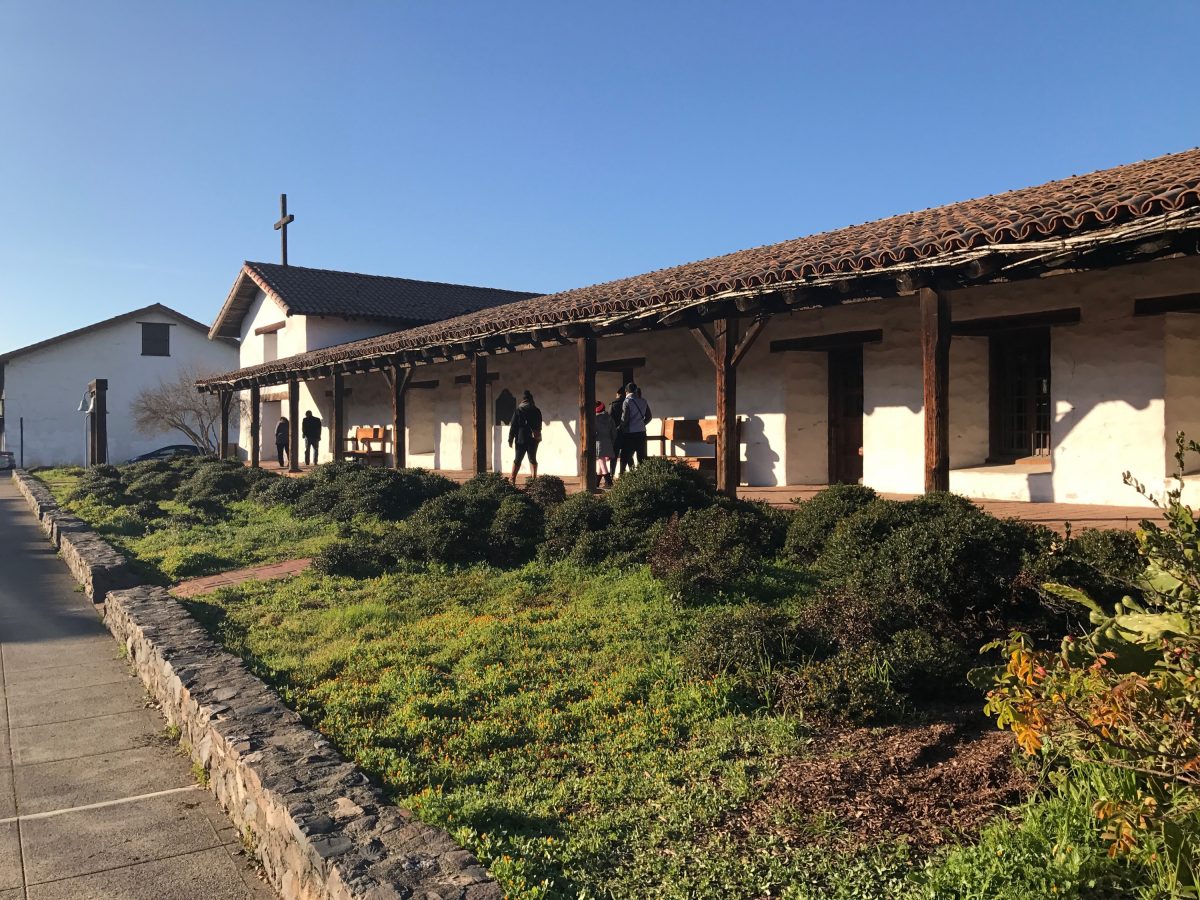

Old Town San Diego tells an adjacent but distinct story. This was the site of California’s first Spanish settlement — the presidio and pueblo that grew up around Mission San Diego de Alcalá, the chain’s first mission, founded in 1769.
The mission itself was relocated a few miles upriver in 1774, so Old Town holds the civic and residential architecture that grew alongside the mission system rather than the mission building itself: adobe row houses, a central plaza, the same thick-walled, red-roofed vocabulary applied to daily life rather than religious ambition. It’s the mission formula’s secular cousin — the architecture the system produced once it moved past the church and workshop and into the ordinary business of a Spanish colonial town.


What the Chain Adds Up To
Twenty-one missions, one formula, six hundred miles — an almost startling degree of design consistency for a colonial project executed over five decades by different builders working with different local materials.
California’s earliest built environment was not improvised. It was a pattern, deliberately repeated, and the state’s later Mission Revival architecture is a direct descendant of it — visible at civic scale in Santa Barbara, which rebuilt its entire downtown in Spanish Colonial Revival after the 1925 earthquake and has enforced that style by ordinance ever since, and at a far more ordinary scale in the red tile roofs and white stucco arches still going up on tract housing development today. Both are descendants of a formula built first by Acjachemen and other indigenous hands under conditions the architecture itself was never designed to disclose.


Old Town San Diego’s civic architecture is Spanish Colonial without the mission church itself — the mission moved upriver in 1774. Explore the Colonial Style page for the fuller lineage →
Go deeper: Join The Inspired Lens for early guide access →