
Outer Ring of Paris
Beyond the Boulevard Périphérique, the Grande Couronne holds a different kind of Paris — one measured not in arrondissements but in royal estates, forests, and the grand geometries of designed landscape.
Four departments extend outward from the Petite Couronne: Yvelines (Versailles), Seine-et-Marne (Melun and Fontainebleau), Val-d’Oise (Pontoise), and Essonne (Évry). Each is accessible by RER and Transilien from central Paris. Each carries a distinct spatial character shaped less by urban density than by history, nature, and deliberate design.
This is where Paris breathes — and where some of its most spatially significant landscapes unfold.
Yvelines
Versailles
Versailles is located only twelve miles from Paris in the department of Yvelines. The city is particularly well-known for its 17th-century Baroque-style Château de Versailles, the Palace of the Sun King, Louis XIV. Construction began in 1661 by Louis XIV to replace the small chateau built by Louis XIII on his original hunting lodge site. Versailles became the primary residence and seat of the court of King Louis XIV through Louis XV and Louis XVI until the French Revolution of 1789.
Versailles is not primarily a building. It is a spatial argument — that power, when sufficiently organized, can reshape an entire landscape to reflect its own image. The gardens, the canal, the axes that extend beyond the horizon are as much the palace as the Hall of Mirrors. Le Hameau, Marie-Antoinette’s hamlet at the far end of the estate, is the counterargument — where the same power staged its own escape from itself.


This UNESCO World Heritage Site encompasses over four square miles. Beyond the palace (Le Château), the estate grounds comprise grand gardens (Les Jardins), a park (le Parc) surrounding a cross-shaped canal (le Grand Canal), and the Trianon estate (le Domaine de Trianon), which includes two palaces, Grand Trianon and Louis XV’s Petit Trianon and gardens, and Marie Antoinette’s quaint hamlet village with cottages and a farm (le Hameau).
The Baroque spatial logic of Versailles is explored in the Baroque → entry in the Architecture Style Guide.
Seine-et-Marne
Vaux-le-Vicomte
Marquis and Viscount Nicolas Fouquet’s Baroque-style Château de Vaux-le-Vicomte in Maincy near Melun was Louis XIV inspiration for Versailles. As France’s Superintendent of Finances, the nobleman enjoyed tremendous wealth until he was imprisoned for life in 1661 by Louis XIV for embezzlement and treason, lèse-majesté. When invited to a banquet to show off the exquisite estate, Louis XIV felt insulted by Fouquet’s flaunting of luxury only worthy of the king himself.
To visit Vaux-le-Vicomte is to understand what Versailles was reacting to — the estate that made a king jealous enough to destroy its owner and then build something larger.


The estate grounds comprise grand gardens surrounding a canal. The original 17th-century Baroque decoration and furniture of all four levels of the chateau remain intact.
On Saturday evenings from June to October, 2,000 candles illuminate the château and gardens — the estate returning, briefly, to the atmosphere of the night that cost Fouquet everything. During this time, visitors can also enjoy a three-course meal overlooking the gardens at Les Charmilles, the restaurant on the grounds.
Fontainebleau
Where the forest arrives before the château.
The Forêt de Fontainebleau — 25,000 hectares of sandstone formations, oak forest, and light that has drawn painters since the 19th century — is the defining spatial experience here, not the château itself. The Barbizon School, which worked in these woods in the 1830s and 1840s, was the direct predecessor of Impressionism: a group of painters who left the studio for the landscape and changed how European art understood natural light.
The Château de Fontainebleau, by contrast, is one of the most historically layered royal residences in France — occupied continuously from the 12th century through Napoleon III, its architectural accumulation reflects seven centuries of French history in a single building.


Photos by Eric Prouzet via Pexels
Where Versailles is geometric and intentional, Fontainebleau is accumulated and varied. Where Versailles announces itself, Fontainebleau reveals itself gradually. They are the two dominant modes of French royal space — and together they make the Grande Couronne one of the most architecturally instructive day-trip circuits in Europe.
This section draws on research and geographic study rather than firsthand experience.
Getting to the Grande Couronne
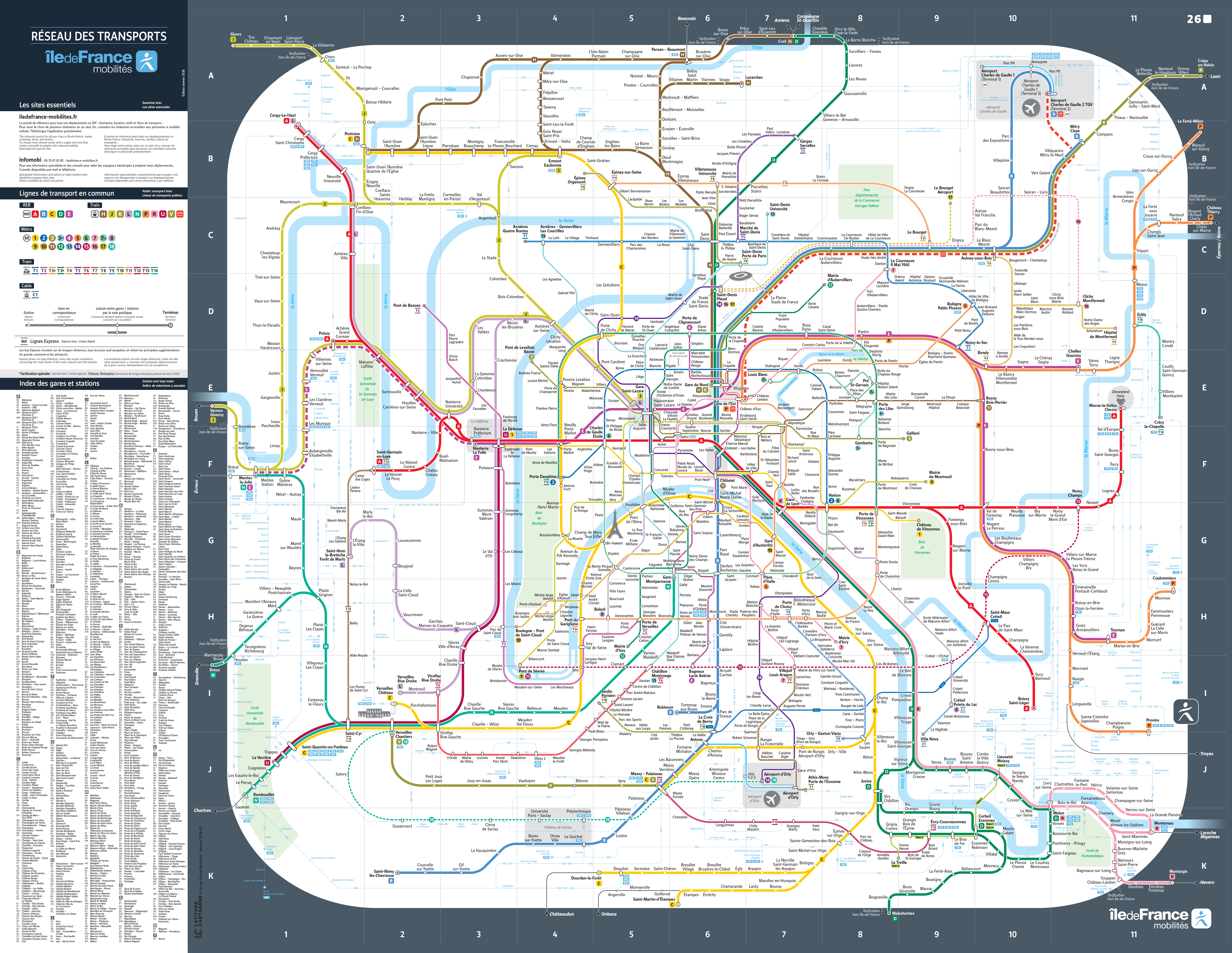
The Grande Couronne is well-served by RER and Transilien lines from central Paris — making day trips straightforward from the city. All major destinations are reachable in under an hour from the center.
The extensive and user-friendly Metro and trams tightly connect the inner city, creating a walkable center, while RER trains extend service from the center into Grand Paris and continue into the greater Île-de-France region. All but one SNCF Transilien train operate from major train stations and extend into the greater Île-de-France region.
To Versailles:
The rapid regional RER train takes visitors directly to the palace in Versailles. From the left bank along the River Seine, take the yellow C5-line from Paris to Versailles-Rive Gauche.
To Vaux-le-Vicomte:
The RER train’s green D2-line through Paris and Transilien train’s pink R-line from Gare de Lyon run to Melun from which visitors can take a taxi to Vaux-le-Vicomte. (The chateau and tour operators also offer shuttle services.)
To Fontainebleau:
RER D or Transilien R line from Gare de Lyon to Fontainebleau-Avon station. The forest is walkable from the town center; the château is a short taxi or bus ride from the station.
Observations on Versailles, Vaux-le-Vicomte, and the landscapes of the Grande Couronne — including the Fouquet story that made a king build Versailles — are in development for The Inspired Lens.
Continue the Journey
The Grande Couronne holds Paris at a deliberate distance — and in that distance, some of the most spatially significant landscapes in France.
Return to Paris Île-de-France → or explore France in The Atlas →
Join The Inspired Lens → for early access to the Reading Paris and Grande Couronne guides.