
On a Thursday morning we stopped at Boulangerie Michel on a quiet street in Den Haag, sat down with croissants and café at the owner’s instruction, and didn’t think about paying until we’d finished. When we reached for the credit card, she shook her head: cash, or the Dutch Maestro bank card — PIN only, nothing else accepted.
We had no cash. We had no Dutch card. The man waiting behind us stepped forward without being asked. He would pay. We could come to his shop around the corner later and settle it. He said this the way you might give someone directions — practical, unhurried, assuming no credit for it. We thanked him, genuinely taken aback, and found his shop within the hour.


That kind of generosity, offered as a matter of course, turned out to be characteristic of Den Haag (The Hague in English, La Haye in French) — and of the Dutch more broadly. We had encountered it in smaller forms all week. Here, in a city that receives far fewer visitors than Amsterdam and makes no particular effort to ease their passage, it arrived more plainly.
We had come to Den Haag because the Ajax camp had been scheduled there. Cole, thirteen, and Caden, fifteen, had been registered for a week-long day camp run by Ajax [EYE-ax] Amsterdam at a training complex in Zoetermeer, just outside the city. The camp set the itinerary: a full week in South Holland, Den Haag as the base, the Dutch rail system as the connective tissue for day trips to the surrounding cities. It was the kind of travel that produces the most useful knowledge — staying long enough in a single place to understand its rhythms rather than simply its monuments.
We arrived from Amsterdam on Sunday, the city making no great announcement of itself at Den Haag Centraal. The station moves people with the quiet efficiency of a place that has practical purposes for them. Along a shopping street near De Passage — the city’s covered shopping arcade, its vaulted glass roof and lined shop fronts belonging to the tradition of the Parisian passages — the hotel building itself was hard to miss.


A large white box base with a smaller white volume offset above it to one side, the whole thing perforated at regular intervals by large rounded black glazing cutouts that carried their rhythm up from the curve of the ground-floor storefront. Modern and deliberate.
What was harder to find was the entrance. We passed it twice before doubling back to the corner, where a discreet sliding storefront door led to an elevator lobby that had nothing on the outside to suggest what was above. We took the lift to the third floor, the doors opened on the opposite side, and the space that met us was bright and airy — a modern living-room arrangement overlooking Grote Marktstraat, the city’s main pedestrian street below. The contrast between the exterior and the interior had the quality of a reveal.
We left the bags in our room and went out to the Hofvijver. The Court Pond sits at the front of the Binnenhof, and in July the white swans move across it with the unhurried authority of things that have always belonged there. The Gothic spires of the medieval parliamentary complex reflect in the still water; the neoclassical facades along the far bank hold the evening light from the west. Above the Binnenhof’s roofline, the glass towers of the modern city rise — not competing with what’s below so much as completing it, the centuries made legible in a single view.


The city had an almost suspended quality on a Sunday — streets that would be full on weekdays, quiet enough now that the architecture could be read without distraction. We walked along the pond and past De Plaats, looking for somewhere lively to watch the final.


We found Fratelli on the opposite side of the Hofvijver. The game was on in the quiet restaurant. We ate well — the food was consistent with what we were finding Italian food to be throughout the Netherlands, equal to what we’d one day encounter in Italy itself, typically run by Italians who brought with them the same attention to ingredients and the same care in execution.


That Sunday emptiness, we came to understand over the week, belonged to a particular Dutch urban rhythm: the people who work and shop in the center arrive on weekdays, in the evenings — but not on Sundays.
Later that night we returned to the hotel lobby. The upstairs common space had gathered a handful of other international guests — none of them with any particular stake in the result. Caden was wearing the France jersey he had bought at the Nike store in London for his birthday. When France beat Croatia in the final, it was that group of us, in that airy room above Grote Marktstraat, that marked it. We would be in France ourselves not long after. Caden had, apparently, known.


Den Haag is perhaps the most underestimated city in the Netherlands — underrated even by the Dutch, who tend to regard it as the city where work happens rather than where life does. This is not accurate. Amsterdam is the constitutional capital; Den Haag is the seat of government, home to the parliament, the royal family, and the International Court of Justice. It carries that weight without performing it.


The Binnenhof sits at the center with an almost understated authority — its 13th-century Gothic complex still in active parliamentary use, the Ridderzaal at its heart where the King opens parliament each year on Prinsjesdag. The Hofvijver fronts it with civic composure: water, medieval towers, neoclassical facades arranged with the particular Dutch discipline that makes its public spaces feel purposeful rather than decorative. I had not expected to be as moved by The Hague as I was. It is the kind of city that doesn’t ask to be discovered, and then turns out to be worth knowing very well.


On the days Aaron and I had the city to ourselves — the boys on their commute, the camp day already underway — we moved through the historic center at the pace it seemed to invite. From De Plaats square, the Grote of Sint-Jacobskerk anchors the view: a Gothic church whose tower has marked the center of the city since the 15th century, its mass in easy conversation with the Het Oude Stadhuis opposite.


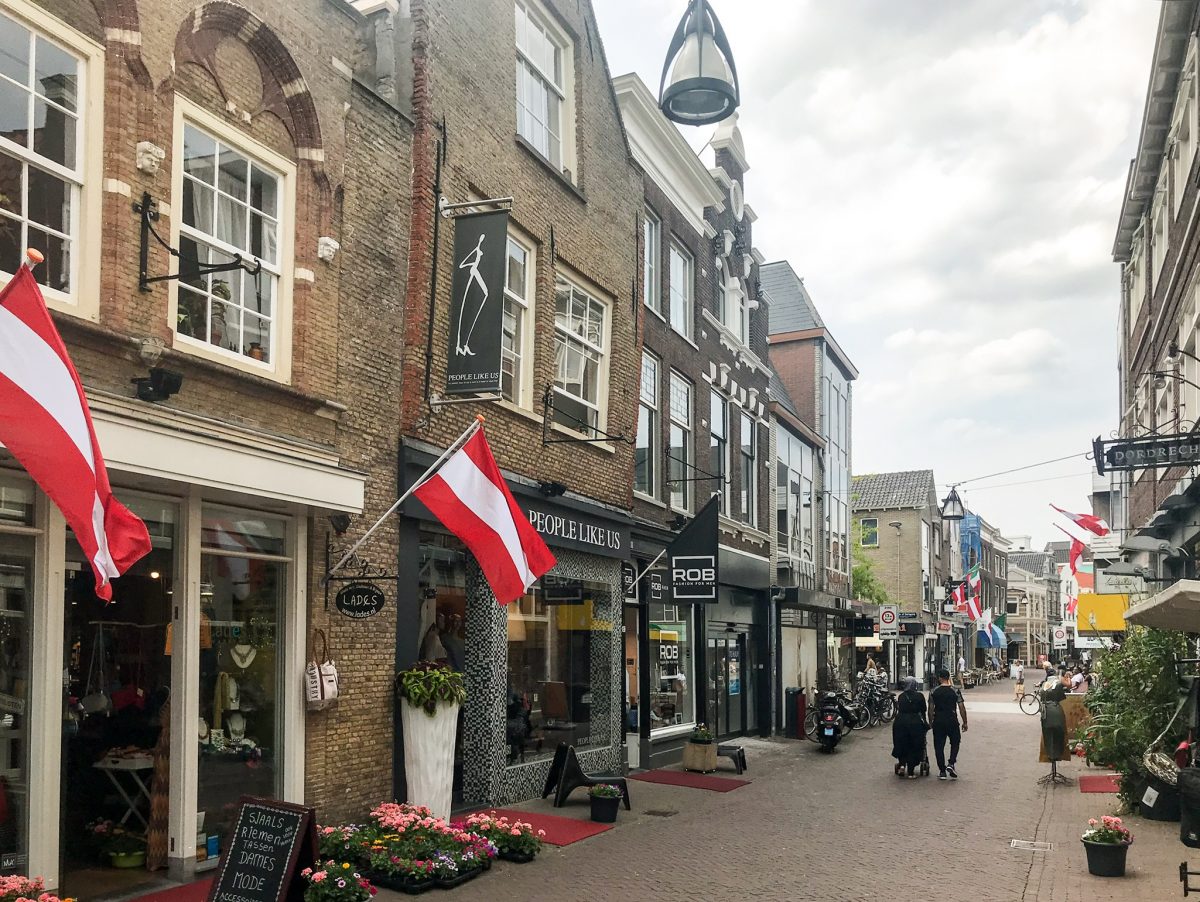
Along Noordeinde toward the palace, and near the junction with Oude Molstraat, the scale draws in — narrow streets, Flemish facades, the kind of civic accumulation that comes from centuries of actually governing a country from a place rather than merely representing the idea of it. The Noordeinde Palace sits in this context without ceremony: a working palace, not a monument, where the King receives heads of state while the street outside goes about its business. It is a quality Den Haag has throughout — institutional weight carried lightly.


Monday was camp opening day. We rode the tram with the boys to understand the route — and discovered that the direct line to Zoetermeer was under construction. A transfer at the small Laan van NOI station would add fifteen minutes to what was already a nearly one-hour commute each way. We rode it once together, confirmed the transfer, and sent them off Tuesday on their own. They navigated it without incident for the rest of the week.
Midweek, I went with Aaron to met a Dutch colleague for lunch — an Amsterdam native who commuted to work in Den Haag and knew both cities well. When he mentioned the boys were commuting daily to Zoetermeer on their own, the colleague paused with concern. The area around the complex was a commuter suburb — mostly residential, working-class, not much open during the day, not on any tourist map. When we told him the boys had found it perfectly manageable, that people had greeted them with Goedemorgen on the street, that the area had felt safe and the route comprehensible, he nodded: yes, of course — the Netherlands is generally safe. He had simply forgotten, perhaps, that safety and interest are not the same thing.
That first morning, stepping off the tram at Oosterheem Centrum before the fifteen-minute walk to the field, I had asked a man whether there was a café open nearby — everything was still closed. He offered the use of the bathroom in his home instead, without ceremony. I graciously declined. That is also the Netherlands.


Later we’d found Pavarotti in the Stadshart Zoetermeer commercial centre — good pizza, eaten at midday in a shopping complex in a commuter suburb — and it had been excellent. Italian food in the Netherlands had consistently been that way. We had stopped being surprised.


What made the commute manageable was less the boys’ confidence, though they had that, than the particular clarity of the Dutch transit system — a city that trusts its infrastructure to be comprehensible, and so it is. It was not that we were cavalier about sending a thirteen and fifteen-year-old across an unfamiliar city on their own. It was that the city gave us no reason to worry.
On the last morning, a woman stopped us at the station. She had seen the boys every day on the train — commuting from the Zoetermeer direction, as it happened. She had been watching over them without their knowledge, instinctually, the way someone who belongs to a place watches over those who are passing through it. She wanted us to know they had impressed her. Their maturity, she said. How perfectly comfortable they seemed. She offered this not as reassurance but as a simple observation, the way you might mention something you’d noticed about the weather. We thanked her and stood there for a moment after she left. That is also Den Haag.
One afternoon walking through the historic center, we stopped to watch a crew of workers repairing a section of street. They were hand-laying bricks in a herringbone pattern, each one placed with a precision that made the work look almost meditative. No asphalt. Just the same material that had been used in these streets for centuries, laid by hand, one at a time. It was the kind of detail you would not pause for in most cities. Here, it felt entirely in keeping.


The camp ended on Friday with a ceremony at the Zoetermeer complex. The director conducted the entire proceedings in Dutch — which meant comprehension arrived only in fragments for most of the families present, including us. Cole’s name appeared in those fragments more than we expected. He had been working at the game since before he could properly walk — a ball at his feet at eighteen months, early game savvy matched by a technical focus that had always been his own — and what the Ajax camp confirmed was that the foundation held at a different level.
He won the speed and finishing course competition, then reached the 1v1 final against a boy three years his senior. We understood almost none of the director’s commentary and every word of what mattered. Caden received a special captain’s armband — recognized formally as a leader among the group, a distinction that carries more weight for arriving without ceremony.


The boys had spent the week alongside kids from across Europe and beyond, many sharing no common language with them. It hadn’t mattered. They had simply played, which is the version of international communication that needs no translation.
On our last evening, Aaron, Cole, and I took the tram to Scheveningen — the North Sea resort beach connected to Den Haag by a straight run west. We found a table on the Strand for moules-frites, the fries arriving in the Dutch manner, and ate facing the water as the light dropped toward the horizon. The North Sea in July holds the light longer than you expect; the sun was still above the water when we finished and walked to the pier.


Caden had elected to stay back and find his own dinner — Wok to Walk, eaten at whatever pace pleased him. He had navigated the city on his own terms all week. It seemed fitting that the last evening should be no different.
What the Ajax camp gave us beyond the football was a week at a fixed point — a home base with reliable rail connections fanning out in every direction. From Den Haag Centraal: Haarlem, Leiden, Delft, Utrecht, Rotterdam, Dordrecht — six cities across five days, each one a different register of Dutch life, all of them reachable because we had somewhere to come back to each evening. That is the particular gift of a week rather than a weekend: the city itself becomes navigable, and the cities around it become available. None of them could be done justice in a single day. Several drew us back five years later. For the fuller account of all of them — and the return — read The Netherlands: Water, Tolerance, and the City That Shouldn’t Exist →


Den Haag had been conceived as a base — a logistical convenience organized around the Ajax camp, a place to leave each morning and return to each evening. What it became, over seven days, was a city we actually knew: its Sunday quiet and its weekday density, its civic architecture and its handlaid streets, its transit and its bakeries, the woman at the station who had been watching over our boys without ever introducing herself. Most people who know Den Haag by name don’t know it at all. They know its institutions — the court, the parliament, the peace palace — but not the city underneath them: the Hofvijver with its swans, the covered passage, the streets near the old city hall where the scale draws in and the centuries become readable in the stone. I had not expected to be surprised by it. I was.


Cultural notes
Den Haag / ‘s-Gravenhage / The Hague / La Haye: Den Haag (the common Dutch name) means “the hedge”; The Hague is the English equivalent, La Haye the French. The full official name, ‘s-Gravenhage, means “the Count’s hedge,” referencing its origins as a private hunting ground for the Counts of Holland. Amsterdam is the constitutional capital; Den Haag is the seat of government, parliament, and the Dutch royal family.
The Binnenhof: The Gothic parliamentary complex at the center of Den Haag has housed Dutch governance since the 13th century. The Ridderzaal (Hall of Knights) is used for the annual ceremonial opening of parliament on Prinsjesdag.
The International Court of Justice / ICC: The ICJ, the principal judicial organ of the United Nations, sits in the Peace Palace (Vredespaleis) in Den Haag. The International Criminal Court — the body associated with the phrase “tried at The Hague” — is a separate institution, also in the city, established in 2002.
The Mauritshuis: A 17th-century palace on the Hofvijver housing the Royal Picture Gallery. Notable works include Vermeer’s Girl with a Pearl Earring, Rembrandt’s The Anatomy Lesson of Dr. Nicolaes Tulp, and Fabritius’s The Goldfinch.
Payments in the Netherlands: In 2018, Dutch in-store payments were dominated by Maestro (PIN), and many smaller shops, markets, and cafés did not accept international credit cards — as we discovered at Boulangerie Michel. Dutch banks are now actively phasing out Maestro in favor of Debit Mastercard and Visa Debit, which means international card acceptance is improving. Smaller independent establishments may still vary; it’s worth carrying some cash or confirming before you order.
Scheveningen: The North Sea beach resort attached to Den Haag by tram, known for its long pier, its broad beach, and its year-round seafood restaurants along the Strand.
Part of the 2018 Northwestern Europe journey — London, Amsterdam, The Hague, Brussels, Paris, Lyon. Read the full trip overview →
For day trips from Den Haag by rail — Haarlem, Leiden, Delft, Utrecht, Dordrecht, Rotterdam — read The Netherlands: Water, Tolerance, and the City That Shouldn’t Exist →