
The train from Breda was not what we had planned. A canceled service had redistributed its passengers onto ours, the first-class car had filled before we reached it, and by the time we boarded, the remaining cars were standing room in July heat with the air conditioning out and nowhere to go.
An American family squeezed in beside us in the center aisle with luggage proportioned for six months abroad — each of us carry-on only on our month-long journey — pushed it in our direction without particular acknowledgment, and then proceeded to discuss, at length and at volume, how uncomfortable they were. When the train stopped in Antwerp, we got off.

Belgium is the size of Maryland and contains within it two countries that do not particularly like each other.
To the north, Flanders: Dutch-speaking, economically dominant, architecturally Flemish — Gothic spires and market squares and the particular civic pride of cities that were, in the 15th century, among the wealthiest in Europe.
To the south, Wallonia: French-speaking, historically industrial, the older wealth gone now and with it a certain confidence — but what remains is a landscape of genuine character: the Ardennes forests, the Meuse valley in its limestone gorge, medieval châteaux and ruins, Trappist abbeys still brewing beer by the same methods they have used for centuries, and the town of Spa, which gave its name to every wellness retreat that followed.
Between them, Brussels: officially bilingual, belonging to neither region, the capital of Belgium and of the European Union, a city that has spent its entire existence negotiating between two cultures that speak different languages and perceive different histories.

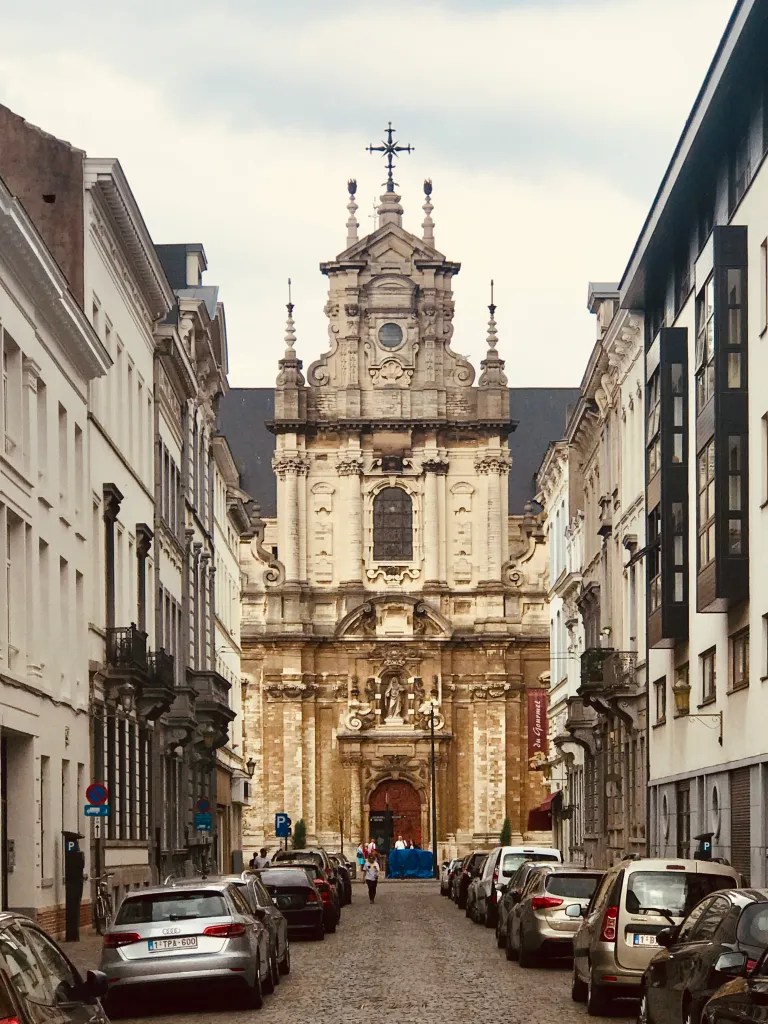


The country functions — has functioned for nearly two hundred years — as a kind of enforced cohabitation. It works, and the tension never fully disappears. Belgium is not a country of grand monuments so much as a country of beauty accumulated in smaller registers: the guild hall facade, the canal at dusk, the village church at the base of a cliff. The contradictions are real, and so is what has been built in spite of them.
Antwerpen-Centraal — de Middenstatie to the Antwerpeners — was where we discovered all of this. Antwerp is a Flemish city with the easy confidence of old money: diamond wealth, port wealth, the wealth of having been the commercial center of northern Europe at the moment northern Europe was reorganizing the world’s trade.
The train station announces this immediately — a Beaux-Arts cathedral of iron and stone, its main hall rising through multiple galleries under a vaulted glass roof, decorative ironwork at every level. It is, by some measures, the most beautiful train station in Europe, and the Antwerpeners know it. The city beyond it is composed and handsome in the way of cities that don’t need to prove anything. We stood in the main hall long enough to understand that we were in a building of serious architectural intention, then got back on the next train south.


Brussels received us on July 21 — Belgian National Day, the Fête nationale belgique / Nationale Feestdag — which may well have explained the canceled train and the redistributed passengers that had brought us here through Antwerp.
Belgium has been marking its national day since 1831, the year King Leopold I was inaugurated as the country’s first monarch following independence from the Netherlands. In the streets around Sainte-Catherine, where we arrived, there was nothing to suggest the occasion. The festivities, as we would discover later from the parade stands still in place near the Royal Palace, had been concentrated elsewhere. What Brussels actually was would take more time to find.
Brussels is different from Antwerp. Brussels is at once opulent and gritty, grandiose and grounded, French and Dutch. Coming from the Netherlands — nine days of Dutch clarity, the canal ring’s purposeful geometry — the first impression registered as deliberate contrast. Structures showed their wear: peeling paint on upper floors, soot on the older stone, graffiti on the lower registers of facades with good bones needing care more than transformation.
We had come in by metro and checked into the Citadines Sainte-Catherine, our apartment-hotel beside the Marché aux Poissons. Brussels, across its center, had the texture of a city in the middle of its own conversation rather than the one it presents to visitors. What was underneath that texture we would discover gradually.
The Grand-Place — the central market square surrounded by baroque guild halls with gilded facades — is one of the great civic spaces in Europe, the kind of square that makes you understand what the medieval city was building toward.


Then you walk two streets and you’re in the ordinary city: the covered passages of the Galeries Royales Saint-Hubert, mid-19th century and lovely; the waffle stands and the friteries; and the particular Brussels habit of placing Art Nouveau architecture between buildings of no particular distinction, as if the city tried for beauty in intervals rather than systems. Victor Horta’s townhouses still stand in the residential neighborhoods south of the center, their iron tendrils growing up facades in a style that only Brussels produced — and that Brussels promptly tore down half of before deciding to protect the rest.
Belgium has a dry and particular sense of humor, and Brussels is its clearest expression. We came to appreciate Brussels for its contradictions — for the way it works hard to meet in the middle of itself, and for how visibly that effort shows. A city with no contradictions is either very small or not paying attention. Brussels has too much history packed into too little space for resolution to be an option.
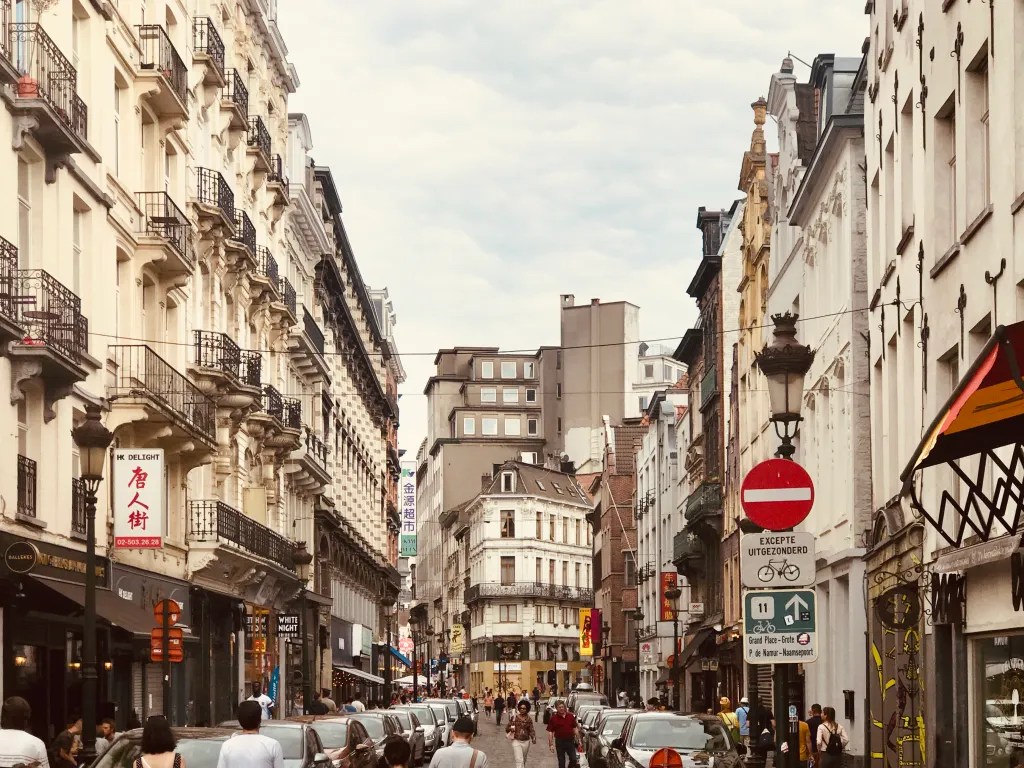

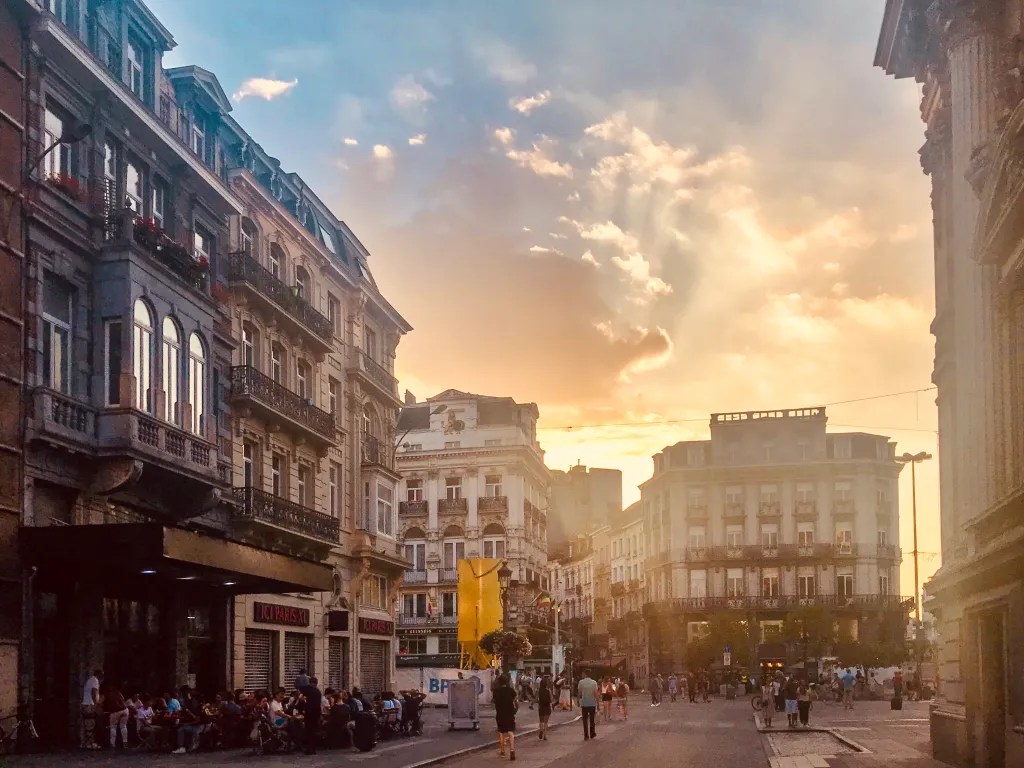
What Brussels holds in careful balance, the regions make unmistakable. The capital sits in its own bilingual territory, belonging to neither the Dutch-speaking north nor the French-speaking south — Dutch and French on every sign, every announcement, every metro line. In Flanders the French recedes; in Wallonia the Dutch disappears. In Brussels they coexist, imperfectly and visibly, which is as close as the country gets to a unified identity.
That first evening we found Ballekes — then just off Place Sainte-Catherine, a few streets from the hotel — low-key, the kind of place that feeds people who actually live in the neighborhood. The name means meatballs, which is what the kitchen does: Belgian meatballs, Belgian endive braised and bitter, Brussels sprouts in the city that named them, and Belgian ales that were smooth and tasted nothing like the same labels we’d find back home. The meal was simply good — the kind of food that doesn’t need to announce itself. It was the right introduction to a city that would turn out to operate on the same principle: more beneath the surface than its facade suggested.


On a day trip west from Brussels we took the train to Bruges, where the medieval city survives almost intact. We walked from the belfry in the Grote Markt across the Burg square past the Gothic Stadhuis and through a covered passage to the Groenerei canal, where the sound of horse and carriage on cobblestone followed us at intervals, evoking something unhurried and genuinely old.
Near a street fair at the old Vismarkt filled with jewelry, paintings, pottery arranged along the canal, I stopped to watch a woman turn clay on a wheel with skilled precision — her hands barely moving, the form rising. Nearby, two young musicians played traditional folk instruments: he on accordion, she on a hammered dulcimer, the Renaissance-era sound carrying across the water with the ease of something that belonged there.


We found our own quiet wandering the perimeter of Sint-Janshospitaal — one of the oldest surviving hospital buildings in Europe — where a small architecture exhibit was on display in the exterior gardens, the kind of thing you only find by arriving without an itinerary. Bruges is often described as too preserved, too visited, too perfectly itself — and the criticism is not unfounded. But a city that knows what it is and holds it that carefully has earned the attention it receives.


On the way back we stopped in Ghent on the last day of the Gentse Feesten — a ten-day celebration of the city’s cultural heritage and one of the largest festivals of its kind in Europe. Ghent is larger than Bruges and more city in its energy. The tents of the Predikherenlei spread along the Leie below St. Michael’s Bridge, the Belfry and Sint-Niklaaskerk rising above them — the canonical view that makes clear what a medieval city was organizing itself toward.
We walked from there toward Sint-Baafsplein, the square held between the Belfry and Sint-Baafskathedraal, where the festival had spread further still: more stalls, more people, the square alive with the particular warmth of a city celebrating itself on the last evening of something.


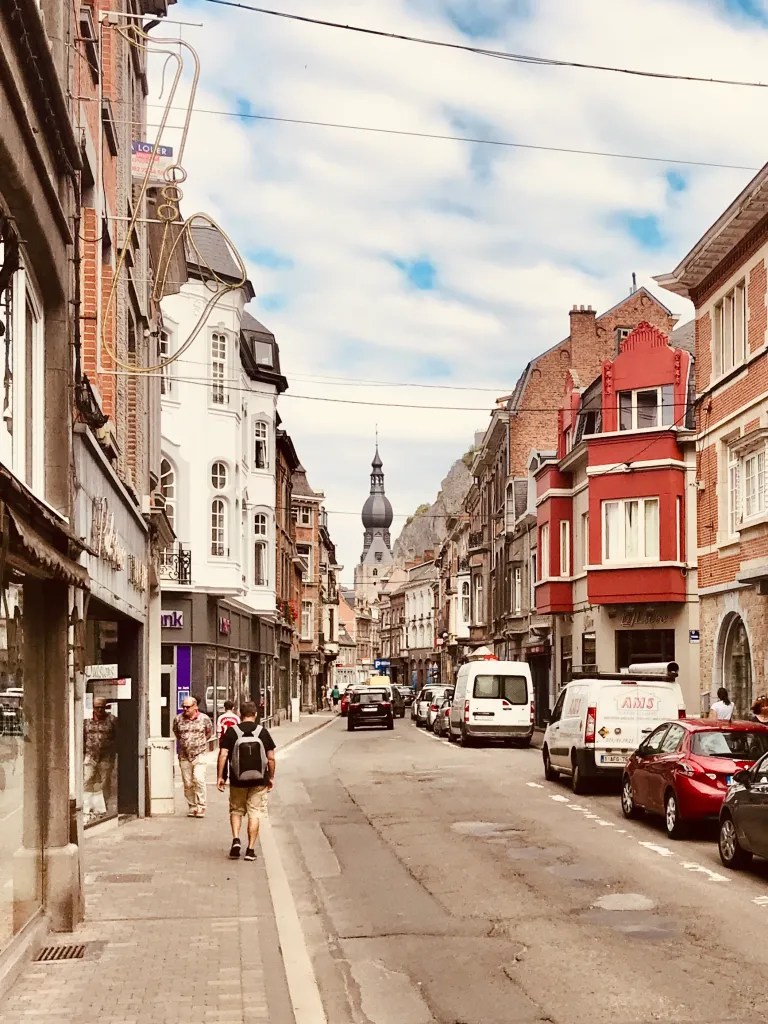
Dinant was quiet on a different register entirely — almost too much so, a ferris wheel turning empty near the tree line of the hill behind the town. The scale changes east of Brussels: the flat Flemish landscape gives way to the Meuse valley, narrow and steep, limestone bluffs rising on both sides with a gravity to the whole scene.
The town is small and perhaps humble by the measures of Bruges or Brussels, but it is well-built and genuinely beautiful — the kind of place that doesn’t announce itself and doesn’t need to. The Collégiale Notre-Dame sits at the base of a sheer cliff face, its bulbous onion dome the architectural signature of the Walloon Baroque, and directly above it a citadel that has watched every army that ever moved through this valley.


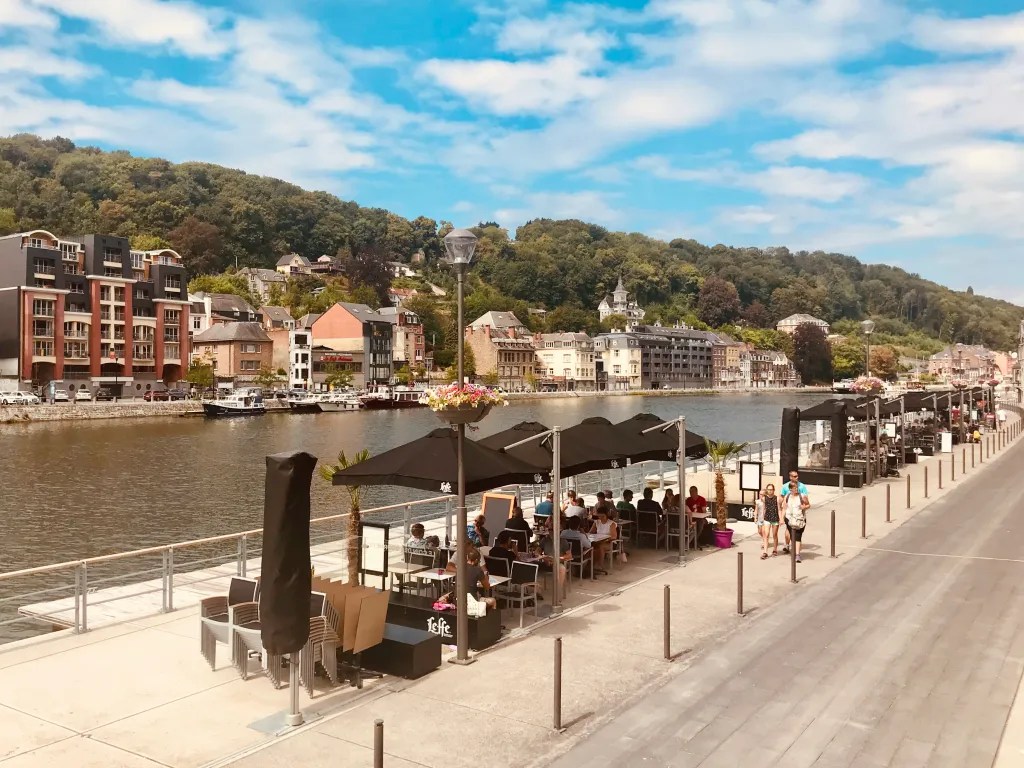

Dinant is the birthplace of Adolphe Sax, inventor of the saxophone, and takes this with characteristic Walloon seriousness — saxophones painted in every color line the bridge over the Meuse, a large brass monument standing as if auditioning for a more prominent street. We stopped at Café Leffe for a brune — dark, smooth, brewed at the nearby Abbaye de Leffe since the 13th century — and had lunch overlooking the river. Cash only; this far into Wallonia, the card reader is not guaranteed.


Returning from Dinant, we came up from the metro through the Parc de Bruxelles — the long formal park running between the Parliament and the Royal Palace, the only time we reached this part of the city.
Returning from Dinant, we came up from the metro through the Parc de Bruxelles — the only time we reached this part of the city, and a different Brussels entirely from the one we had been moving through. The park is formal in the French manner: a geometric layout of allées and parterre, the Palais de la Nation at one end and the Palais Royal at the other, the whole composition arranged as a ceremonial forecourt to a capital that knows how to receive royalty and heads of state.


The neoclassical facades on both sides of the park have the particular restraint of official architecture designed not to impress but to endure — the confidence of a city that has been governing at this address for two centuries and has arranged its spaces accordingly.
The parade stands from National Day were still in place in front of the Palace, the event now days past, the city having absorbed and moved on. It was a quiet view of an institutional Brussels that the tourist circuits don’t require you to find: the formal axis of a capital that has been governing itself, at some cost, for nearly two centuries.


The Grand-Place that final afternoon: the baroque guild halls with their gilded facades surrounding a square whose proportions are simply correct — not overwhelming, not modest, the scale working the way good civic design always works, by making you stop thinking about design and simply experience the space.


That evening, ‘T Kelderke — nearby and below street level, vaulted cellar, carbonnade à la flamande with a dark Flemish beer, the dish for which Belgian beer culture and Flemish cooking converge most completely.
After ‘T Kelderke we went looking for the Manneken-Pis — the famous small bronze of a boy relieving himself into a fountain, which Brussels has somehow elevated into a civic symbol; the dry humor, it turned out, made permanent in bronze.


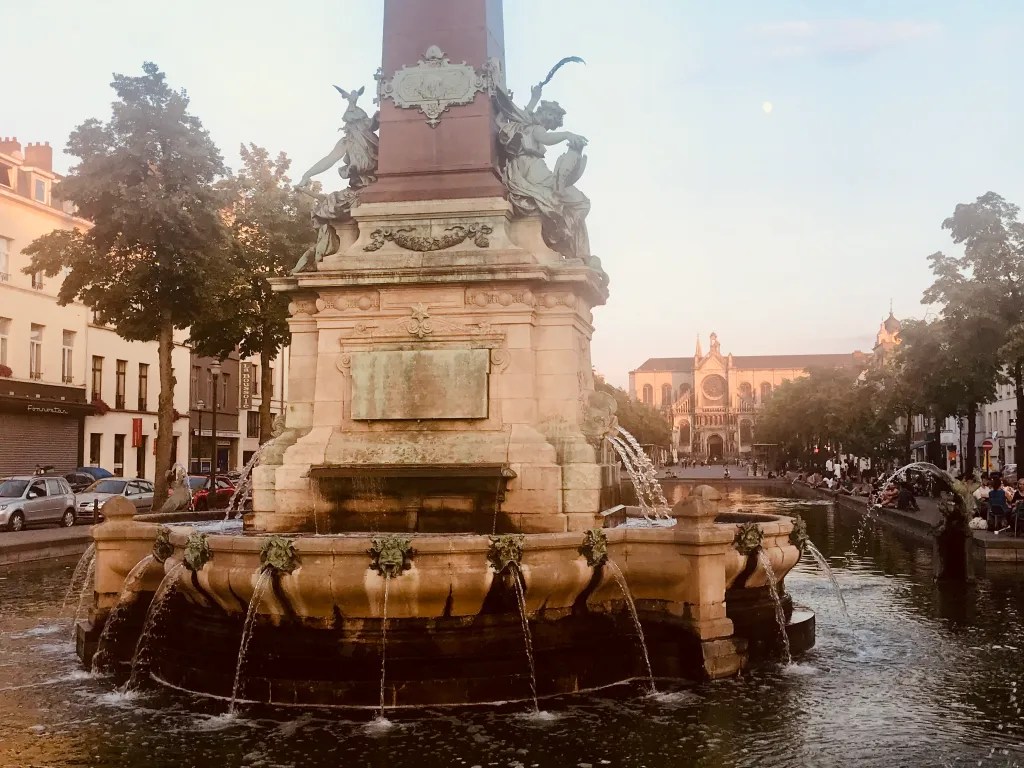
The statue is smaller than expected and considerably less interesting than the crowd of tourists surrounding it with selfie sticks. We left them to it and walked back through the streets past La Bourse toward Sainte-Catherine, where we discovered a small chocolate shop that required a longer stop than planned. The church itself was darker with soot than it should have been — a condition Brussels was still living with, though not for much longer.


We departed from Bruxelles-Midi on the Thalys, high-speed south toward France. Breakfast at Paul, then the platform, and France on the other side of an hour. Belgium had given us more than we had come expecting to find.
Five years later, we returned for a single night. The Brussels that came back into view — the Galeries Saint-Hubert at their best, the Grand-Place at dusk, and, we were glad to find, the chocolate shop still near the plaza fountain, the soot gone from Sainte-Catherine — is another story. Read it here: Brussels: The Second Reading →
Cultural Notes
Belgium’s two communities: Flanders (north) is Dutch-speaking; Wallonia (south) is French-speaking. Brussels is officially bilingual, constituting its own region. The linguistic border runs east-west across the center of the country and represents one of the sharpest cultural divisions in Western Europe. Belgian National Day (July 21) commemorates the 1831 inauguration of King Leopold I following independence from the Netherlands.
Art Nouveau in Brussels: Brussels produced the first fully realized Art Nouveau architecture in Europe. Victor Horta’s townhouses (1890s) represent the movement at its most developed. The city demolished a significant portion of its Art Nouveau heritage during postwar redevelopment — a period Brussels architects refer to as Bruxellisation — before protections were established. What remains is protected and worth finding.
Carbonnade à la flamande: Flemish beef stew braised in Belgian dark ale — the dish for which Belgian beer culture and Flemish cooking converge most completely. Best understood at source.
Belgian ale: Belgium’s beer culture encompasses Trappist ales, lambics, saisons, dubbels, gueuze, and more — each style with a designated glass designed for how the beer behaves. Exported Belgian beer is a different product from Belgian beer in Belgium.
Frites: Twice-fried and served with mayonnaise or aioli — not ketchup. The term “French fries” refers to the French cut of the potato, not its country of origin. Belgium takes this distinction seriously.
Dinant / Café Leffe / Adolphe Sax: The Abbaye de Leffe has been associated with beer production since 1240. Adolphe Sax, born in Dinant in 1814, invented the saxophone in 1846. Cash is still required in many rural Walloon cafés and restaurants.
Antwerpen-Centraal (de Middenstatie): Completed in 1905, combining neo-Gothic, neoclassical French, and Moorish ornamental elements under a vaulted iron and glass roof. Consistently ranked among the finest railway stations in Europe.
Part of the 2018 Northwestern Europe journey — London, Amsterdam, The Hague, Brussels, Paris, Lyon. Read the full trip overview →
Belgium connects to the Benelux Atlas.
For the 2023 return to Brussels — one night in the capital, the Galeries Saint-Hubert, Grand-Place at dusk — read Brussels: The Second Reading →