
The first morning in Paris, jet lag woke us at four.
Rather than lie there fighting it, we dressed in the dark and took the metro from our hotel, joining the early commuters — the cleaners, the market workers, the people the city runs on before the rest of it wakes up. We got off at Trocadéro and walked through the Palais de Chaillot, its two curved wings framing the open esplanade. And then we rounded the corner, and there it was.
The Eiffel Tower in early dawn, the sky warming behind it, the city still quiet. I had been obsessed with France since middle school French class — high school essays on the Loire Valley châteaux, French films, French history, a years-long intention to get there that had taken until my thirtieth year to become a ticket.
I had seen the tower in photographs all my life and still wasn’t prepared for the scale of the thing, or for the particular quality of seeing a lifelong dream in person for the first time — the way reality and image briefly occupy the same space before reality wins.
We stood there long enough for the sky to change. Then we walked down to the bridge and across the Seine, ducking between the massive archway legs of the tower into the open cavern beneath it. There were no fences then, no queue barriers — just the enormous feet of the structure and a direct sightline down the Champ de Mars in both directions.
We lined up at one of the leg elevators and rode to the second level, then transferred to the upper lift for the top.


I am not particularly fond of heights. We stayed long enough to take in the view — Paris spreading in every direction, Haussmann’s boulevards tracing their diagonals across the grid, the Seine catching the early light, Notre-Dame’s Gothic towers rising from the Île de la Cité, Les Invalides’ gold dome visible to the south — and then came back down.
The only problem with the view from the top of the Eiffel Tower, I noted, is that it doesn’t contain the Eiffel Tower. Next time, I decided, I would go to the top of Tour Montparnasse.
From there, the day unfolded on foot the way Paris rewards when you let it. We walked down Rue Cler — the market street in the 7th, lined with butchers and fromageries and flower stalls — and stopped for soupe à l’oignon, the bread served straight on the table without ceremony.


Through the quieter streets of the arrondissement we peered into the official-looking courtyards behind heavy doors, the kind that reveal nothing from the street and everything once opened.
At Les Invalides we spent time in the military museum before descending to Napoleon’s tomb beneath the dome — the circular gallery, the red porphyry sarcophagus on its green granite base, the twelve figures of Victory standing watch in the floor mosaic. Whatever you think of Napoleon, the space makes an argument.
Down the Boulevard Saint-Germain the city picked up pace again. At Saint-Germain-des-Prés — the oldest church in Paris, its origins in the 6th century, rebuilt and rebuilt again — students from the nearby École des Beaux-Arts sat on the cobbled stone in the square sketching. The church simply exists among them, neither demanding attention nor withdrawing from it.


Across the square, Les Deux Magots had its chairs angled toward the street as they always have, occupied by people doing what Parisians do at café tables — watching, reading, talking, or simply sitting with a coffee in the particular unhurried way that is itself a form of participation in the city. The coffee came strong and small. We stayed long enough to feel the rhythm of the place.
We continued down along the Seine and took the steps to the river promenade. Under Pont des Arts, a man sat on the bank with a sketchbook, drawing the Louvre across the water, the trees in front of it tinged orange and amber — the first suggestion of autumn arriving in the leaves.
We watched him for a moment before crossing Pont Neuf, Paris’s oldest standing bridge, where curved stone benches are carved into the sides of the parapets — small architectural acts of generosity, places to sit above the water and rest. We sat in one for a while. The Seine moved below. The light had gone fully golden.


Notre-Dame was next, and it stopped me the way great buildings occasionally do — not gradually but all at once.
First the facade: the three portals dense with carved figures, hundreds of them, saints and kings and angels and scenes from scripture covering every surface in a stone grammar I didn’t have the vocabulary to fully read but felt the weight of immediately.
Then inside: the height of the nave, the logic of the vaults rising to their keystones, the light coming through the rose windows at the narthex and at each end of the transept — the north and south roses enormous, the color in them extraordinary even on an ordinary October afternoon.
The building was begun in 1163. It took nearly two centuries to complete. Standing inside it, that duration becomes legible somehow — not as a fact but as a physical experience of accumulated human intention.


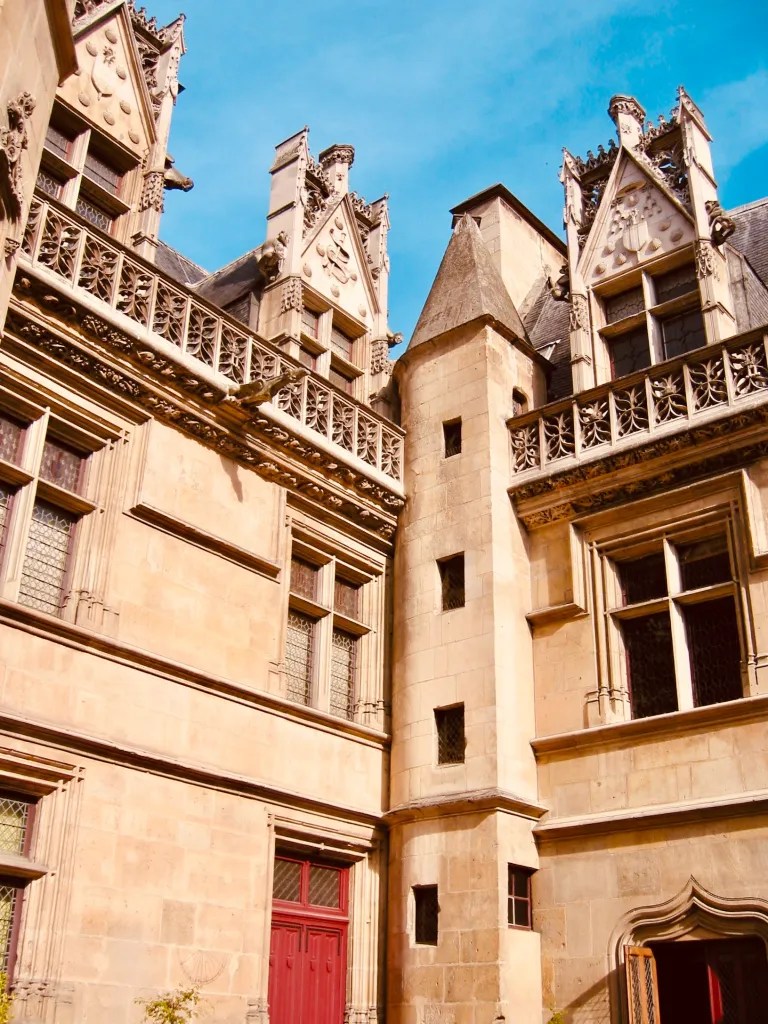
We crossed Pont Saint-Michel into the Quartier Latin and walked toward La Sorbonne, stopping at the Musée de Cluny — the medieval museum built over the remains of Roman baths, the frigidarium still intact, its vaulted ceiling one of the best-preserved examples of Gallo-Roman architecture in France. A group of school children was there on a field trip, their teacher trying to hold their attention among the ruins. The everyday city, in other words. Parisians carrying on.
Luxembourg Gardens in the late afternoon: the paths, the formal parterres, the round basin with its toy sailboats. Under the canopy of trees — their leaves beginning to turn — groups of men played pétanque on the gravel, their concentration entirely on the game. Somewhere in the garden there is a small replica Statue of Liberty, one of several Bartholdi placed around the city before the full-scale version went to New York. We found it tucked among the trees, almost domestic at that scale, the gesture of the original still legible in miniature.


That evening we did the tourist thing properly: a dinner cruise on the Seine. It began beneath the Eiffel Tower lit at night, which is exactly as it sounds. The meal was a three-course prix fixe, competently prepared and entirely forgettable. We passed another small Statue of Liberty on the river.
It was pleasant, it was fine, and it was unmistakably the version of Paris designed for visitors rather than inhabited by anyone. We knew it at the time and enjoyed it anyway — there’s a version of every city that exists for this purpose, and it doesn’t cancel the other version.
In the days that followed we covered the obligatory ground: the Louvre, the Arc de Triomphe, the Marais, Montmartre, Versailles. We loved all of it. But the Paris that stayed with us — and that has continued to draw us back — was the one from that first long day on the Left Bank. A table at a brasserie with the daily prix fixe menu. A jambon-beurre from a counter near the metro. A crêpe from a street stand. Steak-frites, foie gras, escargot ordered without occasion, tarte tatin with crème fraîche at the end. The seasonal, the local, the unremarkable in the best sense — the food a city eats when no one is performing anything.


Paris has a version it presents to first-time visitors, and it is genuinely magnificent. But the city it becomes when you slow down enough to be in it rather than at it — that version takes longer to find, and it’s the one worth returning for.