
The train out of Barcelona had been canceled. That single fact rerouted an entire day — and turned Geneva, always planned as an overnight transit stop, into something we had to earn.
The political unrest in Catalonia that had complicated our arrival in Barcelona followed us to Barcelona Sants that morning. Several trains north had been pulled. The woman at the help desk was calm and efficient, presenting us with handwritten tickets for the next available departure — so unofficial in appearance that I half-expected to be questioned at the platform about whether we’d written them ourselves. No one blinked. The situation was understood.
We had planned to stop for a few hours in Montpellier before continuing north — our first time in Switzerland warranted more than a night, but the itinerary allowed what it allowed. The canceled train collapsed the Montpellier window. We made it to Gare de Montpellier Saint-Roch with enough time for a short walk near the station before boarding again, which was better than nothing and enough to confirm that Montpellier deserves a return visit. From there, a third train through Lyon Part Dieu and we arrived at Gare de Genève in the afternoon, on schedule — the extra hours I had built into the itinerary having absorbed the disruption cleanly.
Outside the station, Geneva announced itself with the quiet efficiency of a city that has organized itself around discretion. Switzerland is not in the EU, maintains its own currency and its own foreign policy neutrality, hosts the UN’s peacemaking infrastructure, and operates a rail network of precise and almost theatrical reliability. None of this felt abstract standing outside the station; it felt legible in the air quality, the cleanliness of the street, the measured pace of the traffic.
The air was crisp. Birds filled the sky above us in a murmuration — twisting black ribbon patterns that shifted and reformed as we walked to the hotel — European starlings, as we later identified them. It was one of those incidental moments that registers as a small gift from a city you didn’t expect to notice you.
We checked into Hôtel Montana on the Rive Droite — well-appointed and reasonably priced by Geneva standards, which is to say still not inexpensive — dropped our bags, and went straight out. It was a Friday afternoon at the end of the workday and we had one evening.
Past the Brunswick Monument in Jardin des Alpes, we came to La Rade — the harbor — and the Jet d’Eau shooting 145 meters into the air across the lake. Its origin is more industrial than ornamental: a pressure-release valve from jewelry machinery that was eventually formalized into the city’s most iconic landmark. Geneva being Geneva, the accidental became the immaculate.


At the western tip of Lac Léman — what French-speaking locals call the lake that the rest of the world knows as Lake Geneva, one of the largest freshwater lakes in Europe — we crossed Pont du Mont-Blanc at the upper point of the Rhône. The river begins in the Alps above, flows through the lake, continues south through Lyon and Arles, and eventually reaches the Mediterranean. Standing on the bridge, the end of a workweek was playing out around us: traffic crossing in volume, the sidewalks beginning to clear, the city seemingly emptying into the suburbs.
On the Rive Gauche, the older left bank, we walked through Jardin Anglais along the waterfront. The flower clock — l’Horloge Fleurie — sat in the park, immaculately maintained, the kind of civic ornament that would read as whimsical anywhere else and in Geneva simply makes sense. No peddlers. No amplified music. The contrast with the Spanish cities we’d come from was total.


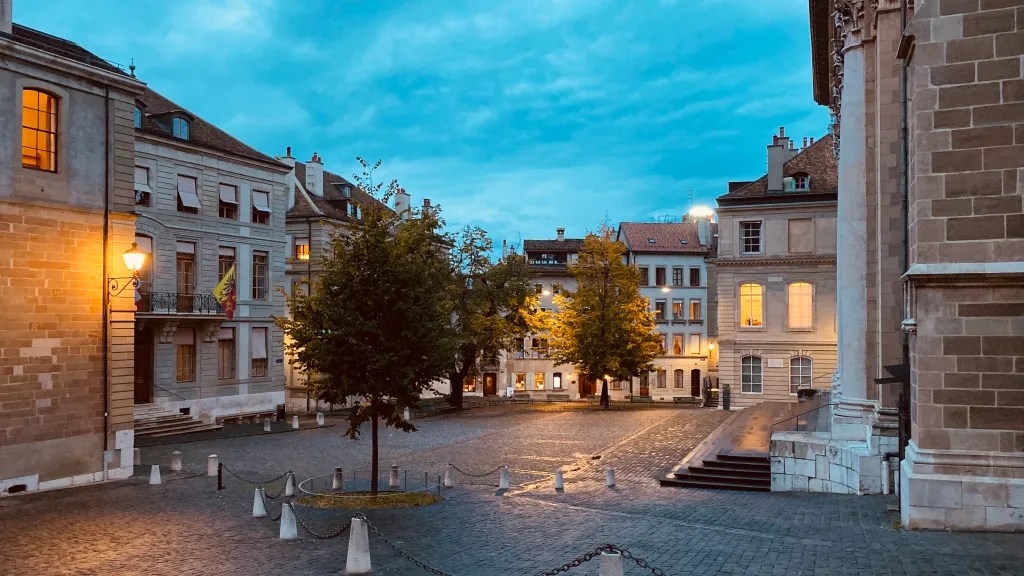
Climbing into the Haute-Ville, the medieval and Renaissance upper city, the streets were cobbled and quiet. Place du Bourg-de-Four, the oldest square in Geneva, was nearly still. At its center, a carousel — small, exquisitely made, lit from within like a jeweled music box enlarged to human scale — turned slowly. It was a Friday night. The historic center was buttoned up. After the animated streets of Valencia and Barcelona, the quiet felt almost cinematic: every surface clean, every lamppost lit, the atmosphere composed rather than inhabited.


Cathédrale Saint-Pierre stood at the top of Cour de Saint-Pierre, its original medieval façade replaced by a Neoclassical portico in the 18th century. A Classical face grafted onto a Gothic body — incongruous anywhere else, but here it felt characteristically Swiss: a rational solution to an untidy earlier problem, the medieval deemed insufficient and replaced with something more orderly. That the result is genuinely beautiful is almost beside the point. The impulse toward precision is the thing.


For dinner, I had wanted Les Armures, a hotel restaurant set in a 17th-century building just off the old town. Reservations, it became clear, were not optional in Geneva on a Friday evening. The maître d’ at Les Armures tried genuinely and apologized that four seats were not available. Merci, quand même.


Around the corner at the Hôtel-de-Ville, I tried again in French and was luckier — ushered through a corridor and upstairs to a table in a vacant room beside a window overlooking the artillery museum colonnade. Overflow seating for the reservation-less. Our waiter was engaged in an ongoing private monologue that no one attempted to interrupt.
The fondue was moitié-moitié — half Gruyère, half Vacherin Fribourgeois, served in a ceramic crock with sliced baguette, the cheese bubbling at exactly the temperature it should. A Salade Genevoise with caramelized lardons, croutons, and a soft-boiled egg. A glass of Rhône Valley wine. Simple, fresh, well-prepared — and, by Geneva’s standards, modestly priced. The ingredients were doing the work without assistance.


One evening in Geneva is not a basis for conclusions. What it offered was a mood: orderly without being cold, beautiful without performing it, quiet in a way that felt chosen rather than empty. A city that appears to have decided, at some point, that discretion is its own form of elegance. We left the next morning, the train tracing the edge of Lac Léman before climbing into the Alps toward Milan — where we transferred for Florence — and the transition was, appropriately, seamless.
Continue to Florence → • Return to Barcelona →
Join The Inspired Lens → for European travel guides.