
Somewhere between Valencia and Barcelona, my phone rang a few times. I let it go. But it wasn’t the routine coordination I had assumed.
We had spent ten days in Valencia in 2019 — Cole playing in an international tournament, Caden at the age threshold where he assisted their coach rather than played (other teams had not been as scrupulous about their rosters), Aaron and I discovering a city we immediately loved — before boarding the train north to Barcelona at Estació del Nord on the morning of October 14.
The station that morning was more hectic than the relaxed Valencia rhythm we had come to know — cafés con leche, unhurried strolls, uncrowded metro rides. The light rain and the long queue at the platform were the first signals that something had shifted.
Our train sat for an hour without explanation. Having found the trains reliably efficient during our Northwestern Europe trip the year before, we chalked it up to Spanish scheduling and settled in for the ride north. The Mediterranean rolled by unhurried outside the window: three and a half hours along the coast, aqua inlets and golden palm-lined beaches racing past as the train darted through tunnels cut into the rugged coastal cliffs. The host kept calling. Without international coverage on the train, I let it go.
Pulling into Barcelona-Sants, we understood. Armed police stood on the platforms. The station outside was full of commotion, people moving with the particular purposefulness of a city in the middle of something. We called the host. That morning, nine Catalan leaders who had initiated an independence referendum two years earlier had been sentenced to prison terms of up to thirteen years. The airport was shut down. Roads were barricaded. He had been calling to warn us that taxis were impossible and that the metro would be crazy but was our only option.
He was an Argentine who had moved to Barcelona seven years earlier, escaping his own country’s political turmoil. He had not, as it turned out, escaped it entirely.
We rolled our carry-on bags to the metro entrance, grateful as always that we travel light. The tunnel was hot. The ticket machine rejected two cards before accepting the third. The train arrived full — two people exited, the rest of us compressed further to make space. As the doors closed, a woman threw herself between the carriage and the platform, face pressed against the glass, and spent the next two stops addressing the entire car in Catalan at considerable volume. No one had a millimeter to spare. A man across the carriage directed her somewhere useful. She departed at the next stop. Agitation was in the air and it was not hers alone.
Three stops to Diagonal. Street level, fresh air, l’Eixample. Our apartment on Carrer del Rosselló was a few minutes’ walk — two balconies overlooking the tree-lined street between two ramblas, a short block from Passeig de Gràcia. We were, we would discover, directly central to the protests.


El Mercader
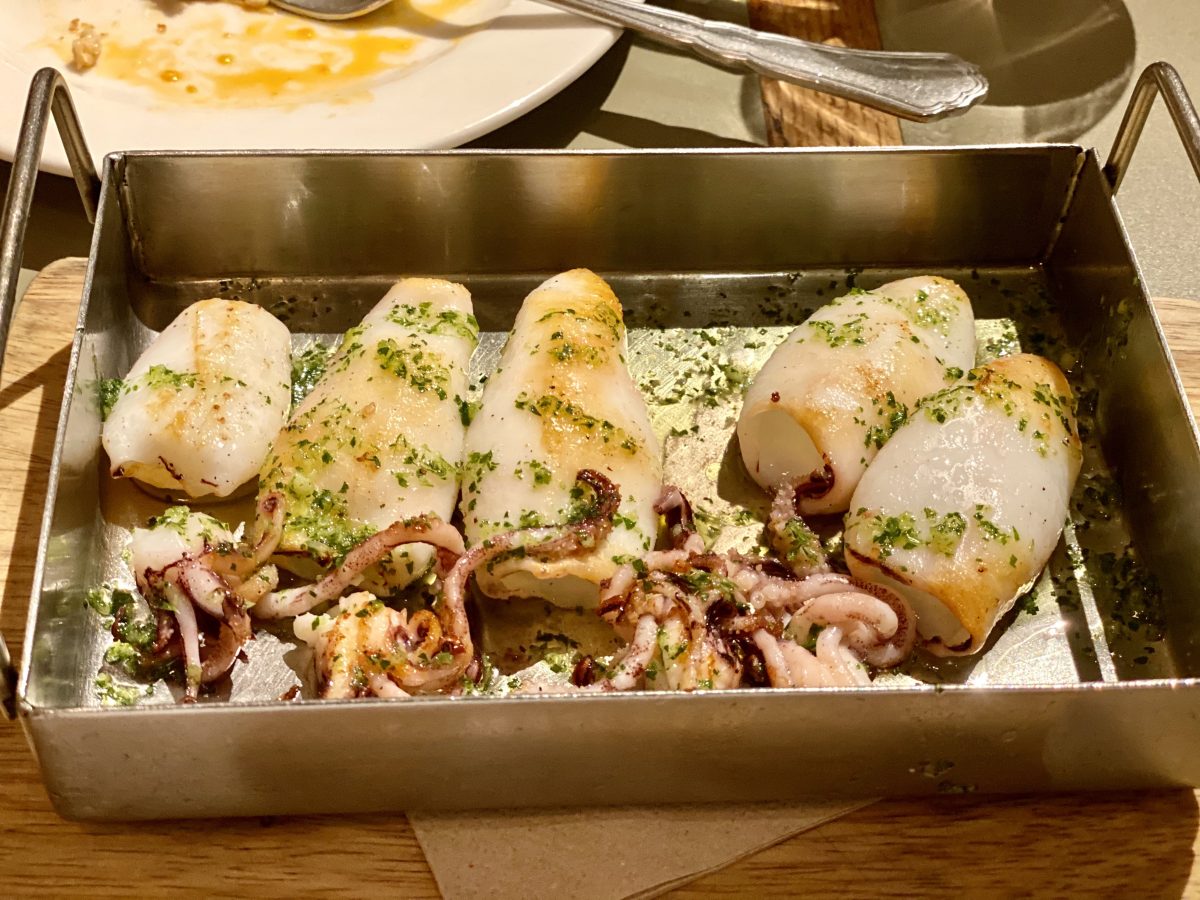
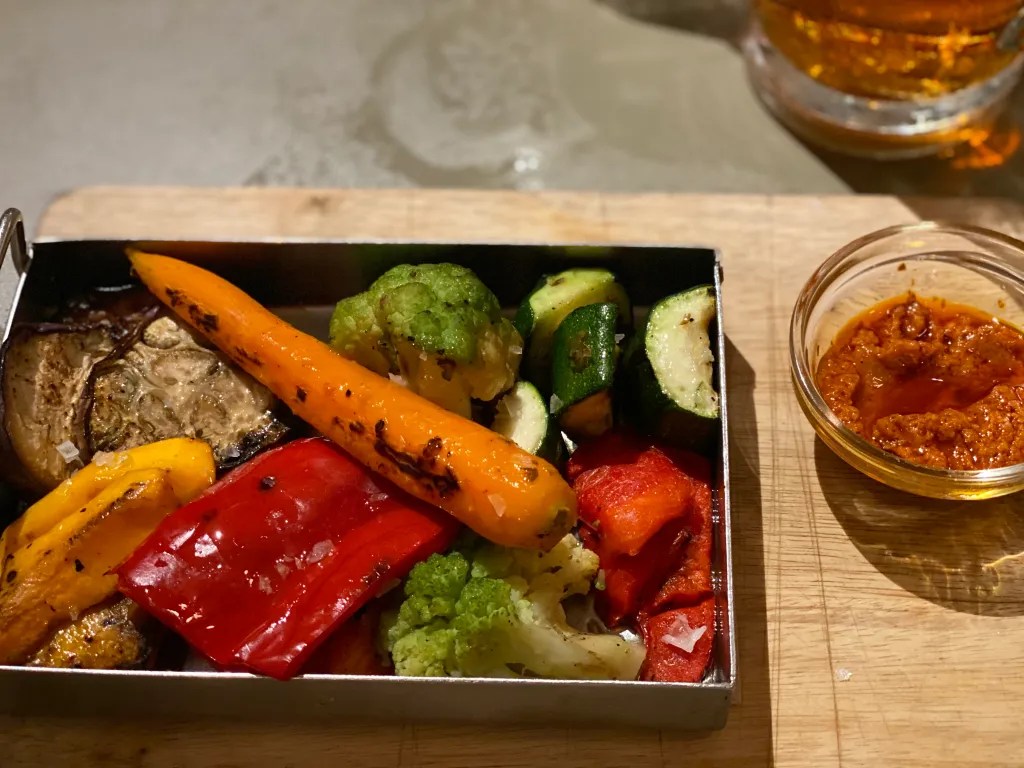
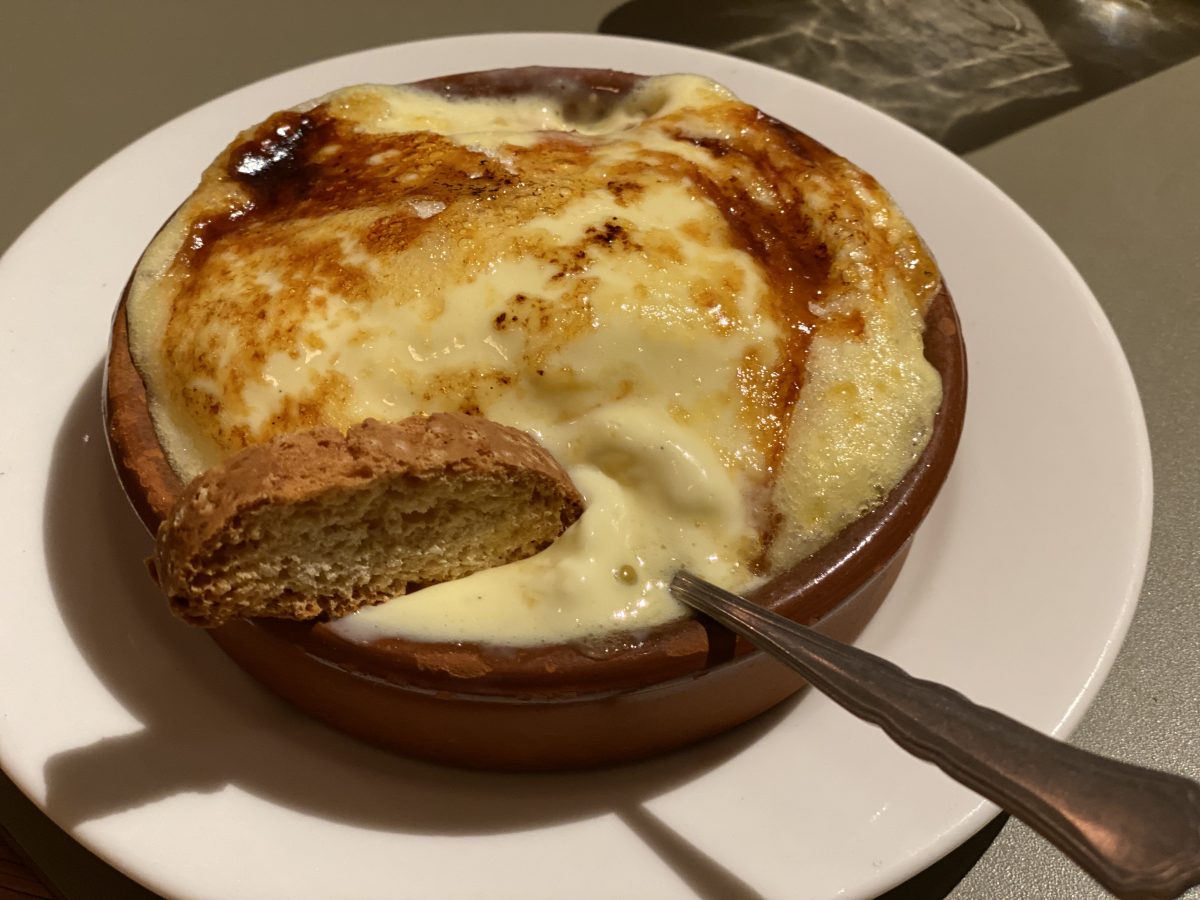
The boys were hungry — we had been traveling since morning and dinner in Spain begins at nine, which is several hours past the American threshold. We headed out into the early evening, the streets quieter than they should have been without traffic, and found El Mercader. What followed was one of the most memorable meals of the trip: a layered grilled eggplant starter, then cannelloni a la Barcelona — more crepe than pasta, the way Barcelona makes it — grilled vegetables with salvitxada, the spicy tomato and almond sauce from the Costa Daurada, tender baby squid with garlic and parsley, and a crema catalana at the close that remains the finest I have tasted. The custard, the thin caramelized crust, the proportion of everything. I think about it still.

Walking back along Passeig de Gràcia after dinner, the grand boulevard was eerie without its traffic. At the Diagonal plaza, people had gathered — many wrapped in the Estelada, the Catalan independence flag: the senyera, Valencia and Catalonia’s four red stripes on gold, with the addition of a blue triangle and white star at the hoist. They were chanting, and the chanting was not calm. We didn’t feel threatened — this was not directed at us — but we returned to the apartment. Getting to sleep proved difficult. People marched through the street below. Explosions went off in the pavement. We closed the shutters.


The City by Day
The next morning, street cleaners and reporters. Barcelona carried on.
We returned to Casa Milà — La Pedrera — in the daylight, Gaudí’s undulating stone facade on Passeig de Gràcia making its argument about what a building could be. Then to the FC Barcelona store, then to La Sagrada Família on our scheduled entry time.
Photographs had suggested the experience but could never have prepared me for standing beneath its immense height — the soaring columns branching overhead into an organic web of star-like vaulted forms, colorful light bouncing off the sculpted surfaces as it came through the enormous stained glass. The whole space something between a forest and a cathedral, occupying a category Gaudí invented for it alone.


In the adjacent Plaça de Gaudí, the cathedral’s spires reflected off the pond. Nearby, a group of older men were playing a game I didn’t recognize until one explained it: bitlles — pronounced “bityes” — a traditional Catalan bowling game played with pins rather than a ball, thrown to knock down a cluster of six. Catalan identity finds its expression in the everyday as much as in the monumental: in a game in a park on a Tuesday morning as much as in Gaudí’s modernisme, the early 20th-century movement that made Barcelona’s architecture unlike any other city’s.


Gaudí’s influence ran through the city. In the Eixample grid — Cerdà’s rational 19th-century plan for Barcelona’s expansion — the Gaudí buildings stood as arguments against rationalism: Casa Batlló, with its scaly ceramic facade and skeletal interior; La Pedrera, its rooftop of chimney stacks disguised as warriors; the Sagrada Família, still under construction after over a hundred years. An identity expressed in stone and tile that belonged to Barcelona and to nowhere else.


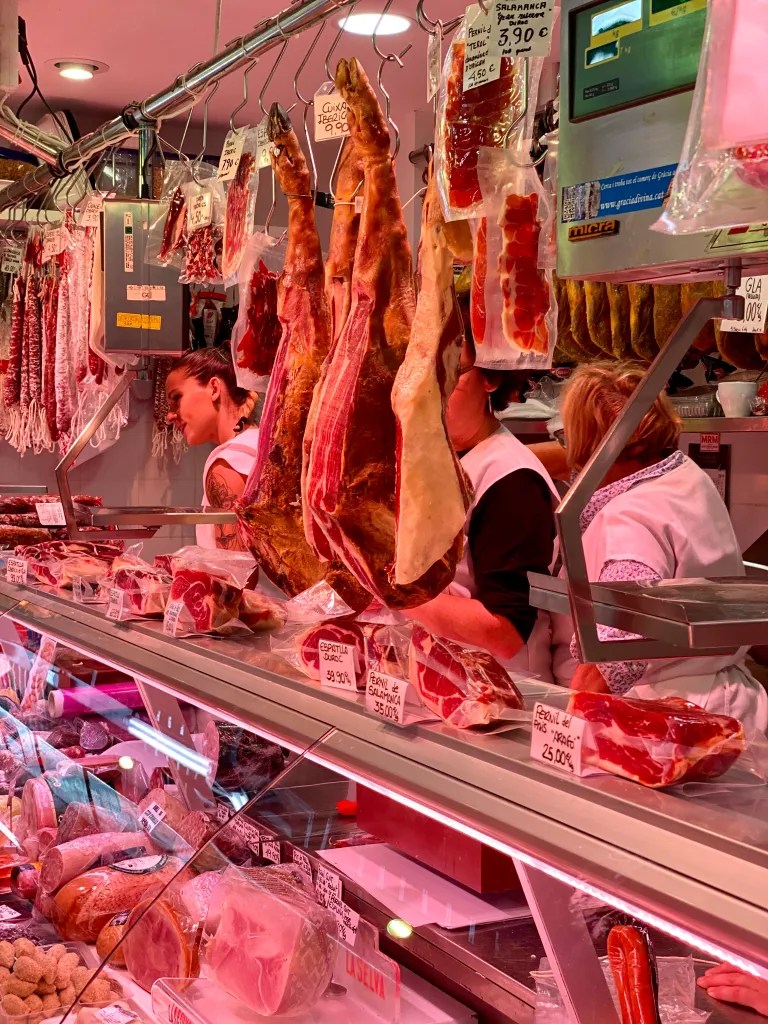
In Vila de Gràcia we found Mercat de l’Abaceria: produce bursting with color, jamón legs hanging from their ankles beside ropes of cured sausage, eggs sitting at room temperature as they do throughout Europe — unrefrigerated because unwashed, the protective bloom intact, entirely safe and shelf-stable for months. The prices were what farmers’ markets in the US might charge if farmers’ markets in the US were organized for people rather than as events.


At Camp Nou the boys stood outside and took it in without needing the tour. This was the 2019 dream squad — Messi, Jordi Alba, Piqué, Sergio Roberto, Busquets. At the entrance, Johan Cruyff’s statue stopped us longer than the stadium itself.


Cruyff had shaped not just the footwork and style of FC Barcelona but the philosophy of technical football development that the boys had grown up training under at their home club. It was also the tradition that had taken them to the Ajax camp in The Netherlands the summer before — Ajax being the club where Cruyff himself had learned and where the philosophy had its roots. Most American youth programs still approach the game physically — the ball a thing to be fought for rather than read. The Dutch total football tradition, transmitted through Cruyff to Barcelona and outward from there, is what their coaches had taught them to aspire to instead.
Ciutat Vella
From Plaça de Catalunya we walked La Rambla south into Barri Gòtic — Barcelona being one of those cities that genuinely organizes itself around the pedestrian, the rambla not a street with sidewalks but a boulevard where walking is the point. Street vendors worked the rambla and the metro simultaneously, bouncing between districts with their gathered tarp-rucksacks of trinkets; we spotted the same man at three different locations across the city. Somewhere along the way Caden realized his small wallet had gone missing — it contained only his school ID, which was presumably less useful to its new owner than anticipated.

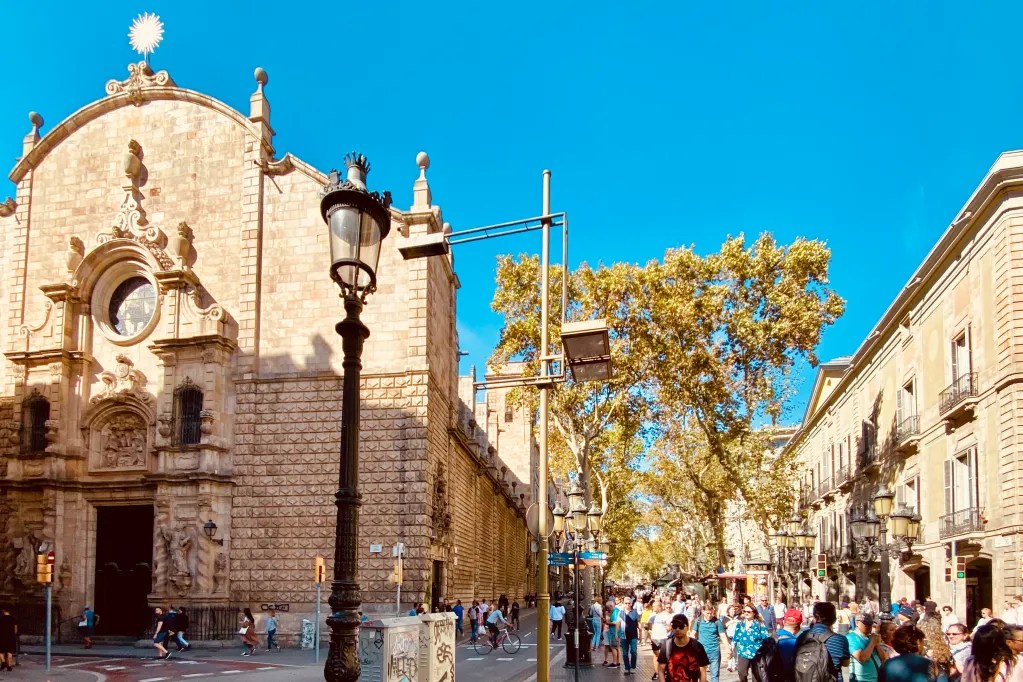

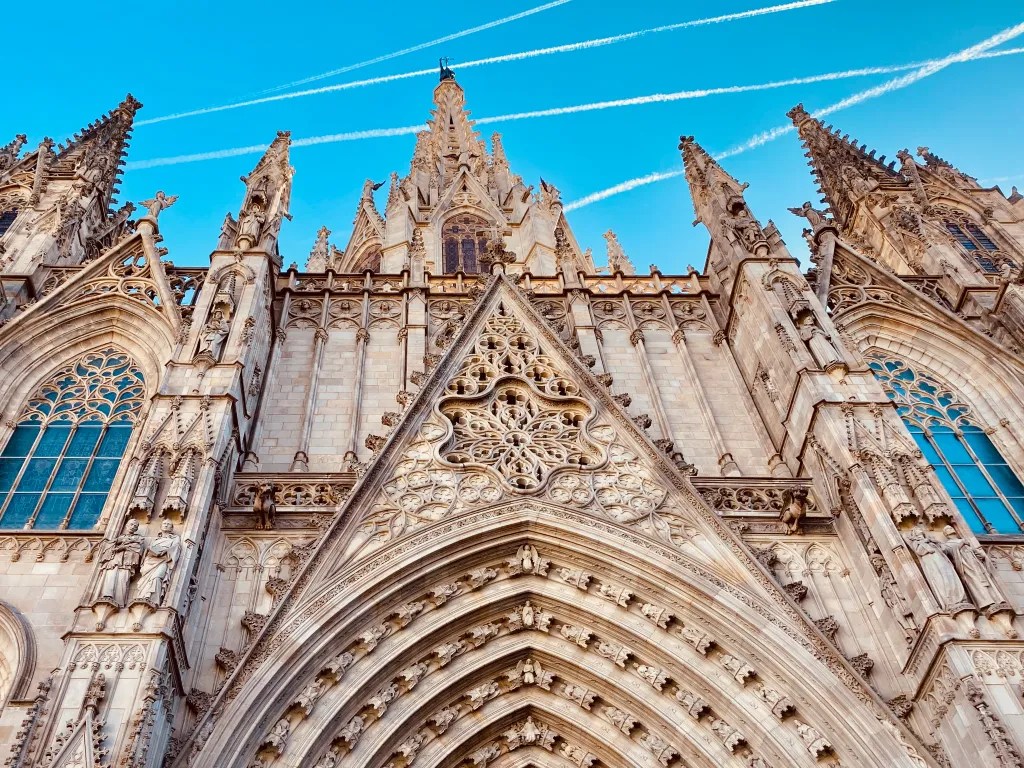
Outside the Gothic Cathedral, I heard her before I saw her: a young woman playing a steel-tongue drum — a handpan, I learned later, its circular array of dimpled tone fields hammered into the metal. The sound was warm, resonant, and meditative, rising into the stone tracery of the cathedral facade with an ease that suggested the building had been waiting for exactly that frequency.



La Boqueria was crowded in the way of a market that has become too famous — the place to arrive early for a seat at the counter, to navigate before the tourist pressure builds to the point where it defeats the purpose. Beautiful produce, open-air steel trellises, the full Mediterranean abundance of a coastal market. Worth it still.
We continued to El Raval for lunch at Suculent. The presentation was as considered as the food: cutlery resting on handmade branded earthenware, embossed side plates. Paté and croquetas served on a honed rough-hewn wood slab. Grilled squid in saffron sauce. Steak tartare served on the marrow of a grilled bone sitting on a bed of evergreen sprigs. The kind of meal where the environment and the food are making the same argument about what matters, and both are correct.


From El Raval through Poble-Sec to Montjuïc [mon-zhweek]: the Plaça de la Cascades flowing from the National Art Museum of Catalonia down to Font Màgica, then along the boulevard to Font de la Plaça d’Espanya, the view continuing all the way to the Temple of the Sacred Heart of Jesus on the hilltop far beyond. We walked the full Olympic Complex as the fountains shut off for the night.


Park Güell and La Ribera
The following morning we arrived at Park Güell [gway] before dawn — free entry before opening, the city still dark below us, the horizon beginning to shift from deep orange to pink over the Mediterranean.
As the light came up the mosaics began to reveal their color: the serpentine bench on the main terrace, the columns of the hypostyle hall, the ceramic fragments forming patterns that reward close attention as much as the panoramic view. Then the selfie sticks arrived — their wielders throwing themselves bodily over the sculptures for the shot, the mosaics reduced to backdrop. The window for photography without them in the frame closed decisively. We left.


Across the medieval center to La Ribera. Near Santa Maria del Mar — the 14th-century Gothic church built by the people of the Ribera quarter, stone by stone, as a collective act of faith — we stopped at El Chigre for la hora de vermut. My vermouth arrived with a plate of cured fresh anchovies and olives, the combination exactly right. Then down the quieter streets of El Born — iron rails around shallow balconies, shutters open around French doors above the plazas, tapas bars opening for the afternoon.


Then Barceloneta Beach — crossing the golden sand to the pebbly shore where the cool Mediterranean washed over our feet, the return along the promenade past the marina and its super yachts and sailboats.


The Protests and the Nights
Each evening the demonstrations grew. What began convivially by day — almost festive, groups marching with flags and chanting their message through the Eixample streets — escalated later into the night as a smaller contingent chose confrontation over procession. Bonfires were lit as barricades. Police responded. Glass broke. Those who had come peacefully argued with those who had not, understanding correctly that the spectacle was undermining the message.
The media, of course, focused on the confrontation rather than the more considered argument it was disrupting — a tendency we recognize at home, where fear-based narratives hold attention more reliably than facts, and the loudest moment in a complex story becomes the story itself.
From our balcony we watched it unfold below on the second night — a helicopter overhead, police lights at the corner, the deep burn mark on the pavement below us the following morning, left by whatever had exploded there. Our teenage boys, impressionable and attentive, watched and asked questions. We had not planned this part of the education. It turned out to be the most instructive week of the trip.
We were not the target of any of it. The Catalan conflict was between a culture insisting on being recognized and a state insisting on its authority — a negotiation with a very long history and no clean resolution in sight. We felt welcomed throughout.
The imprisoned leaders had organized peacefully. Their thirteen-year sentences had arrived anyway. The people who filled the streets each night were responding to that fact as their conscience directed them, each by their own calculus of what was necessary and what was appropriate. We watched without judgment, trying to understand what we were seeing.


The Departure
We packed to leave on the fourth morning. Our train from Sants was cancelled — the protests had disrupted rail schedules as they had disrupted everything else on the day we arrived. We rebooked for the next one, lost most of our planned time in Montpellier to the delay, managed a brief walk outside Saint-Roch before our connections through Lyon to Geneva.
The same city that had made it difficult to enter made it difficult to leave. It felt consistent.
Nearly two years later — and a global pandemic in between — we returned to Catalonia, briefer than we had planned before continuing on to explore more of the region. In Girona, we would stand in Plaça del Vi on the night of Sant Joan and watch a city celebrate its Catalan identity with fire and music — the same flags, the same language, the same fierce sense of a culture that intends to persist. The contrast between the two moments was the clearest thing we had learned about Catalonia: a people that knows how to grieve what it has lost and celebrate what it refuses to surrender.
Continue to Geneva → • Florence → • Return to Valencia →
Barcelona connects to the Iberia Atlas. Read about Girona and La Nit de Sant Joan, where Catalan pride took a different form →