
California’s South Cascade Range
Lush forests surround the southerly volcanoes that dot the Cascade Range. Explore its caves and waterfalls. Hike and bike trails around reservoirs and natural lakes, while rivers and streams offer rafting and fishing.
For thousands of years, natives such as the Karuk, Shasta, Wintu, and Modoc tribes coexisted and cared for the land in this region. They had no conception of seizing and owning land or of exploiting resources and people. Colonization deteriorated this human harmony with nature as natives were swept away along with their wisdom.
During the Gold Rush, “boomtowns” cropped up as people flooded the area in search of personal wealth. They claimed land, established towns and boundaries. But in the late 1800s, the new residents felt ignored by their government, a sentiment that persisted into the future.
Feeling seriously neglected by their respective state governments, citizens proposed a new State of Jefferson in a secession movement of counties along the Oregon and California border. Though just three days after the inaugural celebration in 1941, the bombing of Pearl Harbor put a halt to the notion. As citizens turned their attention to the far more pressing matter of protecting their country and roads were built to access resources, the idea of this separate state simply faded.
The movement has since gained cultural traction in the following decades. For most, its a romantic notion of regional pride in its great natural beauty and its uniqueness; for some, it’s tribalism, a political movement by a disparate group wanting to disconnect from the interference of oppressive government—though ironically to create a new one.
Ultimately, the borders are not what are important, but rather, the preservation of this region’s great natural beauty and the inclusion of its diverse community, however small its numbers. As for the natives, they too persevere and radiate their ancestral insight.
Cascade Range Counties
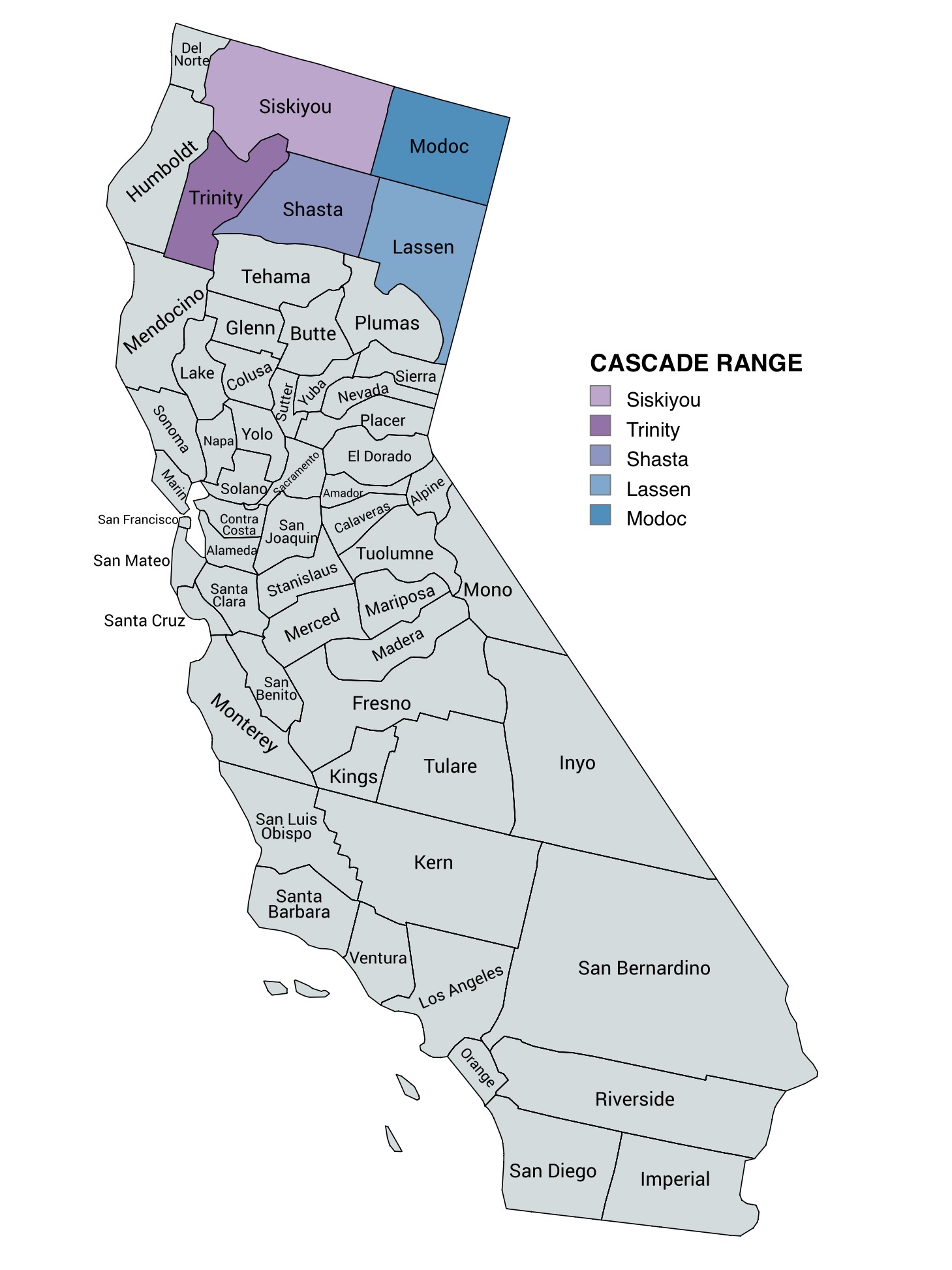
SISKIYOU COUNTY
Mount Shasta
Siskiyou County
County Seat: Yreka
- Mountain Shasta
- Volcanic spires and caves
- Waterfalls, lakes, and etlands
- Valley farmland
TRINITY COUNTY
Trinity River
Photo courtesy Visit California
Trinity County
County Seat: Weaverville
- Mountain forests
- Lakes and rivers
SHASTA COUNTY
Lassen Volcanic Hot Springs
Photo by Adrián Valverde on Unsplash
Shasta County
County Seat: Redding
- Shasta Lake and Caverns
- Mount Lassen
- Volcanic hot springs
- Rivers, lakes and waterfalls
LASSEN COUNTY
Susanville Ranch Park
Photo by Deanna Lewis on Unsplash
Lassen County
County Seat: Susanville
- Volcanic cinder cones and buttes
- Lakes
- Great Basin
MODOC COUNTY
Modoc County
Photo by Visit California
Modoc County
County Seat: Alturas
- Modoc National Forest
- Hot springs
- Lakes and wetlands
- Petroglyphs
Read More
All About California

Yosemite Spring
After California’s wettest winter on record, Yosemite Valley ran louder than usual — every fall at full volume, granite walls disappearing into mist, a rainbow waiting at the end of it. A spring trip through rain, the Ahwahnee’s fireplaces, and a detour to a fig-tree kitchen in Gold Rush country.

Mission San Juan Capistrano and the Pattern That Built a Coast
San Juan Capistrano holds the ruins of the Great Stone Church alongside the state’s oldest building still in use — a single site where the mission system’s architectural formula, and its human cost, are both fully legible. The same quadrangle logic repeats from Sonoma to Santa Barbara, and echoes once more, without the mission itself,…

Hearst Castle: The Discipline Behind the Excess
Hearst Castle is 165 rooms of Spanish Colonial, Moorish, Gothic, and Neoclassical detail, built over 28 years by the same architect who designed two buildings I’ve walked past my whole adult life in Sacramento. A family stop along the PCH, and a quieter return fourteen years later.