
Deep South
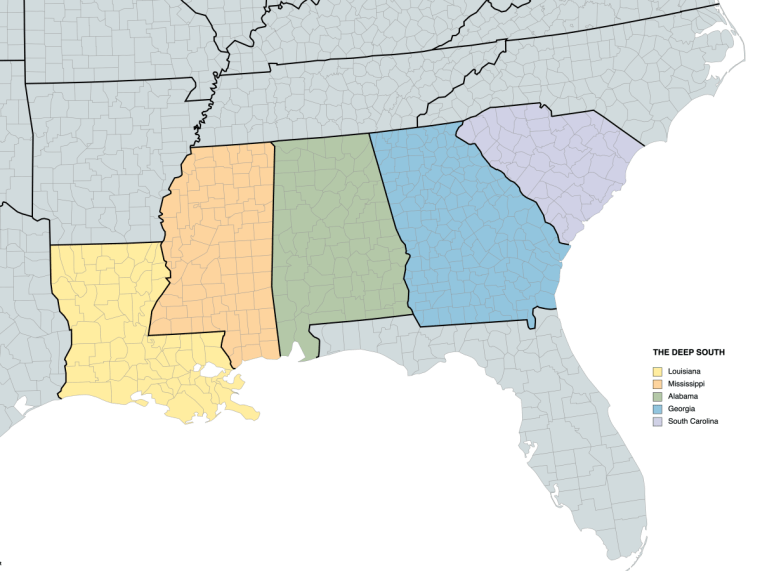
Louisiana • Mississippi • Alabama • Georgia • South Carolina
The history that built the wealth, and what came after
The Deep South’s economy in the early nineteenth century depended more heavily on enslaved labor than any other region in the country — vast plantations producing cotton, rice, indigo, and sugar for a global market, and a regional wealth built directly on that system. The Civil War, and the system’s end, struck this region hardest of all; the decades of decline that followed are still legible in the built environment, in the gap between antebellum grandeur and the industrial and agricultural towns that came after.
What the region became, in the century and a half since, is something the plantation-era story doesn’t fully predict: a place of extraordinary cultural production — music, food, language, craft — much of it originating with the same communities the plantation economy was built to exploit.
Jazz, blues, gospel, and the entire vocabulary of American vernacular music trace back to this region. Creole and Cajun culture in Louisiana, Gullah Geechee culture along the Carolina and Georgia coast, and the foodways that resulted from all of it — gumbo, barbecue, shrimp and grits, biscuits — represent one of the most significant cultural contributions of any American region to the wider world.
Geographically, the Deep South runs from Louisiana’s Gulf Coast — once a French colony, as was Mississippi across the river — east along the Gulf through Alabama, then north and east to Georgia and South Carolina, two of the original British colonies, facing the Atlantic. Each state reckons with its history differently, but none of them have stopped reckoning with it, and that ongoing negotiation between memory and reinvention is, in its way, the region’s defining character.
Charleston + Columbia (state capital) + Beaufort + Hilton Head & Myrtle Beach
Atlanta (state capital) + Savannah + Athens + Augusta
Montgomery (state capital) + Huntsville + Birmingham + Mobile + Tuscaloosa (Bama University)
Oxford (Ole Miss University) + Jackson (state capital) + Natchez + the Delta
New Orleans + Baton Rouge (state capital) + the Bayou
SOUTH CAROLINA
Palmetto Palms and Antebellum Charm — Charleston
South Carolina
Low Country grandeur, a college town, and a coastline that’s seen everything
Columbia is the capital, but Charleston is where South Carolina’s identity concentrates most completely. Named for England’s King Charles II, the city was once the largest slave port in North America — a fact the city does not hide, even as it celebrates the architecture that wealth produced: pastel stucco and brick facades south of Broad Street, grand porticos, white column-lined piazzas built to catch the harbor breeze, wrought-iron gates closing off the walled gardens of the French Quarter. The Battery and the antebellum mansions along East Bay Street have looked out over Charleston Harbor since before the country existed in its current form. The Civil War’s first shots were fired a few miles offshore, at Fort Sumter.
Columbia carries a different register — state capital and college town simultaneously, the domed State House visible from the same streets as the University of South Carolina’s bars and restaurants. The university’s Horseshoe, an 1801 oval green flanked by Federal-style buildings, is enclosed by a brick perimeter wall built during the Civil War — the wall is the reason the buildings survived burning. USC’s Darla Moore School of Business runs the country’s highest-ranked Sports Management program, training students who go on to staff Olympic Games and major league front offices.
Along the coast, Beaufort preserves an Old South character with less tourist infrastructure than Charleston; Hilton Head and Myrtle Beach are the state’s resort towns. The Gullah Geechee people, descended from enslaved West and Central Africans, maintained a distinct Creole language and culture along the Sea Islands due to relative isolation during and after slavery — their basketweaving, rice cultivation, and oral storytelling traditions are a direct, living connection to West African heritage rare elsewhere in the country.
Ways to Navigate South Carolina
Charleston (the Battery, French Quarter, antebellum East Bay Street, Fort Sumter) • Columbia (state capital, USC’s Horseshoe, the State House) • Beaufort (Old South character, Gullah Geechee heritage) • Hilton Head & Myrtle Beach (Atlantic coast resort towns)
Food: shrimp and grits, she-crab soup, biscuits, Lowcountry rice cuisine
Signature Moments
- Charleston by carriage, clopping south through the streets below Broad: estate after estate with shuttered windows and deep piazza porches, the layered color of a city that has been painting over itself for three centuries.
- The Battery’s harbor promenade at sunset, the light over the Cooper River doing what the architecture spends all day setting up.
- USC’s Horseshoe on a clear afternoon — the brick perimeter wall, the Federal-style colleges, a campus that has had time to think carefully about itself.
GEORGIA
Georgia state capitol — Atlanta
Georgia
Upcountry and low country, plantation roots and a city reinventing itself
Founded as a British colony and named for King George II, Georgia was one of the original thirteen states. Its coastal lowlands prospered through enslaved labor on rice, cotton, tobacco, and indigo plantations; poor farmers without enslaved labor moved inland into the southern Appalachian foothills, becoming known as the Upcountry Folk — a class and geographic divide that still shapes the state’s internal character.
Savannah, founded in 1733 as the capital of British Georgia, sits in the coastal Low Country — moss-draped oaks, magnolias, a city that has preserved its plantation-era architecture more completely than most.
Atlanta, the modern capital and largest city, represents the opposite instinct: international hub, one of the world’s busiest airports, a city actively building toward its future rather than preserving its past. Centennial Olympic Park, built for the 1996 Games, anchors a cluster of contemporary institutions — the Georgia Aquarium, the National Center for Civil and Human Rights — alongside the global media presence of CNN.
Athens, home to the University of Georgia since 1785, sits apart from both registers entirely — a campus town that reads as a haven grown up among its own trees rather than a continuation of the surrounding corridor. The town has also produced an unlikely musical legacy — the B-52s and R.E.M. both formed here.
The UGA campus enters through a historic iron gate on College Avenue, past the Holmes-Hunter Academic Building, named for Charlayne Hunter and Hamilton Holmes, the first Black students admitted in 1961 under court order, who arrived to protests and went on to distinguished careers; the building honoring them is the most architecturally prominent on the original campus. Red brick and white trim hold the 760-acre campus together as a matter of deliberate policy, sustained across two centuries of construction.
Ways to Navigate Georgia
Atlanta (state capital, Centennial Olympic Park, Georgia State Capitol) • Savannah (Low Country, colonial-era architecture, coastal moss-draped squares) • Athens (University of Georgia, historic campus gates) • Augusta (golf heritage)
Food: peaches, boiled peanuts, grits, cornbread, fried chicken, Vidalia onions, pecan pie
Signature Moments
- Standing at UGA’s campus bell — a modest white trussed tower behind the chapel — watching a student ring it, a tradition with roots in an 1894 football victory still observed without irony.
- The drive on Highway 78 between Columbia and Athens, the road narrowing through small towns where the landscape feels suspended somewhere around the Confederacy — dense, quiet forest holding the weight of the region’s history in a way the cultivated streets of Charleston don’t quite convey.
- Atlanta’s Centennial Olympic Park at the edge of Pemberton Place, the World of Coca-Cola and the Georgia Aquarium at one end, the National Center for Civil and Human Rights at the other — a different register of the city entirely from what surrounds it.
ALABAMA
University of Alabama’s Gorgas House — Tuscaloosa
Alabama
Steel, space, and a campus that survived its own burning
Montgomery, the state capital, briefly served as the capital of the Confederacy and was later a center of the civil rights movement — two chapters of the same long argument about who the state belongs to. Birmingham, founded after the Civil War as an industrial city, became the state’s second-largest through steel production; Huntsville, in the lower Appalachians, became a hub for space exploration and solar research. Mobile, the state’s smaller Gulf Coast city, has held Mardi Gras traditions since 1703 — predating New Orleans’ version by over a century, and the city is sometimes credited as gumbo’s birthplace during French colonization.
Tuscaloosa, home to the University of Alabama since 1831, carries its history more dramatically than most Southern campuses. Confederate troops burned most of the original campus in 1865; the Gorgas House is the only building that survived. The campus rebuilt in layers that remain simultaneously visible today — the few surviving antebellum structures, Victorian Gothic red brick from the postwar restoration, and an early-twentieth-century Neoclassical expansion that now defines the visual identity most visitors associate with the school. Denny Chimes, a 115-foot Art Deco bell tower, marks the campus’s central axis. The President’s Mansion is said to have been saved when Louisa Garland stood between it and advancing Union soldiers; it remains the president’s residence today, with no building named for her.
Birmingham’s two civic monuments sit in instructive contrast. Vulcan, atop Red Mountain, is the largest cast-iron statue in the world — built from Alabama ore for the 1904 St. Louis World’s Fair, a Roman god of the forge standing in for the city’s industrial ambition. Below it, the Sloss Furnaces operated from 1882 to 1971 and survive as a National Historic Landmark, their blast furnaces, casting shed, and ore bridges making the scale of the city’s industrial period physically present in a way the statue above only gestures toward.
Ways to Navigate Alabama
Montgomery (state capital, civil rights history) • Birmingham (Vulcan Park, Sloss Furnaces, industrial heritage) • Tuscaloosa (University of Alabama, the Quad’s layered architecture) • Huntsville (space exploration hub) • Mobile (Gulf Coast, Mardi Gras tradition since 1703)
Food: barbecue (pulled pork and ribs), Gulf shrimp and oysters, white BBQ sauce, fried green tomatoes, banana pudding, pecan pie
Signature Moments
- The University of Alabama’s Quad on a clear, storm-scrubbed afternoon: antebellum survivors, Victorian Gothic reconstruction, and Art Deco intervention all visible from the same patch of grass, the layering more dramatic here than almost anywhere else in the region.
- Standing at the base of Vulcan on Red Mountain, the cast-iron god of the forge looking out over a city literally built from the ore beneath his feet.
- The Sloss Furnaces’ blast furnaces and ore bridges at close range — industrial architecture at a scale that makes Birmingham’s steel-era ambition legible without a single word of explanation needed.
MISSISSIPPI
Mississippi Bayou
Photo by Jp Valery on Unsplash
Mississippi
The river, the Delta, and the blues it produced
Named for the river along its western border, Mississippi takes its identity from water and from what grew along it — cotton wealth built on enslaved labor in the early nineteenth century, followed by one of the steepest postwar declines of any state in the region. Jackson is the capital; Oxford, home to the University of Mississippi since 1848, carries a literary identity (William Faulkner’s home, Rowan Oak, sits just outside town) alongside its football culture.
Natchez, founded by the French in 1716, is preserved today as a National Historic Park whose grounds document the full arc of the state’s history in one place — colonialism, the cotton economy, slavery, and the civil rights struggles that followed. The Mississippi Delta, the flat alluvial plain along the river’s edge, is also the acknowledged birthplace of the blues — a musical tradition that grew directly out of the work songs and spirituals of the enslaved and sharecropping communities who worked that land, and that would go on to shape nearly every form of American popular music that followed.
Ways to Navigate Mississippi
Jackson (state capital) • Oxford (University of Mississippi, Rowan Oak) • Natchez (National Historic Park, antebellum history) • The Mississippi Delta (birthplace of the blues) • Gulf Coast beaches
LOUISIANA
City Park — New Orleans
Photo by Susan Q Yin on Unsplash
Louisiana
French, Spanish, African, and Native — and still distinctly its own
Baton Rouge is the capital, but New Orleans carries the state’s identity. Originally a French colony named for King Louis XIV, Louisiana’s culture is the product of layered colonization — French, then Spanish, then French again, then American — overlaid on Native American and West African foundations that never disappeared.
Creole culture (mixed African and European descent) and Cajun culture (descendants of French-Acadian exiles displaced from Nova Scotia in the eighteenth century) each carry distinct languages, music, and cuisine: crawfish étouffée, jambalaya, gumbo, beignets.
By 1840, Louisiana held the largest enslaved population of any state; by 1860, it also held the largest free Black population in the country — a contradiction specific to New Orleans’ particular colonial and economic history. Hurricane Katrina devastated roughly eighty percent of New Orleans in 2005; the historic French Quarter, nearly three hundred years old, has been largely rebuilt and remains the city’s tourism anchor, especially during Mardi Gras, the pre-Lenten carnival the city treats as something closer to religious observance than festival.
Ways to Navigate Louisiana
New Orleans (French Quarter, Creole and Cajun culture, Mardi Gras) • Baton Rouge (state capital) • The Bayou (Mississippi Delta marshlands, Cajun country)
Food: crawfish étouffée, jambalaya, gumbo, beignets
Continue the Journey
The Deep South holds the country’s heaviest history alongside some of its richest cultural inheritance — neither fully explains the region without the other.
- Explore the United States in The Atlas →
- Discover stories in The Lens →
- Design your journey through the United States →
Go deeper: Join The Inspired Lens for early guide access →
Read More
All About the Deep South

The American South: Three States, Three Campuses, One Tornado
The American South carries a history that shouldn’t be forgotten. It happened. We can’t erase it. What we can do is preserve the beauty it left behind and learn from its heavier lessons — so as not to repeat them. We flew into a frozen Denver in February 2022, the four of us meeting at…