
- |
- The Atlas
- |
- Europe
- |
- Italian Peninsula & Malta
- |
- Italy
- |
- Tuscany
- |
- Florence
Firenze — The Cradle of the Renaissance
Florence isn’t grand in scale — but it is exacting in composition.
Set within the Arno Valley and held gently by surrounding hills, the city feels intentionally placed. Nothing here is accidental. Streets align, views terminate, proportions hold. Even the skyline—anchored by the Duomo — feels calibrated rather than grown.
This is where the Renaissance took form — not just as a period, but as a shift in how people saw the world. Art, architecture, and human perspective realigned here, supported by patronage, craft, and an unusual concentration of wealth and intellect.
Florence doesn’t overwhelm like Rome — it doesn’t sprawl or compete at scale.
It overwhelms differently. It concentrates.
At certain hours, the historic center compresses. Around the Duomo and the Ponte Vecchio, waves of visitors narrow movement and intensify the experience. The city tightens. Beauty and crowds occupy the same space, and for a moment, Florence feels smaller than it is.
But it only takes a turn down a side street to remember — this is a city of composition, not chaos.
The Arno & The Historic Center
Movement through balance
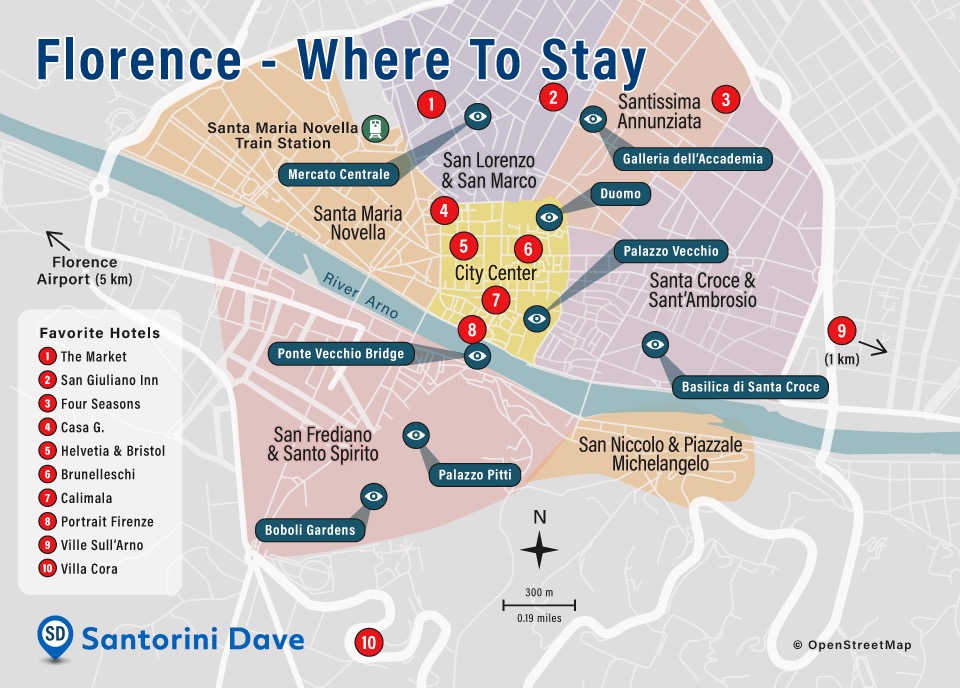
The Arno River divides Florence — but more importantly, it organizes it.
On the north side lies the historic and civic core: the Duomo, Piazza della Signoria, and the dense network of streets that define the city’s cultural identity. South of the river, the Oltrarno offers a quieter, more local rhythm — artisan workshops, residential streets, and a slower pace of life.
Bridges here are not just crossings.
They are transitions in tone.
The most iconic, the Ponte Vecchio, compresses movement into a narrow corridor of shops and passage. But step away from it, and the river reveals a different quality — reflective, open, and quietly anchoring the city.
Architecture & Power
Built influence, not just beauty
Florence’s architecture is not decorative — it is declarative.
Cattedrale di Santa Maria del Fiore, the Florence Cathedral simply known as the Duomo, dominates the skyline not only through scale, but through innovation. Its dome — engineered by Filippo Brunelleschi — remains one of the most ambitious structural achievements of its time.
Nearby, the Palazzo Vecchio asserts civic authority, while the Uffizi frames art as both cultural and political capital.
Underlying much of this is the influence of the
Medici family — patrons who shaped Florence not only through wealth, but through vision. Their legacy is not confined to buildings or collections. It is embedded in how the city thinks about beauty, proportion, and influence.
The Renaissance architecture of Florence — Brunelleschi’s dome, the Medici patronage system, and the proportional logic of the historic center — is explored in the Renaissance → entry in the Architecture Style Guide.
The Renaissance in Motion
Where perspective changed everything
Florence is often described as the birthplace of the Renaissance — but that phrase can feel abstract until you experience how the city unfolds.
Here, perspective is not just artistic — it is spatial.
Streets frame views. Piazzas open with intention. Buildings respond to human scale in a way that feels both controlled and intuitive. The result is a city that teaches you how to see — through alignment, proportion, and sequence.
This is not a museum city.
It is a working study in how ideas become form.
Everyday Florence
Refinement without performance
Despite its global reputation, Florence still operates at a human pace.
Morning begins at the bar — espresso taken quickly, standing. Lunch stretches longer, often with simple, high-quality ingredients that don’t need explanation. Evenings unfold slowly, especially across the river in the Oltrarno.
Craft remains visible here.
Leather goods, paper, textiles, and goldwork are not just souvenirs — they are part of a living tradition that continues alongside tourism, not beneath it.
Florence is elegant, yes.
But it is also grounded.
Signature Moments
- Escaping the density around the Duomo to emerge into Piazza di Santa Croce — bells ringing out of sync, a violinist filling the space, artists painting along the edges, and the cloister courtyard offering a quiet, almost hidden pause behind it all
- Crossing the glowing Ponte Vecchio at night, the river finally still, after dinner in the Oltrarno — where a perfectly simple bistecca alla Fiorentina and fresh tagliatelle with white truffle made it clear that restraint is a form of luxury
- Climbing to Forte di Belvedere — the city unfolding in red-tiled density on one side, and soft rolling hills dotted with villas on the other
Basics of Florence
Know Before You Go
Italian
official language
Euro €
currency
5
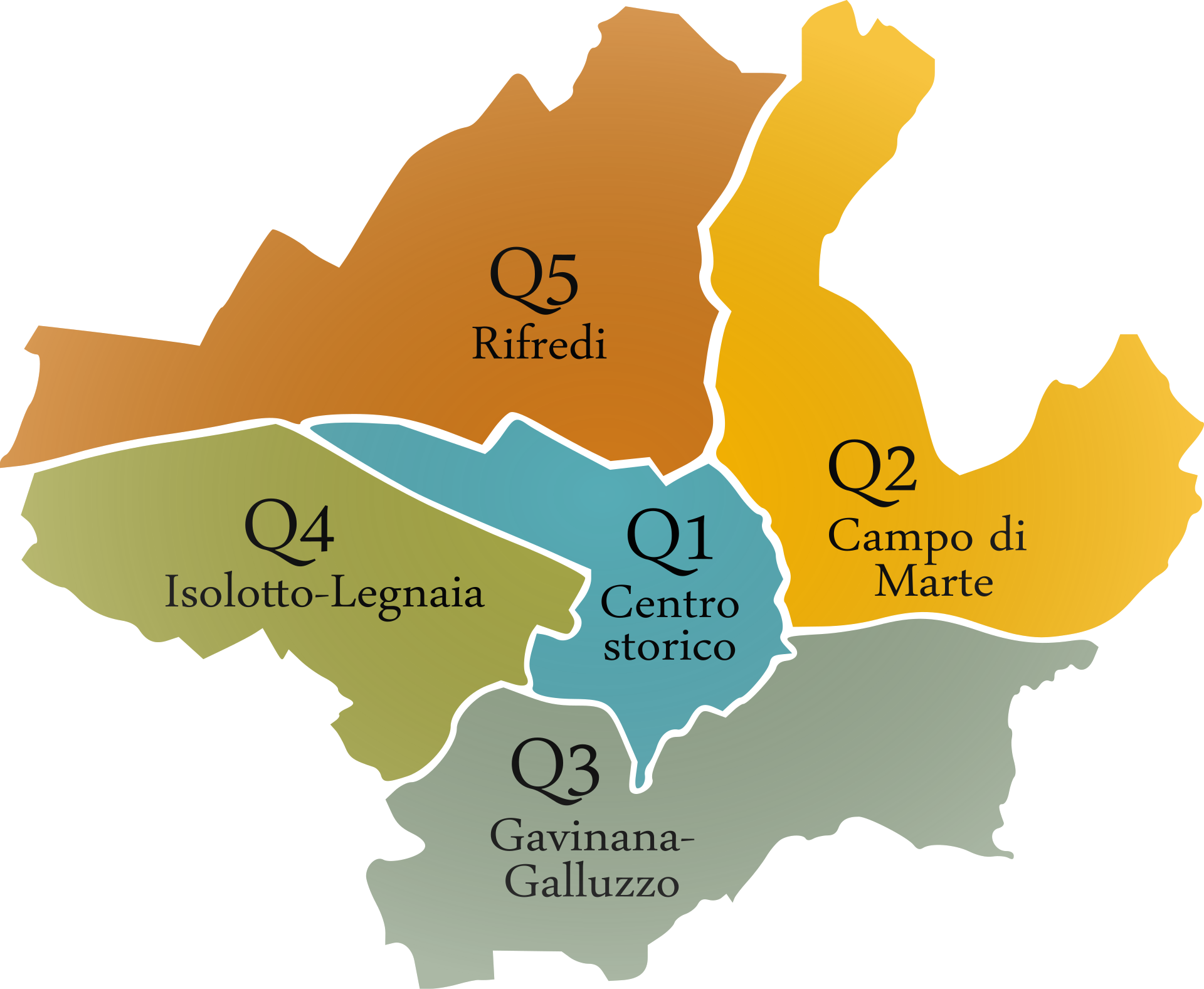
quartieri
On Foot + Bus + Tram
transport
When to Go
- Spring and fall temperatures are most pleasant
- High travel season in April, May, June, September, October, and early November
- Summers (June to August) tend to be hot and humid and heavy with tourists
Safety
Florence is ranked a very safe city, but be aware of pickpockets, particularly in crowded tourist areas; friendly, walkable city; public spaces and streets are warmly lit and enjoyed after dark (like any city, take general precautions and be aware of your surroundings)
Getting around
- Very walkable and the best way to get around the historic center
- Buses are well-connected; Tickets can be bought at the stops themselves, or inside the bus, which has two places where you can validate them — at the front and back of the bus
- Vespas and Bicycles are popular forms of transportation beyond the historic center
Airports
- Amerigo Vespucci Airport (FLR)
- Aeroporto di Firenze-Peretola
Rail
- Firenze Santa Maria Novella is in the center
Practical Movement
Florence connects seamlessly to Italy’s high-speed rail network via Firenze Santa Maria Novella.
Trenitalia Frecce trains reach: Rome in ~1.5 hours, Milan in under 2 hours, and Venice in just over 2 hours.
The city itself is best experienced on foot. Distances are short. Details are close.
The case for slow travel is made most clearly in Florence — where the city rewards depth over coverage and punishes the itinerary that tries to see everything.
Florence Through The Lens

Florence: The City That Rewards the Unhurried
Florence concentrates. Where Rome sprawls and Paris unfolds in layers, Florence compresses everything into a walkable density that rewards patience and punishes the itinerary that tries to see it all. Two nights was enough to understand why the city earns its reputation — and to begin to see past it.
Continue the Journey
Florence refines how you see Italy — through proportion, craft, and the quiet discipline of beauty.
Explore Tuscany → or Central Italy → in The Atlas.
Join The Inspired Lens → for early access to the Reading Florence guide.