
THE ETERNAL CITY
Rome does not preserve history — it lives inside it.
From its ancient core to the wider metropolitan landscape that still orbits around it, this is a city where time stacks vertically. Ancient foundations hold Renaissance palaces; Baroque churches rise beside Roman columns; daily life unfolds around ruins so old they no longer announce themselves. The Forum sits open to the sky not as a museum, but as part of the city’s ordinary geography.
Rome is less a place you “see” than one you learn to move through.
Its logic reveals itself slowly — in the curve of a street that follows an ancient wall, in a fountain where people still gather, in the way every piazza feels like both stage and living room. Monumentality exists here, but so does ritual: morning espresso at the bar, evening passeggiata, laundry above a narrow lane, scooters threading past emperors.
As Italy’s national capital and Lazio’s regional capital, the city expands far beyond its historic center, but the heart of Rome still beats through its 22 rioni — the original neighborhoods within the old walls, each with its own rhythm, loyalties, and identity.
Rome rewards attention.
And then it asks for more.
Metro Rome & Geographic Context
The city beyond the center
Rome is experienced in layers — but it is also lived at scale.
What most visitors encounter is the historic center, a relatively compact area shaped by the Tiber River and defined by its 22 rioni. But beyond this core lies a much larger and more complex urban landscape: the Metropolitan City of Rome (Roma Capitale) — a vast administrative region of over 120 comuni extending far beyond the ancient walls.
This broader Rome stretches from inland hills to the Tyrrhenian coast, where places like Ostia reconnect the city to the sea that once powered the Roman Empire.
Geographically, Rome sits within the Lazio region, shaped by volcanic terrain, river valleys, and fertile plains. The land surrounding the city — once Etruscan, then Roman — still carries traces of these earlier civilizations in its roads, ruins, and settlement patterns.
A Living World Heritage Site
The Historic Centre of Rome, along with properties of the Holy See, is recognized as a
UNESCO World Heritage Centre site — not as a single monument, but as an entire urban fabric shaped over more than two millennia.
This designation includes the ancient core (Forum, Colosseum, Palatine Hill); Renaissance and Baroque Rome; key religious and civic structures tied to the Vatican.
What makes Rome distinct is not just the age of its history — but its continuity.
This is not a preserved past.
It is a functioning city where layers remain active, inhabited, and in constant negotiation with the present.
Rome & the Tiber
The Tevere — the Tiber River remains Rome’s geographic anchor.
Flowing from the Apennines to the Tyrrhenian Sea, it shaped the city’s earliest development and continues to define how Rome is navigated and experienced. Bridges are not just crossings — they are transitions between identities, atmospheres, and histories.
Why This Matters
Understanding Metro Rome changes how you experience it:
- The historic center becomes intentional, not overwhelming
- Neighborhoods begin to feel distinct rather than interchangeable
- Day trips and extensions (like Ostia or Tivoli) become part of a larger spatial story
Rome is not just a city.
It is a region organized around a center that still holds.
Basics of Rome
Know Before You Go
Italian + Romanesco dialect
official language
Euro €
currency
22
rioni
Metro + tram + bus
transport
When to Go
- Spring and fall temperatures are most pleasant
- High travel season in April, May, June, September, October, and early November
- Summers (June to August) tend to be hot and humid and heavy with tourists with average temperatures around 78˚
- Winter tends to average around 46˚ — late October through March is most affordable, except for Christmas and Easter
Safety
Rome ranks as a safe city, but be aware of fast-moving traffic and pickpockets, particularly in tourist areas and public transit areas, especially Termini Station
Getting around
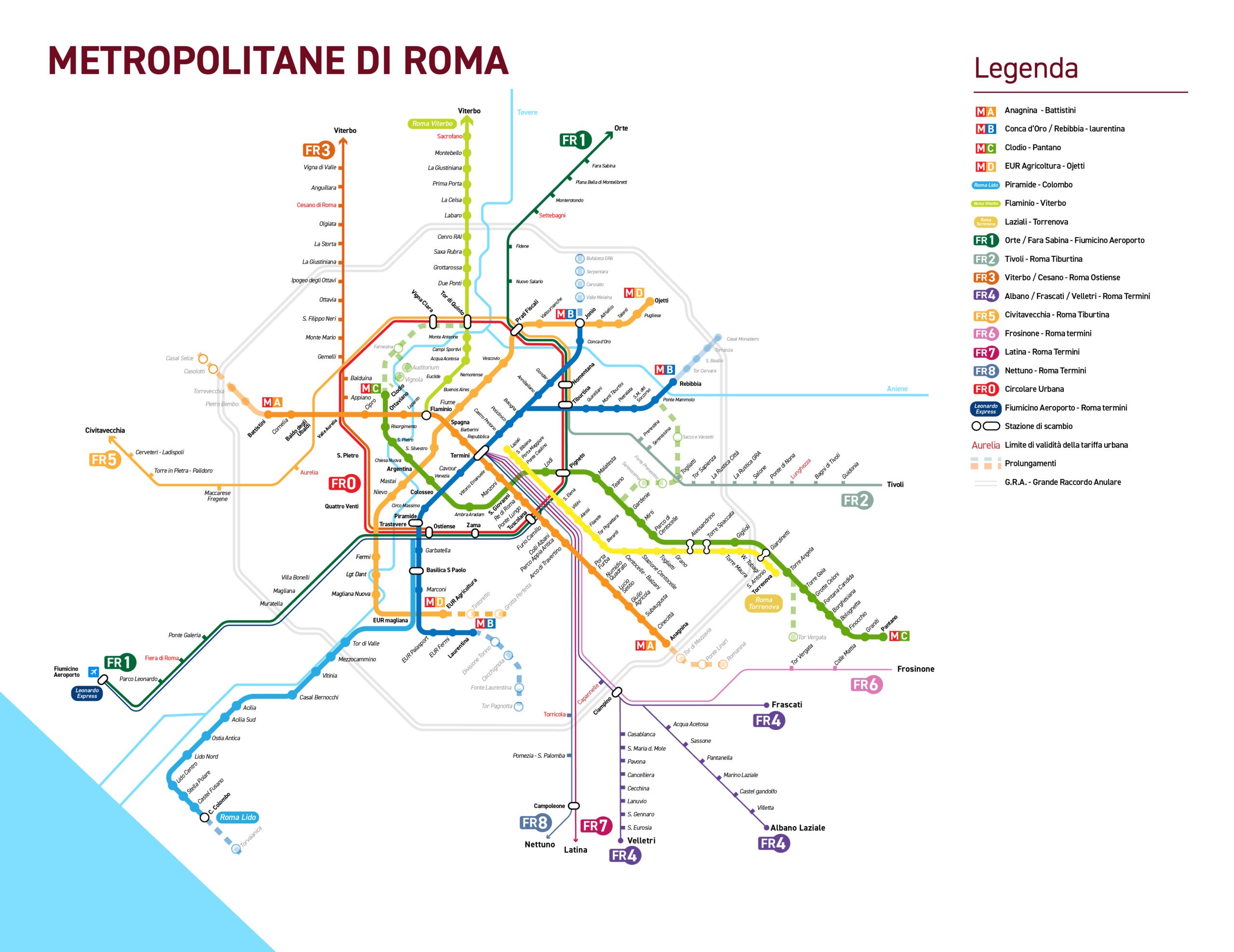
Very walkable; Metro, tram, bus, and local train passes — at the train station (24-, 48-, 72-hour, 7-day passes); Vespas are popular forms of transportation
Airports
- Roma-Fiumicino “Leonardo da Vinci” International Airport (main)
- Ciampino International Airport (secondary)
Rail
- Roma Termini Station (central)
- Roma Tiburtina Station (NE)
- Roma Ostiense Station
Understanding Rome
The Historic Center + 22 Rioni
Rome is divided into 22 historic rioni — historic neighborhoods of the city center that radiate outward from the ancient core around the Forum, the Tiber, and the Vatican edge.
Each rione carries its own character, history, and pace.
Some are ceremonial and grand — like Campo Marzio near the Spanish Steps and Piazza del Popolo. Others feel quieter and more residential, where life happens at neighborhood scale: laundry lines, local trattorie, hidden courtyards, and churches you find by accident rather than itinerary.
Crossing from one rione to another can change the entire mood of the city.

| I. Monti | XII. Ripa |
| II. Trevi | XIII. Trastevere |
| III. Colonna | XIV. Borgo |
| IV. Campo Marzio | XV. Esquilino |
| V. Ponte | XVI. Ludovisi |
| VI. Parione | XVII. Sallustiano |
| VII. Regola | XVIII. Castro Pretorio |
| VIII. Sant’Eustachio | XIX. Celio |
| IX. Pigna | XX. Testaccio |
| X. Campitelli | XXI. San Saba |
| XI. Sant’Angelo | XXII. Prati |
UNESCO World Heritage-listed Historic Centre of Rome spans these 22 historical rioni.
Key Districts to Know
Centro Storico
Pantheon • Piazza Navona • Campo de’ Fiori • Trevi Fountain
Monti + Ancient Rome
Colosseum • Roman Forum • Palatine Hill
Trastevere
Hidden churches • neighborhood trattorie • evening life
Testaccio
Roman food traditions • local markets • less performance, more reality
Ghetto Ebraico + Isola Tiberina
Layered religious history • Portico d’Ottavia • Ponte Fabricio
Prati + Vatican Edge
Order, symmetry, and the transition toward Vatican City
Ancient Rome
The city beneath the city
Rome’s oldest layer remains its most visible.
The Forum, Palatine Hill, and the Colosseum form the architectural spine of the ancient city — not preserved behind glass, but embedded directly into modern movement. Streets bend around former walls. Apartment buildings face imperial ruins. Everyday Rome continues beside what was once the center of an empire.
This is where scale becomes difficult to process.
What survives is only a fragment, and still it overwhelms.
Walking here is less about chronology and more about orientation — understanding how the city grew by building over itself rather than away from itself.
Key Places
Colosseum • Roman Forum • Palatine Hill • Capitoline Hill • Baths of Caracalla
Signature Moment
- Standing above the Forum at dusk, watching modern traffic move past the ruins of what once governed much of the known world — the strange Roman reminder that history does not disappear, it simply changes jobs.
Everyday Rome
Where ritual becomes architecture
Rome is not only monumental — it is deeply habitual.
The city is built around repetition: the same café each morning, the same walk across the bridge at dusk, the same trattoria that somehow never disappoints. Roman life is structured by ritual, and food is one of its clearest expressions.
Pizza romana arrives whole, unsliced, with a paper-thin crust meant for a knife and fork. Cacio e pepe is almost aggressively simple—proof that restraint can be a form of confidence. Cappuccino belongs to the morning only; after that, espresso stands alone.
Rome is a city that teaches you quickly when you are doing it wrong.
Usually with affection. Sometimes not.
Key Places
Testaccio Market • Campo de’ Fiori • Trastevere • Jewish Ghetto • neighborhood cafés
Signature Moments
- Watching a sharply dressed barista steam milk with exacting precision, pour cappuccino in one practiced motion, and slide it across the counter with the silent authority of someone who knows this is the correct way to begin a day
- Eating cacio e pepe in Testaccio — the neighborhood where Roman cuisine is most unadorned and most itself — and realizing simplicity here is the result of centuries of refinement, not a lack of ambition
Rome in Motion
Crossing the river changes everything
The Tiber does not divide Rome so much as reframe it.
Crossing a bridge shifts the pace. On one side, ceremonial Rome — grand boulevards, monuments, processional space. On the other, neighborhoods that feel more intimate and improvised.
Trastevere softens the city. Streets narrow, conversations linger, churches hide behind ordinary facades.
Further north, Piazza del Popolo opens wide and formal, a stage set for arrival. During festival days, the city becomes performance — music, procession, ancestral rhythms, and the cracking of ceremonial whips echoing through the square as each rione reasserts its identity.
Rome is never still.
It just changes tempo.
Key Places
Piazza del Popolo • Trastevere • Ponte Fabricio • Isola Tiberina • Portico d’Ottavia
Signature Moments
Happening upon the beginning of a festival parade in Piazza del Popolo — each quarter of Rome represented in traditional dress, music, dance, and rhythmic whip performances that felt both ancient and entirely alive
Crossing into Trastevere to wander quieter streets, finding neighborhood trattorie and hidden churches before returning across Isola Tiberina toward the ruins and layered history of the Ghetto Ebraico
Practical Movement
Rome is connected to Italy’s high-speed rail network through Roma Termini, the city’s primary station and a kind of organized chaos all its own.
TrenItalia’s Frecce trains reach Florence in under 1.5 hours, Naples in just over 1 hour, and Milan in approximately 3 hours. Roma Tiburtina serves additional high-speed, regional, and overnight routes.
In Rome, movement is rarely linear.
Allow extra time. And good shoes.
Rome Through The Lens

The Italian Bar: How a Country Drinks Coffee
In Italy, the morning doesn’t begin with coffee. It begins at the bar. The dapper barista steamed the milk with precision, poured the creamy froth over the shot of robust espresso in a rhythmic swaying motion, then slid the cappuccino onto the counter with a slight nod. As I sipped it, I tasted Italy. The day officially…

What the Romans Eat for Pizza
He wore a collared SS Lazio shirt tucked beneath his round belly, a sweatband on his wrist, and three pairs of glasses stacked on his head. He was our waiter, our pizza authority, and — as it turned out — our referee. Our desire to experience the Romans’ Rome began our first night in Testaccio,…

The Roman Pastas: Four Dishes, One City, No Substitutes
There are four pasta dishes that belong specifically to Rome, and to nowhere else in Italy. Each one tells you exactly where you are. Their origin is the cucina povera — the poor kitchen — of the shepherds and slaughterhouse workers who fed the city before it became famous for anything. They had offal, cured meat, hard…

From Overload to Awe in Vatican City
Vatican City contains the greatest concentration of human artistic achievement on earth. It also contains, on any given morning, thirty thousand other people who know this. We had come from Testaccio — our neighborhood for the week, a proper Roman quarter south of the center where the market and the butchers and the restaurants that…
Continue the Journey
Rome is not a checklist city. It is a city of return. Rome rewards multiple visits — each layer of history becomes more legible as the previous one settles.
Explore Central Italy → or Vatican City → in The Atlas.
Join The Inspired Lens → for early access to the Reading Rome guide.