
Brussels was cleaner than we remembered — the soot that had darkened Sainte-Catherine on our first visit was gone, the church bright now where it had been dull. Five years had changed the city in a good way.
Brussels had been cleaning its face. A sustained civic effort to strip decades of industrial and wartime buildup from the city’s limestone and sandstone facades — the kind of restoration that takes years before it becomes visible all at once, then suddenly the city looks like itself.
Weeks into a journey that had taken the four of us from Italy through Innsbruck, Munich, Strasbourg, and Luxembourg City, our train arrived at Bruxelles-Central in the early afternoon. The line had carried us back through the Walloon countryside familiar now from our Dinant day trip on the previous trip — rolling, green, the kind of countryside that has been continuously farmed for longer than Belgium has been a country.
One night, with the specific intention of being nowhere but the capital. No day trips, no rail connections outward. Just Brussels, concentrated. We had chosen a boutique hotel around the corner from the Grand-Place, a short walk from Bruxelles-Central — close enough to everything to leave the planning to the afternoon itself. Location as the first design decision.
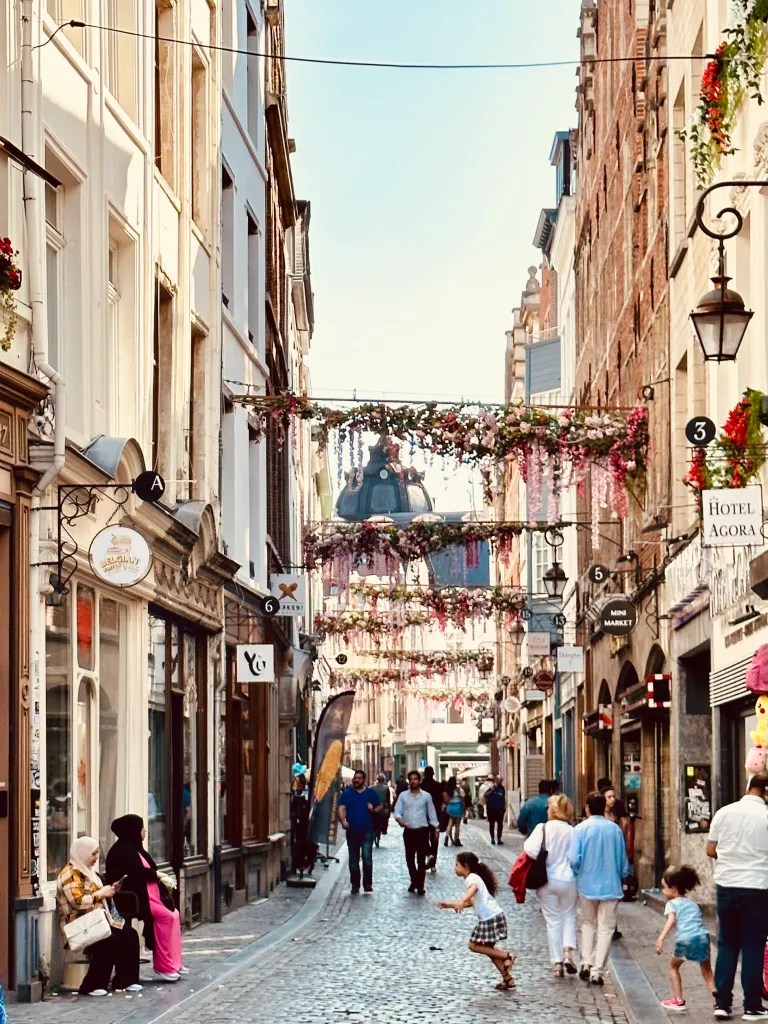


We spent the warm afternoon the way Brussels invites you to: waffles first, then frites with mayo, moving through streets that are decorated and slightly labyrinthine in the way of medieval cities that grew before anyone was planning them.
Inside Les Galeries Royales Saint-Hubert — the mid-19th century covered arcade connecting the Rue du Marché aux Herbes to the Rue des Bouchers — the vaulted glass ceiling produced its particular quality of diffused afternoon light, and we slowed down in the way that good architecture asks you to.


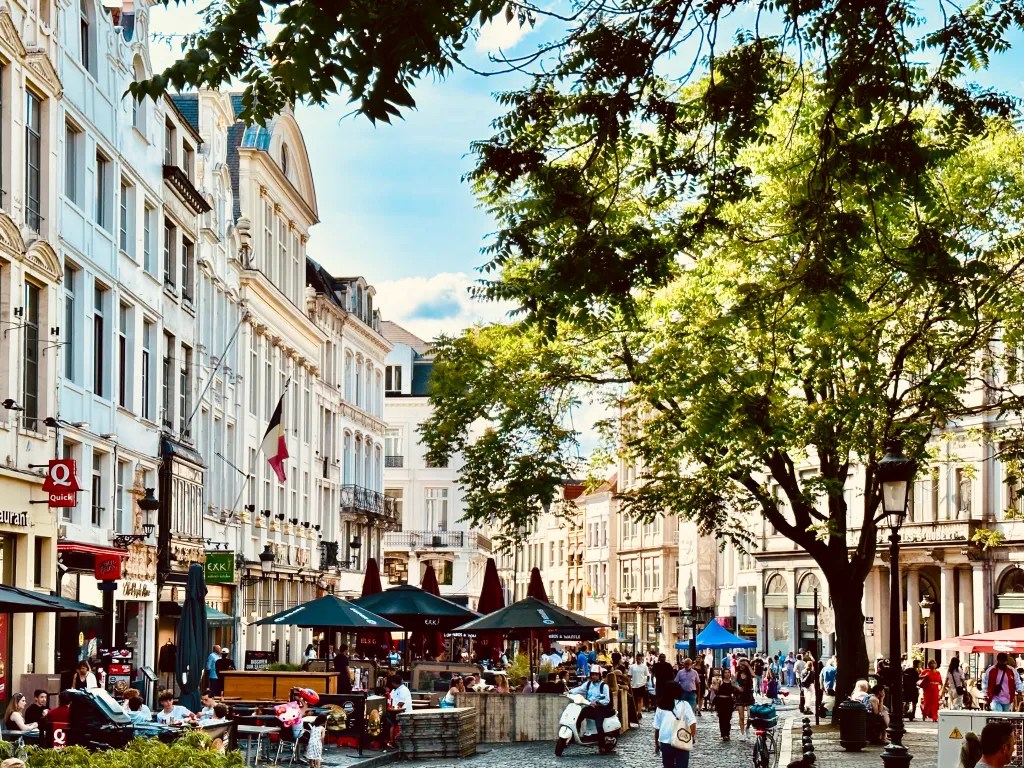
Outside near the Agoraplein, a young woman’s voice stopped me — the second street performer in recent travels I would later discover had gone on to win a four-chair turn on The Voice: aqua blue hair, singing current pop songs with a quality that matched their originals, her sign inviting followers to find her as Mina Blue. We stopped. Some moments in cities are not planned and are better for it.
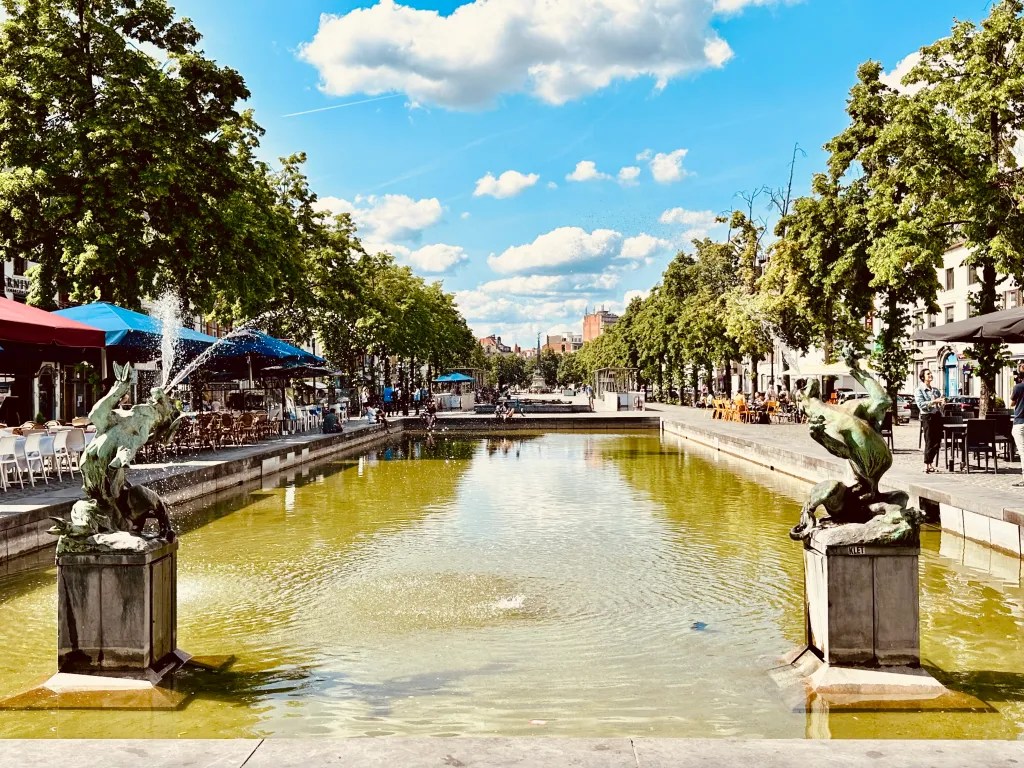
Brussels felt more lively than we remembered — and more itself. On the first visit the city had withheld its charm, requiring time and walking before the grit gave way to elegance. This time it offered both at once: cheerier, more polished, the character that had taken longer to find in 2018, this time immediately apparent. We were also glad to find the chocolate shop still just off the Marché aux Poissons — the Vismarkt, the long square with its water basin and fountains at each end.
Belgian chocolate — the real version, made by people who understand that cocoa percentage and origin matter — ruins you for the exported version.
Atelier Ste-Catherine had changed since our first visit — then a more casual bean-to-bar workshop, the kind of place that felt like a neighborhood discovery. The quality and artistry were still evident in the work itself, but the shop had moved toward something more considered: refined branding, polished packaging, a queue where I recalled there had once been a tasting bar. Beautiful, and slightly less itself than before — the distance between a neighborhood gem and a profitable enterprise, which most neighborhood gems eventually have to cross. I bought a small package. The chocolate was still delicious.



That evening, while the boys did their own thing, Aaron and I settled at an outdoor table at Au Brasseur for a flight of Belgian ales — each in its designated glass, the pouring unhurried, the flight assembled as a deliberate tasting rather than a transaction. Belgian beer culture is among the most complex in Europe and the most misrepresented in export. At the source, at an outdoor table on a warm June evening, it becomes comprehensible in a way that a bottle abroad never quite achieves.
Then we walked to Fin de Siècle for dinner. The menu was written on a chalkboard — the day’s selections, nothing more. Stoemp saucisses: herbed mashed potatoes beneath a juicy sausage, surrounded by a robust gravy that was neither heavy nor greasy. Aaron’s carbonnade à la flamande — the Flemish beef stew braised in dark ale — arrived in the same spirit: deeply flavorful, not heavy. The kind of memorable meal that a city makes when it has nothing to prove.


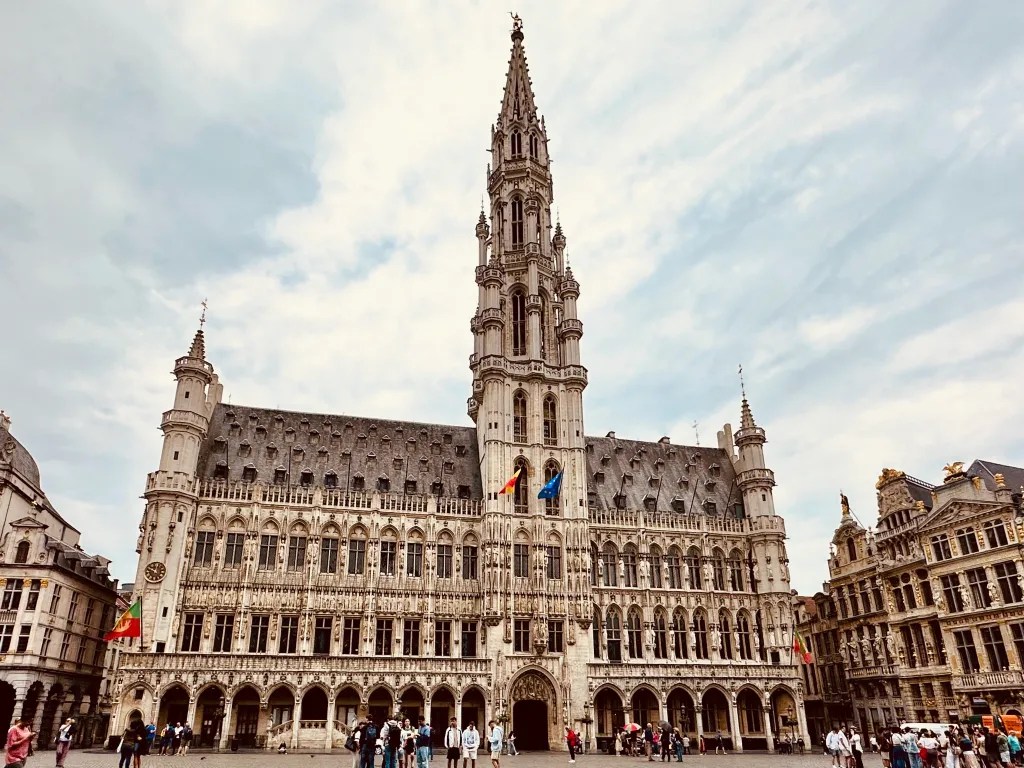
After dinner, dusk was just settling as we walked back past La Bourse — its facade reflecting in the pool below — and into the Grand-Place. It was nearly ten o’clock and the square was still alive, the summer light finally softening into evening, the warmly lit guild facades drawing people in rather than sending them home. We stayed long enough to understand why it’s called what it’s called — grand not just for its size but for what it produces in the people inside it. The kind of outdoor space that makes you understand what a city is for when it gets it right.


The next morning, before the train north, we sat outside a café at the corner of the square — a cappuccino, a pain au chocolat, the Grand-Place nearly to ourselves. In 2018 we had arrived in the afternoon, the square already full. This was the version that requires staying around the corner to find: the square at the hour when the city has not yet decided to perform.

We continued north by rail, a quick stop in Antwerp to walk the concourse of Centraal station once more and along De Keyserlei, before continuing to Amsterdam. The two countries inside Belgium were still working out their terms. But Brussels, held between them, was holding its ground.


Cultural Notes
Galeries Royales Saint-Hubert: Opened in 1847, one of the oldest covered shopping arcades in Europe. Designed by Jean-Pierre Cluysenaar in an Italian Renaissance style, the three interconnected galleries — Galerie du Roi, Galerie de la Reine, Galerie des Princes — produce a quality of diffused light through their vaulted glass ceilings that changes with the afternoon.
Belgian ales: Belgium’s beer culture encompasses Trappist ales, lambics, saisons, dubbels, and gueuze. Each style has its own designated glass — not an affectation but a genuine matter of how the beer behaves. The versions exported abroad are a different product.
Stoemp: A Brussels working-class staple of mashed potatoes combined with root vegetables — carrots, leeks, or turnips — seasoned with herbs, served with sausage or bacon. The dish that a city makes when it has nothing to prove.
Frites: Twice-fried and served with mayonnaise or aioli, not ketchup. The term “French fries” refers to the French cut of the potato, not the country of origin. Belgium takes this distinction seriously.
Antwerpen-Centraal: See Belgium: The Country That Contains Two Countries for the full architectural note.
Part of the 2023 Northwestern Europe return — Amsterdam, Leiden, The Hague, Luxembourg, Brussels. For the Netherlands leg, read The Netherlands: Water, Tolerance, and the City That Shouldn’t Exist →
Belgium connects to the Benelux Atlas.
For the first encounter with Belgium — the 2018 trip, National Belgium Day, Bruges, Ghent, and Dinant by rail — read Belgium: The Country That Contains Two Countries →