
We arrived at night, exhausted after a long day of travel. The metro from the airport let us out at Colón, where we surfaced into the plaza and rolled our bags into the dimly lit corridor toward the address we’d been given.
A man stood in the shadow of one of the lamps, staring at his phone without looking up. We passed him cautiously, scanning the numbers above each door. Then from behind: “Looking for an apartment?” We turned. “Are you Ali?” he asked — in an Arabic accent, addressing Aaron, pronouncing my name as that of a Muslim man. I told him I was Ali, with some emphasis on the soft A. He glanced at me briefly, slightly confused, then led us upstairs and collected our IDs, continuing to direct his remarks to Aaron throughout.
It was, I would come to understand, a very small introduction to the layered identity of this city — Arab in its irrigation systems and place names, Christian in its civic monuments, Valencian in its insistence on being neither entirely one thing nor another. Valencia doesn’t announce itself. It reveals itself. And it had started already.
In the bright light of the next morning, the dark alleyway had transformed into a narrow lane lined with balconettes just off a pedestrian shopping street. After a full Spanish breakfast at the corner café — a platter of sausage and roasted peppers, and for the first time, pan con tomate (toasted bread rubbed with tomato) and tortilla de patatas, a potato frittata we’d later have with pintxos, now among our favorites. We made friends with the non-English-speaking staff and went back most mornings for the food and the Spanish practice.
On the second morning, the boys were too tired to come; since the café didn’t do to-go orders — not a common practice there — the staff put their breakfast into reusable containers that we returned on the next visit.


We were in Valencia in October 2019 — the first ten-day segment of a longer trip that would continue by train through Barcelona, Geneva, and Florence, ending in Rome. Cole was playing in an elite international youth football tournament hosted by La Vall d’Uixó at the end of a week of training, and on the first full day the four of us set out together before he was to join his team at the sports complex on the other side of old town the following morning. Caden, just above the age threshold where he assisted the coach rather than played, stayed with us throughout — the apartment’s second bedroom his for the duration.
That first morning, after breakfast, we walked down into the Turia Gardens past Porta de la Mar and Santiago Calatrava’s Exposition Bridge — La Peineta, a modern cable-stayed structure in deliberate contrast to the much older Puente del Mar spanning a nearby pond — and followed the park eastward through an orange grove past the Palace of Music to Calatrava’s masterpiece complex, Ciudad de las Artes y las Ciencias. Calatrava is a native Valencian, and the pride the city takes in his work is visible in how the complex is maintained, how visitors move through it, how locals use the pools and promenades around it as daily infrastructure.


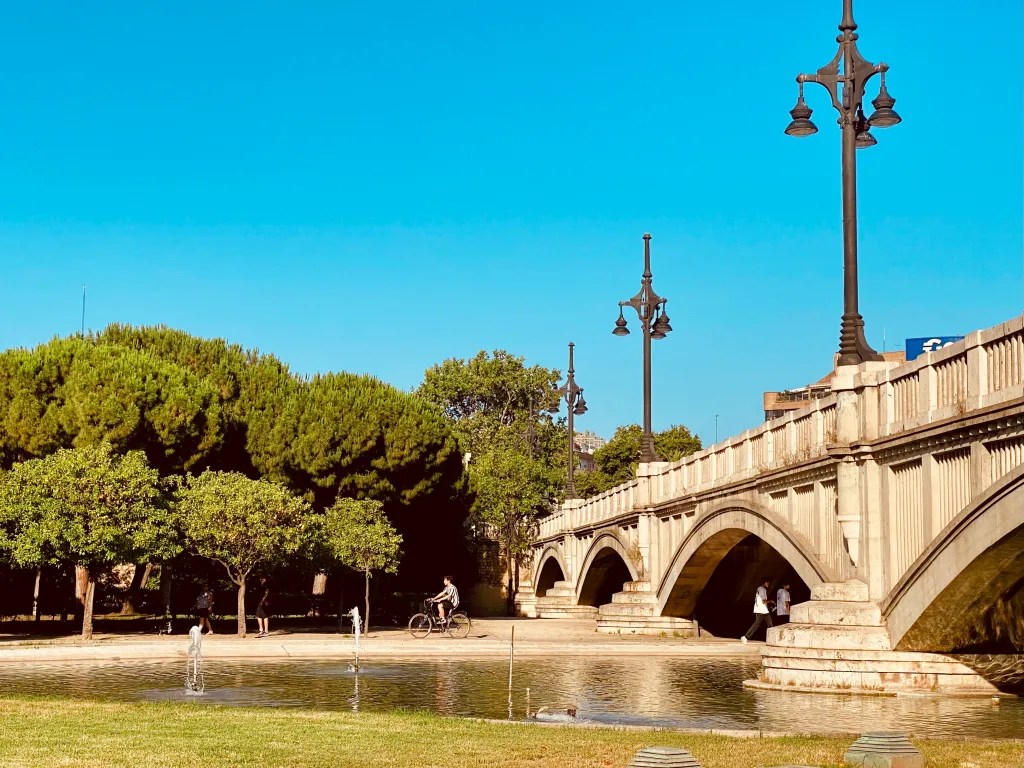
What we were walking through was once a river. The Túria flooded catastrophically in October 1957, killing over 80 people and submerging much of the city. The response was to divert the river entirely — rerouting it south through a new channel — leaving a wide, dry bed running through the heart of Valencia. Franco’s government proposed filling it with a motorway. Valencia resisted, and after years of civic pressure, the city began converting the former riverbed into a park in the 1980s.


Today the gardens stretch nearly nine kilometers from the historic center to the sea, threading through the city as both lung and connective tissue — cycling routes, football pitches, orange groves, playgrounds, and the slow pedestrian rhythms of daily life all occupying the space that once swallowed the city whole. It is one of the great acts of urban recovery in modern Spain, and the city moves through it as though it has always been there.
Calatrava’s complex sits at the far end of the former riverbed: white structural forms reflected in long shallow pools, the engineering demonstrative but not gratuitous, the scale legible only once you’re walking inside it.


From there to the marina, past a man completing a sand sculpture on the beach, along the El Cabanyal boardwalk to a restaurant where we had seafood paella and sangria. The staff were welcoming. The paella was delicious — whole shrimp, langoustine, and mussels, the kind of seafood paella you find at a local haunt near the port rather than the smaller, often frozen versions served in the centro.
True paella valenciana, as I’d read before the trip and the restaurant confirmed, is made with rabbit, snails, and butter beans — the farmworker’s Sunday dish, inland and ancient. The seafood version is more Catalan in origin, adopted along the coast. Both are authentic; they’re just telling different stories about the same region.


Valencia is not a beach town. It is a city that happens to sit near the sea, which is a different proposition entirely.
El Cabanyal — the old fishing village absorbed into the city over the 20th century — fought hard to keep what makes it distinct. A proposed boulevard that would have demolished much of its historic core was blocked after years of civic resistance; the current city plan pivots instead toward preservation, rehabilitation, and revitalization of its tiled fishermen’s cottages and public spaces. It has its own character along the shore, and the beaches at Malvarrosa and Patacona to the north get quieter and more local the further you walk.
A day spent wandering those streets and walking along the water has its own particular pleasure. But travelers who stay in the resort hotels along the coast get a much thinner version of Valencia than those staying in or near Ciutat Vell — the generic comfort of a beach resort is, by design, not very different from any other beach resort in the world. The city is the point. The beach is incidental to it.


Returning by metro across the old city, we passed the ceramics museum and the former home of the Marqués de Dos Aguas — its alabaster portal carved into a confection of figures and foliage that reads like architecture trying to become furniture — past the bell tower of Església de Sant Martín and through El Mercat at sunset, Mercat Central and the Real Parròquia to Torres de Quart, the sky behind the medieval gate towers lit in bright oranges and pinks.


Walking back through the now yellow-cast streets, past Palau de la Generalitat and into the lively Plaça de la Virgen, people had gathered around the Turia fountain — the reclining river god figure, arms extended toward the eight irrigation channels of the huerta he governs. Around to the Plaça de la Reina, still lined with taxis that year in the days before its more recent pedestrian renovation, El Micalet and Santa Catalina towers glowing in warm light.
We stopped in a Basque bar for pintxos — the small bread-topped bites lined up along the counter, a toothpick in each, collected and counted at the end to determine the bill. Then back through Plaça de l’Ajuntament, its fountain lit in the triangular plaza in front of City Hall. One of many fountains, many plazas. The city had a rhythm to its public spaces that became more legible each time we moved through them.


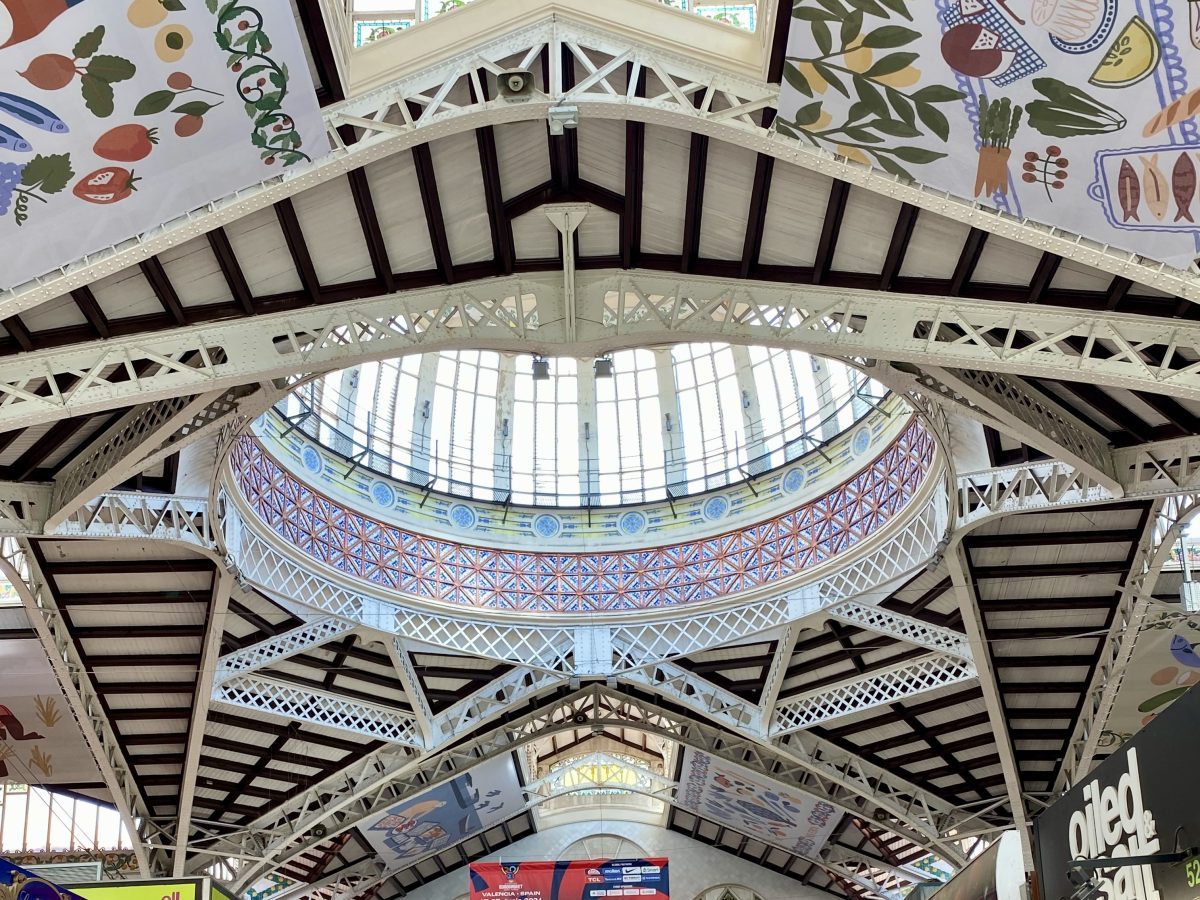
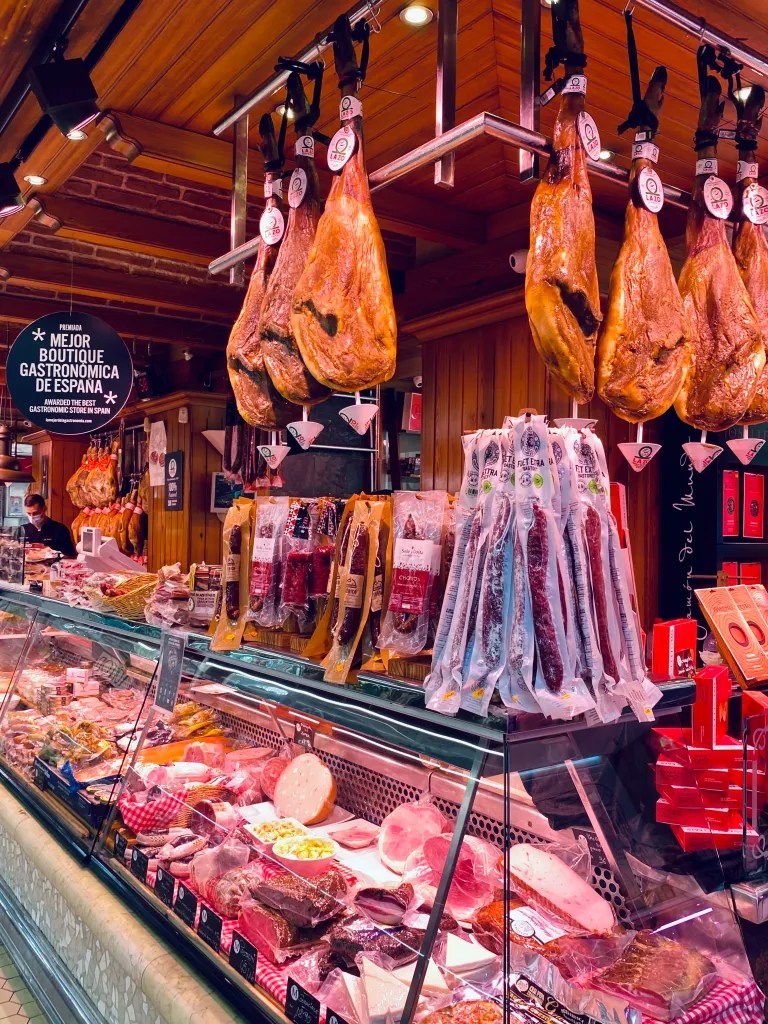
One morning in search of athlete provisions, we arrived at Mercat Central. Paella pans of all sizes hung in the front plaza — some the diameter of truck tires. Inside the Art Nouveau building: hanging jamón at one end, icy beds of whole fish and live shellfish at the other, and between them a density of fresh produce that reflected what the huerta actually yields.
Vendors called out in Castilian Spanish and Valenciano. The quality wasn’t elevated or curated — it was simply the standard the city expected of itself, because this land has been producing this way since the Moors perfected its irrigation system. The market closed early in the afternoon.


In the evenings, we went instead to Mercat de Colón — a different order of building, Modernista and grand — and sat at Horchateria Daniel, returning more than once, to drink horchata made from chufas, the tiger nuts grown in the sandy soil south of the city, and to eat fartons, the elongated sweet pastry made for dipping. It became one of the pleasures the city offered without advertising.
We returned to La Seu many times over those ten days, circling the cathedral, entering the Baroque nave and its chapels beneath the lacework windows of the central dome.
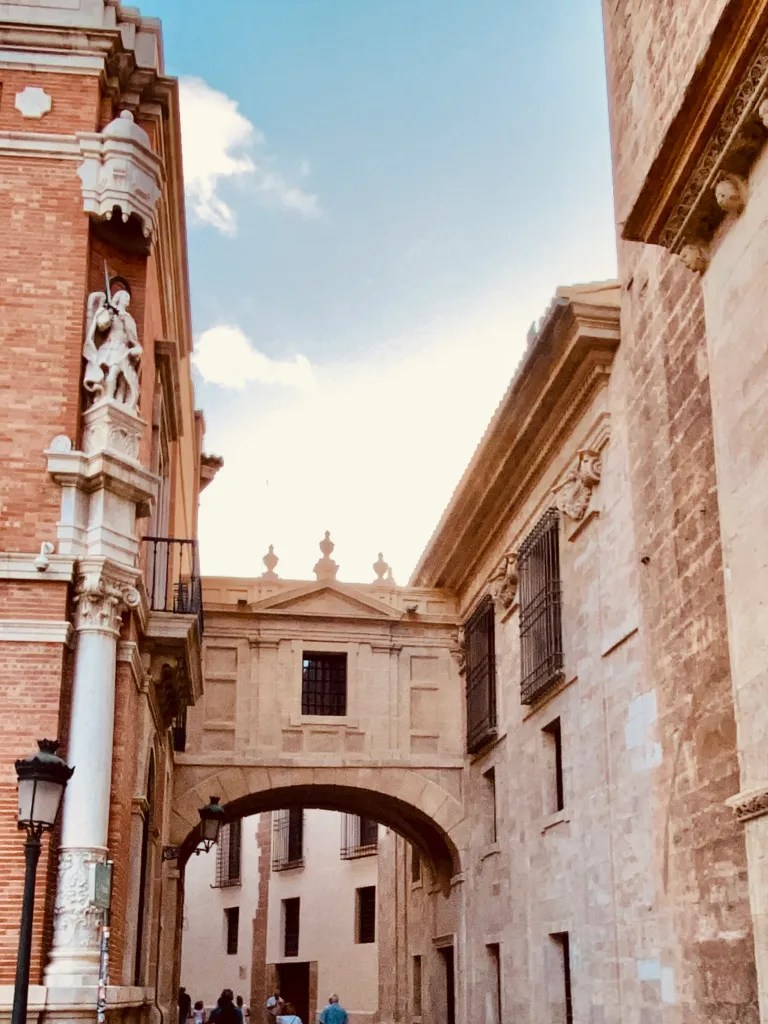


We stood at the portal where the Water Tribunal convenes — the same spot where irrigation disputes from the huerta have been adjudicated weekly since the 10th century, a tradition now recognized by UNESCO. Enclosed bridges connect the cathedral to the Archbishop’s palace on one side and the basilica on the other.
If El Mercat was the stomach of Valencia, La Seu was its heart.


October 9th, Dia de la Comunitat Valenciana, marks the anniversary of King James I’s Christian reconquest of Valencia in 1238 — the founding moment the city has commemorated ever since as its own. Walking from Plaça de la Virgen toward La Xerea, past the Fuente de los Patos, we came upon a crowd near the Jardí de la Glorieta so dense there was no moving through it.
The parade was already underway, and we were glad to be caught in it. Moorish costumes, belly dancers, winged figures in medieval dress, horse-drawn floats depicting the arrival of Christian forces — the full layered narrative of this city’s history performed in a single procession through its streets, the crowd pressed in around it on all sides.


The next day, the street fair at Torres de Serranos filled Plaça dels Furs with artisan stalls: a man chiseling plaster into architectural scenes, a woman selling jewelry, bread baking in a traditional oven. Colorful tents spanned across the bridge beyond the towers. Large paella pans cooked beside a round grill firing various meats; one man carved a leg of jamón while another fanned grilling corn.


We returned the following day and climbed the towers themselves — the medieval wooden doors, stone carvings, and ancient ribbed vaults visible from inside, the city and the gardens visible from the top. This is what the Day of the Valencian Community looked like: Valencia celebrating the particular version of itself it has spent eight centuries constructing.


Cole’s team trained through the week, including a session with coaches at the Valencia CF facility and a tour of the historic Mestalla Stadium — built in 1919, still hosting first-division football. Its replacement — the new stadium whose shell sat unfinished to the north for years — is now under construction again, with an opening scheduled for summer 2027.
At the tournament the following weekend, his team knocked out Arsenal before losing in the quarter-finals to Real Madrid — whose roster included Zinedine Zidane’s youngest son — with Atlético Madrid ultimately winning the final.
When the tournament ended, we went back to the Galician restaurant a few of us had found earlier in the week — this time reserving the whole place for coaches, players, and families. The owner, an older Galician couple with his elderly mother doing most of the cooking, brought out wine and sangria, platters of chorizo, grilled squid, pulpo á la gallega, large bone-in cuts of grilled meat. He spoke all evening in Spanish — his second language to Galician — and none of us spoke a word of Galician; none of them spoke a word of English.
He told stories about his land next to the sea, about difficulty and stubbornness and the particular pride of someone who has transplanted one regional identity into another city and made something of it. One of our players left his jersey to hang on the wall with others already there. What stays with me from that night isn’t the food, which was extraordinary, but the quality of attention in the room — everyone leaning in, parsing meaning from tone and gesture, genuinely trying to understand someone who was genuinely trying to be understood.


The next morning at Estació del Nord, I admired the Art Nouveau details in the lobby mosaics and carved wood — the ceramic tile panels depicting orange groves and regional products, the carved wood ticket windows, the ornamentation that announced the station’s civic ambition at the start of the 20th century.
I was taking it in at the moment when a line was forming for our train to Barcelona — a train that would be delayed — and the relaxed pace of the previous ten days began to give way to something different. The light rain and the long platform queue jarred me into another form of Spain than I had come to know.
Barcelona, as it turned out, would offer its own kind of complexity.


We returned in July 2021, a day trip from Benicàssim — where we had stayed while the boys were playing football tournaments in Vila-Real but in a boutique hotel in the center of the old town rather than one of the large beach resorts to its south, for the same reason we had stayed in Ciutat Vell the first time.
I had offered to act as guide for friends whose son was playing alongside Cole, and spent the day showing them the city I had learned two years earlier.
We returned to Plaça de la Virgen first, stopping for a cone of helado, then climbed Torres de Serranos for the architecture and the views over the city, then lingered longer in El Carmen this time — the murals, the flood-line tiles still marking the height the water reached in 1957, the miniature house built into a wall with a door for cats.


We took our time in Mercat Central before touring La Lonja de la Seda — the 15th-century Gothic silk exchange I had missed on the first trip — and stood for a long time in the Contract Room beneath Pere Compte’s spiral stone columns and ribbed groin vaults. We went into the church across Plaça de la Companyia, only ever seen from the exterior before.
I showed them the covered passage through the buildings into Plaça del Miracle del Mocadoret — named for the miracle of the handkerchief, a piece of Valencian folklore tied to the founding of La Seu — and the ceramics shop inside it. We ended with another horchata at Daniel in Mercat de Colón.


The Plaça de la Reina was under construction that year — scaffolding and temporary fencing where the taxis used to line up. It didn’t matter.
By the second visit, I understood that Valencia is always in the middle of something: a restoration, a renovation, an argument about what to keep and what to replace. The new stadium under construction. El Cabanyal’s tiled facades slowly recovering. The Water Tribunal still meeting at the cathedral door on Thursdays as it has for a thousand years. None of it announces itself as remarkable. All of it is.
That’s what the city had been showing us from the first night — down the dim corridor, through the morning lane with its balconettes, across the huerta market and the Gothic silk exchange and the Galician restaurant where no one shared a language and everyone understood each other.
Valencia doesn’t lead with its best material. It holds it back and lets you find it. The travelers who stay long enough, who choose the old town over the resort and the quiet plaza over the landmark, are the ones it reveals itself to.
Continue to Barcelona → • Geneva → • Florence →
Read La Lonja de la Seda → • Valencia connects to the Iberia Atlas.
Join The Inspired Lens → for early access to Spain and Mediterranean guides.