
Buenos Aires doesn’t ease you in. It absorbs you, neighborhood by neighborhood, until one morning you realize you’ve stopped looking at a map.
We arrived in late June with our son Cole, his Porteño coach Maxi, and a handful of fellow players from his club — the guys here to train for a week with Banfield, a storied Buenos Aires football club. Late June is winter in the Southern Hemisphere, though a mild one: cool, clear days and cold evenings, the city going about its business without concession to the season. This was Cole’s world. Aaron and I were guests in it, which turned out to be the best possible way to arrive.
The City and Its Identity
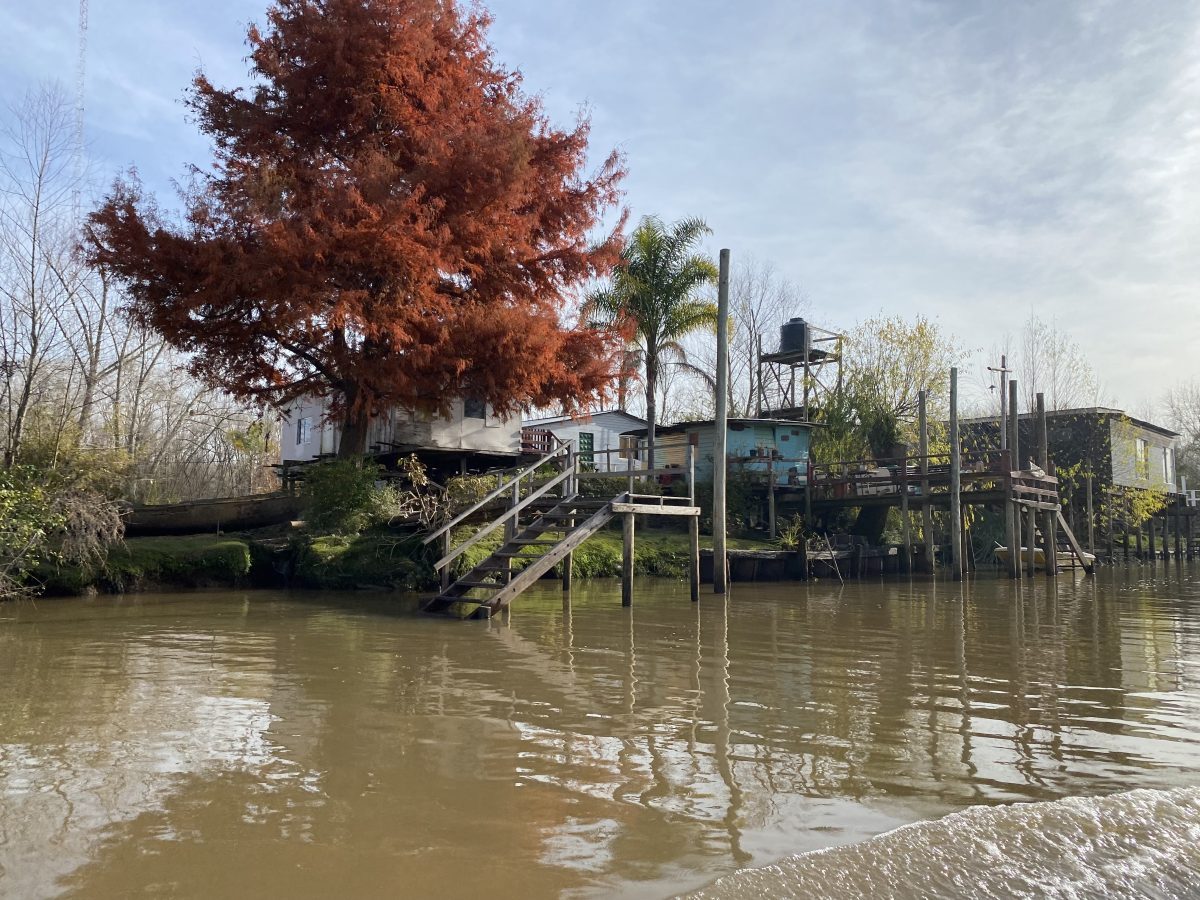
Buenos Aires sits along the southern shore of the Río de la Plata — the widest river in the world, perhaps proportionately its shortest, a vast brown estuary rather than a river in any conventional sense, separating Argentina from Uruguay across a span that is more like a sea than a waterway. Into it flow the waters of the Tigre Delta, which splits from the Río Paraná just north of the city into countless channels through a vast sedimentary wetland of forested and grassland islands — mistakenly named for the jaguars that once roamed there, tigre in Spanish.
From the hotel rooftop we could see the Obelisco: a white marble monument rising from the intersection of Avenida 9 de Julio and Avenida Corrientes, the city’s most recognizable landmark and its most reliable orientation point. Avenida 9 de Julio is the widest avenue in the world — fourteen lanes across, a fact you absorb not by counting but by the experience of trying to cross it. You cannot do it in one set of lights unless you sprint, which the porteños do not. You stop at the median. You wait. You continue. We made this crossing many times. We never stopped finding it instructive.
On the building facing our hotel, visible from our window: a nine-story iron cutout of Eva Perón’s face and silhouette, affixed to the full width of the building’s upper floors. Buenos Aires does not make quiet arguments about its own history.


The city is a product of European immigration in a way that is still legible everywhere you look — in the French and British architecture surrounding the plaza parks of Retiro, in the Italianate facades of Recoleta, in the food and the language and the names above the shops. Spanish came with the colonial past; Italian came with the 19th and 20th-century waves of immigration that shaped the city’s character as much as any official history. The Italian influence runs through the cuisine, the coffee culture, and the easy conviviality of the streets. Buenos Aires tastes as much of Italy as it does of Argentina, which is to say it tastes entirely of itself.
Porteños — as the locals of this port city are called — are genuinely kind. We were struck repeatedly by the care they showed for stray animals and street beggars alike, the way generosity seemed to be a shared civic default rather than an occasional gesture. They know how to celebrate, and they know how to endure. The economic instability, the inflation, the political turbulence that are facts of daily life here exist alongside something the city maintains stubbornly: an appreciation for being alive. La vida es buena. We heard it often. We believed it more with each passing day.


A practical note for visitors: exchange rates in the city run approximately twice what you’ll get from a bank or ATM. Several hotels exchange currency; some restaurants accept smaller notes. Exchange no more than a hundred dollars at a time given the volatility, and pay in Argentinian pesos wherever possible. In Uruguay, the reverse applies — the exchange rate for Argentinian pesos is poor; bring US dollars.
The Table
The Italian influence on Buenos Aires is nowhere more evident than at the table — and nowhere more reliably confirmed than at Café Tortoni, which has been operating since 1858 on Avenida de Mayo, its belle époque interior of dark wood paneling, marble tables, and stained glass carrying the particular calm of a room that has been receiving people for a century and a half without adjusting to any particular era. Borges was a regular.
We arrived before it opened on our first visit to avoid the line that formed reliably along the pavement, and returned twice more on the same schedule. Medialunas— smaller, butterier, and slightly sweeter than a French croissant — with cortados. Churros filled with dulce de leche, the Argentine caramel that is less a condiment than a philosophy. On the third visit: alfajores, the shortbread sandwich cookies of more dulce de leche, at a level of richness that required no justification.


The city’s pizza tradition is equally Italian in origin and entirely its own in execution. At Pizzería Güerrín, fugazzeta is Buenos Aires’ definitive pizza — an obscene quantity of melted cheese topped with slightly caramelized onions on a thick crust, heavy in the most committed way, the kind of pizza that is an event rather than a meal. One slice is plenty. A full pie is a commitment your body will be renegotiating for several days.
The Italian thread ran through every meal we sought out. At Los Galgos in Almagro — a classic 1930s bar of dark wood and mirrors, the particular calm of a room that has seen everything and remains unimpressed — we shared an authentic tortilla de patatas, thick and barely set, exactly like the ones we had loved in Spain, and had our first Negroni: equal parts gin, Campari, and sweet vermouth, over ice with an orange peel. The Negroni has Italian roots. It felt at home here. I ordered a second the following week at another bar and confirmed it was now my cocktail.
At Cucina Paradiso in Recoleta we watched the chef roll pasta sheets by hand at the open kitchen before each of us ordered a single raviolo — singular, intentional — a large parcel of spinach and cheese filled with an intact egg yolk, served over a light buttery cream sauce with shaved truffle. The yolk oozed as I cut into it. The table went quiet in the way that happens when food earns it. We sat for a long time afterward.


At Parrilla Don Julio in Palermo, Argentine beef made its full argument. The matambre a la parrilla — the thin rolled cut, grilled low and slow — achieved a tenderness that reframes your understanding of what beef can be. Argentine cattle roam freely on the Pampas, raised on natural unfertilized pastures without confinement, hormones, or antibiotics — strictly prohibited. The result is a flavor that makes coarse salt the only seasoning needed because the animal is the seasoning. Silky garlic mashed potatoes, avocado and arugula salad, a tray of chimichurri, salsa, and sea salt alongside. We talk about that meal to this day.
Our final meal with Cole was at d’Oro Italian Bar — a modern architectural space inspired by the streets of ancient Rome meeting urban warehouse, raw and refined at once. Rigatoni Amatriciana and pesto gnocchi at the quality of what we had eaten in Rome itself. The Italian thread completing itself, appropriately, at the close of ten days in a city that has been having the same conversation with Italy for over a century.


The Neighborhoods
Buenos Aires is a collection of distinct arguments about what a city should be — each neighborhood with its own vibe, aesthetic, and cultural register, all of them occupying the same grid.
From our hotel in Monserrat we walked in every direction, returning to the same barrios with the accumulated knowledge of previous visits. Plaza de Mayo was our first destination and a frequent one — the historic civic heart, the Casa Rosada at its far end, its pink facade an improbable choice that turns out to be correct. The plaza has absorbed everything: colonial administration, revolution, military dictatorship, the Mothers who circled it for decades demanding accountability for their disappeared children. History doesn’t need to announce itself here; it’s in the pavement.


Avenida de Mayo runs west from Plaza de Mayo to the Palacio del Congreso — a long civic promenade that closes the axis the Casa Rosada opens, the neoclassical dome of the Congress building visible the whole length of the walk. We stopped at Café Tortoni somewhere along the way more than once. In Plaza Mariano Moreno, set along that same axis with a view toward Congreso, El Pensador — the Argentine casting of Rodin’s The Thinker — sat among ordinary park benches where porteños ate their lunch. The museum-quality object in an everyday setting: Buenos Aires makes this move consistently, and it works every time.


North through San Nicolás: Avenida Diagonal Norte cuts through the barrio on a diagonal from Plaza de Mayo toward Plaza Lavalle and the Teatro Colón — a civic axis we walked several times, the broad diagonal offering a different spatial logic from the city’s otherwise rigid grid. Along it and off Calle Florida: Galería Güemes and Galerías Pacífico, their ornate arcades among the finest examples of the city’s European inheritance — Art Nouveau detailing overhead, the San Nicolás street fería running below along Calle Florida with its vendors and the easy commercial energy of a street that has always known its purpose.


Puerto Madero, the modernized waterfront district, is where BA presents its contemporary self — ultramodern against industrial-modern, the renovated red-brick dock warehouses converted to restaurants and offices, the Calatrava-designed Puente de la Mujer spanning the basin, its asymmetric cable mast angled like a tango dancer mid-lean, the bridge rotating on its central axis to allow boats to pass beneath it. We walked north along the water, then back through the grid as the city rose around us.


North from Puerto Madero the corporate towers of Retiro yield to the elegant British and French architecture surrounding its plaza parks, then to Recoleta: the Parisian quarter, Avenida Alvear lined with embassies and grand apartments, the refined streets where we returned one morning for medialunas and cortados at Dos Escudos before a day of walking.
In Recoleta’s park, a giant rubber tree spread overhead — broad and imposing like the magnificent ficus trees we kept encountering across the city, their roots lifting the pavement in patient, decades-long insistence.


We walked the exterior of the Recoleta Cemetery on one visit, then returned to go inside: the mausoleums lining narrow streets of marble and bronze, some polished, others beautifully overtaken by time, Art Nouveau angels and ornate ironwork marking families whose names have mostly faded. Evita is here — the same Evita whose nine-story iron silhouette faced our hotel window — behind a modest door that belies the pilgrimage it draws.


Near Plaza de las Naciones Unidas: Floralis Genérica, the monumental aluminum and stainless steel flower sculpture that opens its petals at dawn and closes them at sunset. Then Plaza República, where community workout areas and football in every variation — fútsal, soccer tennis, curved table soccer — filled the open space with people arriving without registration or admission, playing because the city had simply made space for it.


From there we continued through Parque Las Heras — where monk parakeets had built enormous communal nests in the trees, bright green and improbably noisy, treating the park with the confidence of birds who know they were there first — into Palermo: trendy, walkable, its wide streets lined with murals and good restaurants, the parrillas and wine bars that give the neighborhood its well-earned reputation. Parrilla Don Julio is here.


San Telmo and Boca sit south of the center, at the other end of the city’s register entirely — soulful, gritty, bohemian and festive respectively, the sense of artistry and craftsmanship present at every corner.
San Telmo, the oldest barrio, has a Sunday energy that reshapes the whole neighborhood: the covered Mercado de San Telmo, the outdoor fería surrounding it, antiques and street food and tango danced on the cobblestones by couples who make it look effortless and aren’t. The maté stalls displayed cups and bombillas in every material — gourds, wood, steel — the infrastructure of a daily ritual available at every price point. We bought a gourd and a bombilla on Maxi’s recommendation. The context for why arrived the following morning in the Tigre Delta.


La Boca recalls Southern Italy: colorful corrugated facades, the streets organized around the Boca Juniors football club, the neighborhood where Italian immigrants settled near the port in the 19th century.
Caminito is the street gallery version — the painted lanes, the tango dancers posed on balconies, the vendors knowing exactly what they are and cheerfully providing it. Around the corner, away from the set piece, two guys were grooving to their own music at a little corner stand — Café Bar de los Artistas — making choripán that was not fancy in the least and full of heart. Chorizo split and griddled, laid into a soft roll with fresh chimichurri. We came back on the last day with the team specifically for another one.


The Maté and the Daily Rhythm
Every morning throughout the city, materos — yerba maté drinkers — filled their cups with leaves and carried their thermoses with them into the day: on buses, in parks, on benches, at construction sites. The thermos is as much a daily essential as a wallet. In warmer months the cold-water version circulates; in winter, hot. The cup is personal; the ritual is continuous. We understood the culture of it abstractly until Maxi produced his own leather-wrapped gourd in the Tigre Delta and explained the curing process, the health properties, the years of use that make a well-maintained gourd irreplaceable. Then we understood it properly.

Football and the People
Luis — the driver who moved the team between trainings in a tour bus, a man who knew every shortcut in the city — drove us to La Bombonera for the Boca Juniors match. On the bus, Maxi leaned over to mention, with the ease of someone passing the salt, that his childhood friends Frederic and Valeria had invited us all to their property in the Tigre Delta the following day for an asado. That story has its own telling.
La Bombonera is a vertical stadium, its stands rising almost directly upward, compressing the crowd into a density that amplifies everything. While Cole sat with Maxi and the other players in a box above the center line, we parents sat with Luis in the upper deck behind the goal, which bounced when the fans jumped — and they jumped often, in the synchronized way of people who have been doing this together their whole lives.
High nets above each end zone to catch whatever the more exuberant fans chose to throw, inflatable tunnels that ushered the players onto the field kept them at a safe distance from the stands, multiple security checkpoints of remarkable thoroughness. At one gate, a security agent confiscated my pen and pencil and questioned my powder sunscreen brush with deep institutional suspicion. We had entered at the wrong gate. The correct one was considerably more welcoming, particularly once Estados Unidos entered the conversation.
Outside the stadium’s perimeter, people gathered in clusters during the match, grilling choripán and drinking — the game as neighborhood event as much as sporting occasion. Boca lost a penalty on a retake after the keeper came off his line early. The match ended in defeat. Security surrounded the field before the final whistle finished sounding.


On the last day we went back to Boca with the team for one more choripán from the same corner stand. The guys were grooving again.
We watched the boys’ final training session at Banfield earlier that day. The local players trained hard alongside the visiting ones. When each ball needed retrieving, the local boys greeted us with buen día from the other side of the fence. Small courtesies, consistently offered. The kind of thing you notice in a city that has started to feel like somewhere you know.
The Tango
At Galería Güemes one evening we attended the Piazzolla Tango dinner show in the building’s historic theater. The performers did not stay on the stage. They used all of it — the stage, the balconies above, the dining area floor between the tables — the dancers moving through the space with the controlled intimacy that tango requires, the singers filling the room with a music that oscillates between grief and desire without fully committing to either. I understood intellectually that tango was Argentine. I didn’t understand what that meant until the dancers were between the tables and the music was coming from everywhere at once. It is not a performance so much as a demonstration of what a city sounds like when it is being entirely honest.


Beyond the City
Two day trips completed the picture. The Tigre Delta — forty-five minutes north by train, then by boat into the channels — was the afternoon that gave the whole trip its heart. That story belongs to its own telling.
Asado in the Tigre Delta
Before we left for Argentina, I had said it out loud: I wish I knew someone so we could experience a real asado. The universe, apparently, was listening. A few days into the trip, on the bus to the Boca Juniors game — a cultural immersion that deserves its own telling — Maxi leaned in…
The ferry across the Río de la Plata to Colonia del Sacramento, Uruguay, requires crossing customs in both directions — a detail that surprises visitors who think of it as a day trip and discover it is technically international travel. Colonia’s old town is UNESCO World Heritage: Portuguese colonial cobblestone streets, bougainvillea climbing crumbling walls, a lighthouse, the particular quiet of a place that has been bypassed by the present century and is largely unbothered.


At a small walkup called Los Farolitos we ordered their chivito — Uruguay’s defining steak sandwich — only to discover the solo efectivo sign after ordering, cash only, and that the exchange rate for our Argentinian pesos in Uruguay was not our friend. We offered a US two-dollar bill. The man had never seen one. He accepted it with the expression of someone who knows when the universe has made him a fair offer. He definitely made off on that exchange.
The Register of the City
Buenos Aires is a city of European inheritance and South American soul, of Italian coffee and Argentine beef, of tango and football and a shared daily ritual of maté that structures the hours between meals. It is a city that has endured a great deal and maintains, stubbornly, a quality of gratitude for being alive. We heard la vida es buena often enough that it became not a phrase but a posture — a way of moving through difficulty without being defined by it.
By the end of ten days we felt we understood the rhythm of the city, the character of its neighborhoods, the warmth of its people. We had walked most of it. We had eaten very well. We had been to the Boca game and the Tigre Delta and across the river to Uruguay. We had watched our son train with Argentine players his own age who retrieved stray balls with a buenos días and meant it.
La vida es buena. We believed them.
Buenos Aires connects to the Argentina Atlas. Read the story of the Tigre Delta asado → And the day in Colonia del Sacramento, Uruguay →