
Brussels — A City Built to Hold Two of Everything
Brussels is a capital twice over — the capital of Belgium and, in practice, the capital of the European Union — and a city split down the middle by language before it’s split by anything else. Officially bilingual, sitting between Flemish Dutch-speaking Flanders and Walloon French-speaking Wallonia, Brussels belongs fully to neither language community, which is precisely what allows it to function as neutral ground for both.
That duality runs deeper than language. Brussels is simultaneously a city and a region — the City of Brussels is just one of nineteen communes that together make up the Brussels-Capital Region, itself one of Belgium’s three federal regions alongside Flanders and Wallonia. A capital nested inside a capital, governing a country that’s really two countries sharing one government.
How Brussels Is Organized
Central Brussels is pentagonal, tree-lined boulevards tracing the line where city walls stood until the early 19th century. The natural topography split the city long before any wall did: a riverside merchant district below, an elite quarter on higher ground to the east.
The “lower town” holds the Grand Place — the medieval marketplace, anchored by the Hôtel de Ville’s soaring Gothic tower. The guildhalls facing it, each built for a different trade and each competing subtly with its neighbors, spill out into narrow medieval streets that still carry their old trade names. La Bourse, the 19th-century former stock exchange, anchors the boundary between the Grand Place and the Sainte-Catherine neighborhood, where the Marché aux Poissons — once an actual fish market, now a public square with a fountain — sits at the center of what became our own favorite part of the city to simply walk through.
The “upper town,” east of Gare Centrale, holds the Royal Palace, the Palace of the Nation, and the Parc de Bruxelles between them — governmental Brussels, quieter and more formal than the market square below it, its formal gardens giving the ministries and palace room to breathe.
A Bilingual Capital
What neutrality actually looks like, built into a city
Belonging fully to neither language community is what let Brussels become the seat of both Belgian government and European Union institutions — neutrality isn’t an abstract diplomatic idea here, it’s a load-bearing feature of the city’s own structure. Each of the nineteen communes carries its own local character within that larger bilingual whole, Bruxelles-Ville among them.
The Senne River once ran openly through the city before being paved over during the 19th and 20th centuries — infrastructure decisions made in service of a growing capital, at the cost of the waterway that had shaped it. Recent efforts are underway to uncover and revitalize sections of the river, a small but telling reversal of a century-old choice.
Everyday Brussels
A city that concentrates when you let it
Brussels earns comparison to a hub more than most European capitals — a natural base for moving outward into Antwerp, Ghent, Bruges, and Dinant, rather than a destination that demands its own dedicated stay. That first impression shifts once you’re actually staying within the city itself, with nowhere else to be: Sainte-Catherine’s soot-darkened stone reads differently up close than it does from a train window, the neighborhood’s own quiet character only visible once the rail schedule stops dictating the day.
Food carries its own quiet argument for the city. Stoemp — a 17th-century Flemish stew of mashed potatoes and vegetables, served with sausage — is Brussels comfort food in its most unpretentious form, found at neighborhood spots like Restaurant Het Kelderke rather than anywhere aimed at tourists. Belgium produces more comics per capita than anywhere else in the world, Tintin and the Smurfs both born here, and that same quiet cultural confidence extends to the city hosting both the EU and NATO headquarters without ever feeling like it’s performing global importance.
Reading Brussels Architecturally
Brussels holds two architectural stories at once — a Gothic and Baroque medieval core, and the birthplace of Art Nouveau a few decades later, when Victor Horta and his contemporaries built some of the movement’s defining houses here.
The Grand Place ↓
Guildhalls from different trades, built in competing styles within a few decades of each other, all facing the same square — Brussels’ 17th-century merchant wealth on permanent display, since rebuilt in ornate stone after French bombardment in 1695.
The Hôtel de Ville tower ↓
A single soaring Gothic spire off-center on its own facade, famously not aligned with the building’s main entrance below it — a small architectural imperfection that’s become part of the city’s own self-deprecating mythology about itself.
Art Nouveau, just beyond the center ↓
Brussels is the birthplace of Art Nouveau, and Victor Horta’s townhouses — Hôtel Tassel, Hôtel Solvay, Hôtel van Eetvelde, and his own Maison & Atelier Horta — are UNESCO World Heritage sites alongside the Grand Place itself. We haven’t yet visited them firsthand, though their significance to the city’s architectural identity is well established enough to note here rather than leave out entirely.
The style itself is covered in more depth in the Art Nouveau → entry in the Architecture Style Guide, where Horta’s work sits alongside the movement’s other European origins.
Signature Moments
- Noticing the difference after the cleaning of Sainte-Catherine church’s stone, brighter than it had previously been as it caught the light over the reflecting pool in the Marché aux Poissons (Vismarkt) plaza
- Standing in the Grand Place after dark, the guildhalls lit and the square nearly empty, Brussels finally reading as a destination rather than a hub between destinations
Basics of Brussels
Know Before You Go
French & Dutch
official languages
Euro €
currency
19
communes
Metro & Rail
transport
Capital City
Capital of Belgium
When to Go
- May or September are ideal — mild weather, fewer crowds
- Summer runs mild with some rain, occasionally hot and humid
- Winter is chilly and gray, though the Christmas markets and lights make the season worth it anyway
Airports
Brussels Airport
Rail
- Bruxelles-Central (Brussel-Centraal) for the historic center
- Bruxelles-Midi (Brussel-Zuid) for high-speed Eurostar and Thalys connections
Practical Movement
The pentagonal center is genuinely walkable — the Grand Place, Sainte-Catherine, and the upper town’s government quarter all sit within about twenty minutes of each other on foot, close enough that the metro is more useful for reaching neighborhoods beyond the center than for moving within it.
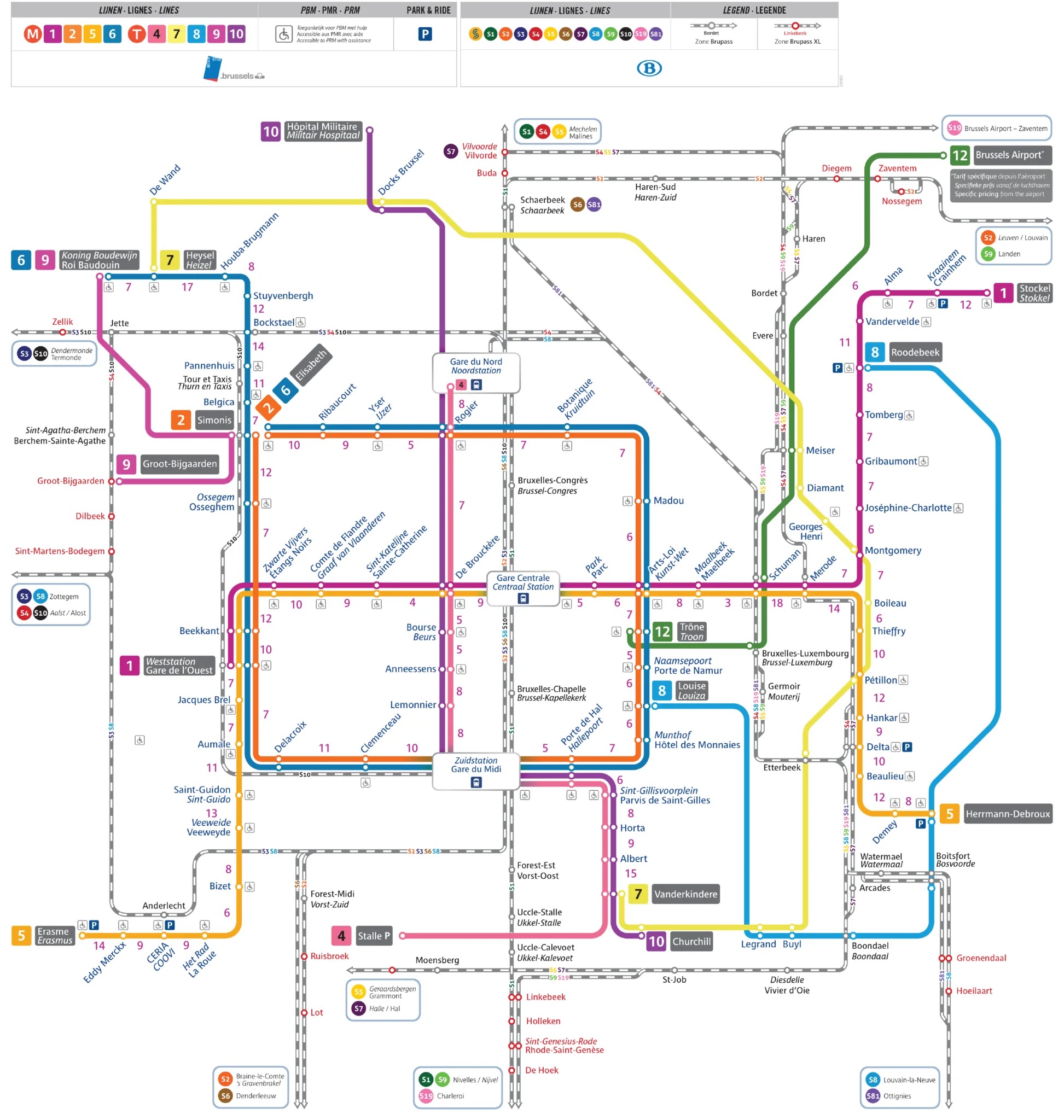
Brussels Metro connects to the two main stations — Bruxelles-Central (Brussel-Centraal) for the historic center, and Bruxelles-Midi (Brussel-Zuid) for high-speed Eurostar and Thalys connections. Local metro tickets are available at station ticket booths.
Brussels sits at the center of Northwestern Europe’s high-speed rail network. The Eurostar reaches London in around three hours; the Thalys reaches Paris in under 90 minutes. TGV connects to other French cities, EuroCity trains run to Luxembourg, Strasbourg, and Basel, and ICE trains connect to major German cities. Regional InterCity trains link Belgium’s larger cities and continue on to the Netherlands and Germany.
Continue the Journey
Brussels is a capital built on negotiation — two languages, two histories, one government finding a way to hold both without either one winning outright.
Explore Flanders → and Wallonia → for the rest of Belgium. Read Benelux → for the region-level context.
Join The Inspired Lens → for early access to new Atlas entries and destination guides.
Explore Brussels

Brussels: The Second Reading
Brussels was cleaner than we remembered — the soot that had darkened Sainte-Catherine on our first visit was gone, the church bright now where it had been dull. A single night in the capital, this time without day trips or rail connections outward. The city concentrated itself accordingly.

Belgium: The Country That Contains Two Countries
The train from Breda was not what we had planned. Belgium, it turned out, was more than we had anticipated either — a small country with two languages, two cultures, and a particular dry humor about holding both together. A week based in Brussels, moving outward by rail into Flanders and Wallonia.