

🇪🇸 Spain — España
La Piel del Toro, The Bull’s Hide
On the Iberian Peninsula, Spain is a union of regions shaped by its history, varied climates, and geography. With 17 autonomous communities and 2 autonomous cities, each fiercely protective of its own language, cuisine, and architecture, “Spanish” describes a collective nation built from cultures that have never fully consented to being one thing.
Castilian Spanish is the language of the state. But Catalan, Galician, Basque, Occitan, and Aragonese each mark a cultural territory as distinct as a separate country — with its own literature, its own architecture, its own relationship to the landscape it occupies. Barcelona is not Madrid. The Basque Country is not Andalusia. Valencia is not Galicia.
Time operates differently here, too. Lunch is the primary meal, often two hours, taken between 2:00 and 4:00 PM. Dinner begins at 9:00 PM at the earliest and runs late into the night. The evening paseo — the walk, the gathering, the occupation of public space before a late dinner — is not a custom. It’s a daily institution, and understanding it is the first real step toward understanding how a Spanish city works.
Spain is not one country pretending to be many. It’s many countries that have agreed, sometimes reluctantly, to share a government.
17 Autonomous Communities of Spain
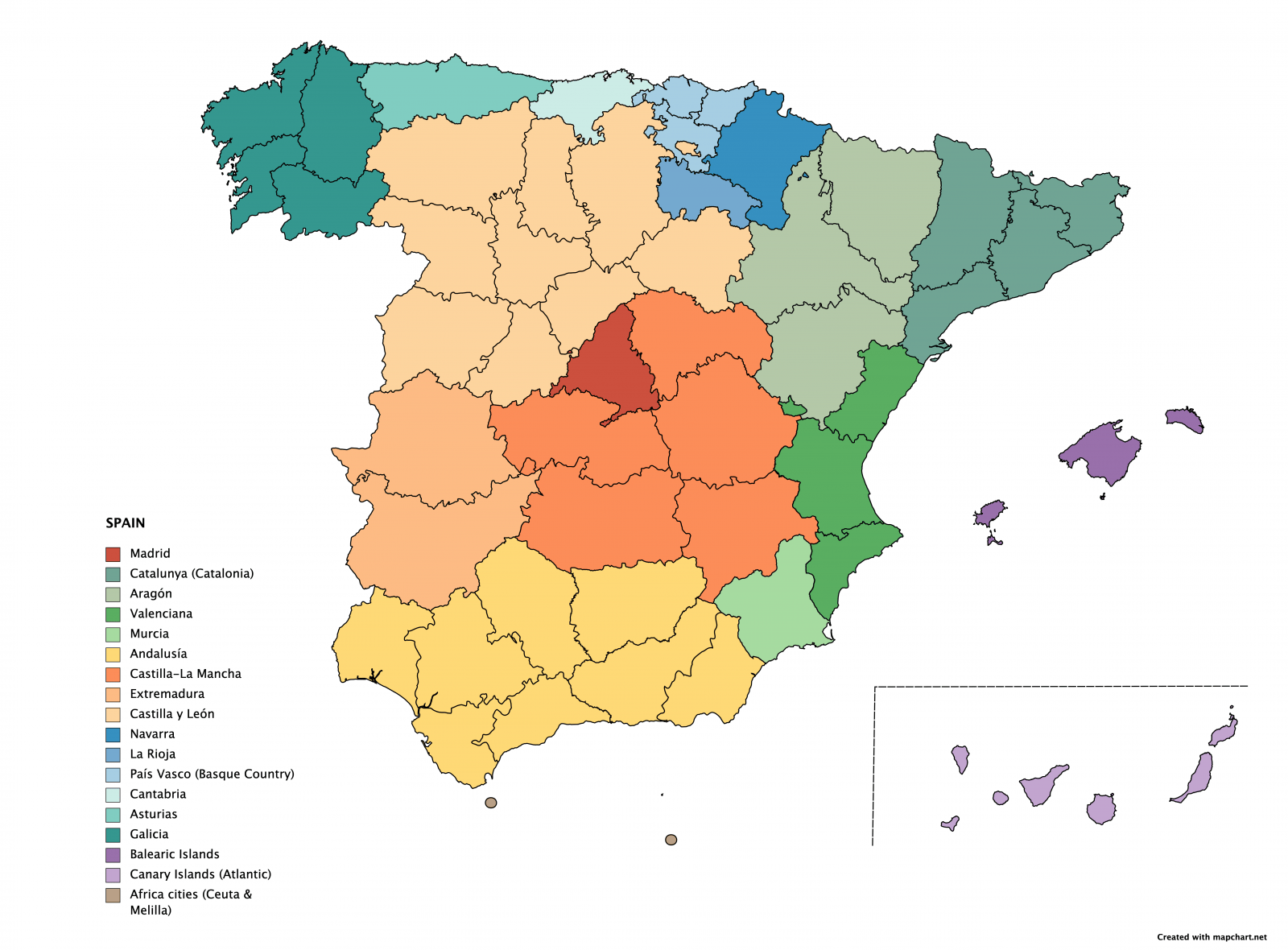
Central Spain
Ciudad de Madrid (capital province)
León + Zamora + Salamanca + Ávila + Segovia + Valladolid + Palencia + Burgos + Soria
Cáceres + Badajoz
Guadalajara + Cuenca + Toledo + Albacete + Ciudad Real
Eastern Spain
Barcelona + Girona + Tarragona + Lleida + ANDORRA (independent)
Huesca + Zaragoza + Teruel
València + Castellón + Alicante
Southern Spain
Almería + Granada + Jaén + Cordoba + Málaga + Sevilla + Huelva + Cádiz + GIBRALTAR (British Overseas Territory)
Northern Spain
Vizcaya + Gipuzkoa + Álava
Ourense + Pontevedra + A Coruña + Lugo
Islands + Enclaves
Ibiza + Formentera + Mallorca + Menorca
La Palma + El Hierro + La Gomera + Tenerife + Gran Canaria + Fuerteventura + Lanzarote
Autonomous cities each bordered by Morocco on the Mediterranean Sea
Central, Southern, and Northern Spain, and the Islands + Enclaves, are research-based. Eastern Spain — Catalonia and the Valencian Community — is firsthand.
Plan Your Journey
Moving through Spain rewards restraint over coverage. The country is large enough, and internally distinct enough, that a two-week loop through four regions produces less understanding than a slower week spent inside one.
- High-speed AVE rail connects Madrid to Barcelona, Valencia, Seville, and most major cities in under three hours — the fastest and most reliable way to move between regions
- Regional Rodalies and Cercanías trains handle day trips within a province
- A car is the only practical way to reach smaller Valencian and Catalan coastal towns not served directly by rail
A few ways in, grounded in place rather than genre:
- Following the paseo through any city’s historic center between 8 and 9 PM, before dinner opens
- A festival calendar built around the agricultural and religious year — Las Fallas in Valencia, Sant Joan’s bonfires on the summer solstice, Semana Santa processions across the south
- Gothic civic architecture in Barcelona and Valencia, read as the physical record of medieval mercantile power
- A provincial football club and its town — the stadium as the actual center of civic life in a way no monument replicates
Follow the Spain Atlas as it develops — Join The Inspired Lens →
Climate & Landscape
Spain holds five distinct climate zones across a landmass shaped by the Meseta Central — the high interior plateau that occupies nearly half the country — and the mountain ranges that wall it off from the coasts on every side.
That geography produces real cultural consequence, not just weather variation: the interior’s continental extremes shaped a cuisine built for preservation and slow cooking, while the coasts’ Mediterranean and Atlantic climates shaped one built around what the sea gives up that day.
Climatic Zones
Meseta Central ↓
High continental plateau, hot dry summers, cold winters
→ cured, preserved, slow-cooked
Mediterranean Coast ↓
Catalonia through Andalusia, mild wet winters, hot dry summers
→ late dinners, outdoor life, seafood-forward
Atlantic North ↓
Galicia • Asturias • Cantabria • Basque Country — green, rainy, cooler
→ dairy, cider, a slower northern rhythm
Balearic Islands ↓
Mediterranean, mild wet winters, hot dry summers, sea-moderated
→ port town rhythm, layered Catalan-Mediterranean identity
Canary Islands ↓
Subtropical, volcanic, near-constant mild temperatures
→ African-Atlantic hybrid culture, year-round tourism
Cultural Landscape

Spanish identity is layered rather than singular, and language is the clearest proof of it — not a matter of dialect, but of literature, architecture, and self-conception built up over centuries in each region independently of Madrid.
Seven languages are spoken across Spain’s regions, several with a claim to nationhood that runs deeper than administrative status.
- Castilian Spanish — the official language of the state, referred to as el español or el castellano
- Catalan — spoken in Catalonia, Valencia, and the Balearic Islands; the sole official language of Andorra
- Galician — spoken in Galicia, closely related to Portuguese, known as el gallego
- Basque — spoken in the Basque regions of Spain and France; a language isolate unrelated to any other, known as el vasco
- Occitan (Aranese) — an endangered language spoken in the Val d’Aran of Pyrenean Catalonia, and in southern France and far western Alpine Piedmont, Italy
- Asturian — endangered, spoken in Asturias
- Arabic — the dominant language during al-Andalus; today spoken in Ceuta and increasingly across Spain by Moroccan immigrant communities
Understanding Spain — A Historic Layer
Spain’s history is best read through a single organizing question: unification imposed from the center, against identities that never fully accepted it. Every era below adds a layer to that same unresolved tension — a tension that has never fully resolved, and that gives each region its own claim to a distinct heritage worth preserving on its own terms.
Before Spain, the peninsula belonged to the Iberians and the Celts. Two distinct peoples who never fully merged, settling instead into a rough east-west divide that still echoes in how differently Spain’s regions read today. Phoenician and Greek traders arrived first for the coasts. Carthage came next — establishing colonies that gave the peninsula its name, and drew Rome’s attention.
Rome began its conquest in 211 BC and held the peninsula for six hundred years. Longer than it held most of its western provinces. Roads, aqueducts, cities like Tarraco and Emerita Augusta, all built to the empire’s template. Latin displaced most of the older Iberian and Celtic languages within a few centuries.
What Rome didn’t manage to displace — Basque, most notably — survives as proof of how uneven even total conquest can be.
Germanic tribes crossed the Pyrenees as Roman authority collapsed in the 4th and 5th centuries. The Visigothic Kingdom of Hispania that emerged ruled a fractured peninsula until 711, when a Muslim army crossed from North Africa and conquered nearly the entire territory within seven years — one of the fastest conquests in medieval history.
For the next seven centuries, most of the peninsula lived under Islamic rule as al-Andalus. For long stretches, it was Europe’s most sophisticated society. The Caliphate of Córdoba produced mathematics, astronomy, medicine, and architecture Christian Europe wouldn’t match for centuries — a legacy still legible in the horseshoe arches of the Mezquita, the geometric intelligence of the Alhambra.
This is also the period that gave Catalonia and the Levante their particular character. Al-Andalus never fully absorbed the northeast the way it did the south, leaving Barcelona and Valencia to develop a hybrid Christian-Mediterranean identity largely on their own trajectory.
Christian kingdoms in the mountainous north spent those same seven centuries slowly pushing south. Not as a single coordinated campaign — as a patchwork of separate kingdoms, Castile, Aragon, Navarre, León, Portugal, each fighting its own war and building its own institutions along the way. By the time unification arrived, these weren’t provinces waiting to be assembled. They were functioning states with their own laws, languages, self-image.
The 1469 marriage of Ferdinand of Aragon and Isabella of Castile joined the two largest of these kingdoms under a single crown, though Aragon — and Catalonia within it — kept its own laws and institutions for centuries afterward. 1492 completed the military Reconquista with the fall of Granada, the last Muslim kingdom on the peninsula, the same year Columbus sailed for the Americas under Isabella’s flag.
Unification, in other words, was a merger at the top. Not underneath.
Spanish imperial wealth from the Americas funded the golden age of Habsburg Spain — the Siglo de Oro of Velázquez and Cervantes — followed by centuries of relative decline as the empire’s cost outran its returns. The 20th century compressed Spain’s oldest tension into its most violent form: the Second Republic’s attempt at genuine regional autonomy, the Spanish Civil War of 1936–39 fought substantially over that same question, and thirty-six years of Francoist dictatorship that followed.
Franco’s regime didn’t just centralize power. It actively suppressed Catalan, Basque, and Galician language and identity — banned from schools, media, public life, replaced with an enforced Castilian uniformity. That suppression is why regional identity in Spain today often carries a political charge a comparable French region simply doesn’t.
Franco’s death in 1975 triggered the Transición — a peaceful, carefully negotiated shift to constitutional monarchy. Critically, it built devolution directly into the new constitution, creating seventeen autonomous communities with real transferred power over language, education, local governance.
That settlement has mostly held. Not entirely. Catalonia’s 2017 independence referendum, declared illegal by Madrid and met with police violence that shocked much of Europe, and its long aftermath of imprisoned and exiled leaders — this is the clearest proof that the question Rome first drew a map for two thousand years ago is still, in 2026, unresolved. How much should the center hold. How much should the regions keep.
What This Means Today
Spain today functions less like a unitary state and more like a federation that agreed to share a government under duress, and keeps periodically renegotiating the terms. Understanding any Spanish region means understanding what it kept from Madrid, what it fought to get back after Franco, and what it never gave up in the first place.
Design, Food & Experience
Spain doesn’t separate the parts most cultures keep apart. A Gothic merchants’ hall is a monument to commerce as much as a place of worship never was. A festival bonfire is civic architecture for one night a year. The evening paseo turns an entire street into a dining room before dinner even starts. Nothing here stays confined to its category.
Three ways in, below: how it’s built, how it’s eaten, how it’s lived.


La Lonja de la Seda: Valencia’s Temple of Trade
Light streams between a forest of spiral stone columns. Each one twists upward, branching into a delicate web of ribbed groin vaults overhead — the ceiling dissolving into geometry, the weight of the stone made invisible by the precision of…
-

La Lonja de la Seda
The Table — food | culture features, cultural studies + living patterns

The Spanish Street as Living Room
In Spain, the street is not a place you pass through on the way to somewhere else. It is the destination. What makes this work is not any…

La Nit de Sant Joan: Fire, Catalan Pride, and a Sleepless Night in Girona
From the shallow Juliet balcony of our apartment in old Girona, rhythmic drums rose from the plaza below. Then horns. A crowd assembled. We had planned to be…
The Street — movement | location features, place studies + travel patterns

Barcelona: Arriving Into Catalonia’s Crisis
Somewhere between Valencia and Barcelona, my phone rang a few times. I let it go. But it wasn’t the routine coordination I had assumed. We had spent ten…

Valencia Doesn’t Announce Itself. It Reveals Itself.
We arrived at night, exhausted after a long day of travel. The metro from the airport let us out at Colón, where we surfaced into the plaza and…
Basics of Spain
Know Before You Go
Spanish
official language
Euro €
currency
17
official regions
Madrid
capital of Spain
Explore Places in Spain
Regions + Cities


Spain rewards the traveler who resists the urge to cover it all — each autonomous community is a separate country in everything but governance.
Return to Iberia → or explore Catalonia → and Valencian Community → in depth.
Join The Inspired Lens → for early access to Spain guides.